

Does your P&L report scream success while your bank account whispers in fear? For too many visionary leaders, this is the frustrating reality: record profits on the books, but a constant, nerve-wracking scramble for cash when it’s time to fund growth. This dangerous gap between profitability and liquidity can stall momentum and prevent you from making the bold moves your company deserves. The key to closing it lies in mastering the strategic nuances of the cash flow statement of your business.
This is not another accounting lesson. This is your CEO’s guide to transforming that raw data into a predictive roadmap for 2026 and beyond. We will empower you to gain total clarity on your company’s financial pulse, anticipate cash needs with confidence, and build investment-ready statements that tell a powerful story of stability and potential. It’s time to stop guessing and start leading with unwavering financial certainty. Let’s unlock your true business potential.
Key Takeaways
- Discover the critical difference between profit and cash to avoid the common but fatal pitfall of profitable bankruptcies.
- Learn to analyze the three core sections of cash movement to determine if your company’s growth is genuinely sustainable or dangerously reliant on financing.
- Reframe your perspective on negative cash flow by learning how the cash flow statement of your business can signal bold, strategic investments for future growth.
- Transform your historical data into a powerful tool to secure capital and shift from reactive reporting to proactive, forward-looking cash forecasting.
Beyond the Basics: Why the Cash Flow Statement is Your Business’s Truth
In the world of corporate finance, the Profit & Loss statement and the Balance Sheet often steal the spotlight. But the real story-the unvarnished truth of your company’s operational health-is told by a third, indispensable report. The cash flow statement serves as the critical bridge between what you’ve earned and what you own, tracking the actual movement of cash in and out of your business. It strips away non-cash accounting conventions like depreciation and amortization to reveal one thing: the raw, spendable capital you have to operate, invest, and grow.
This reveals the great paradox of modern business: how can a company showing record profits on its P&L suddenly face bankruptcy? The answer is simple yet catastrophic. Profit is an opinion; cash is a fact. Failing to grasp this distinction is a high-stakes gamble that even the most promising enterprises can lose.
The High-Stakes Difference Between Accrual Profit and Real Cash
Accrual accounting, which records revenue when a deal is closed rather than when payment is received, can create a dangerous illusion of security. A massive sale booked on 90-day terms looks fantastic on the P&L but does nothing to help you make payroll next week. For any mid-cap business focused on strategic growth, cash flow is the non-negotiable lifeblood that fuels expansion, innovation, and resilience. This is the crucial divide between impressive “paper wealth” and the “spendable capital” needed to fund bold moves and navigate uncertainty.
The Role of Cash Visibility in 2026 Market Dynamics
In a volatile economic environment marked by fluctuating interest rates, a strong cash position is your ultimate competitive advantage. It’s more than a safety net; it’s a war chest. A granular understanding of the cash flow statement of a growing enterprise empowers CEOs to act decisively-acquiring a competitor, investing in new technology, or securing top talent-while less-prepared rivals hesitate. This is the core of our “Know Your Numbers” philosophy. When you have real-time clarity on your cash position, you don’t just react to the market; you shape it.
The Three Pillars: Deconstructing the Anatomy of Cash Movement
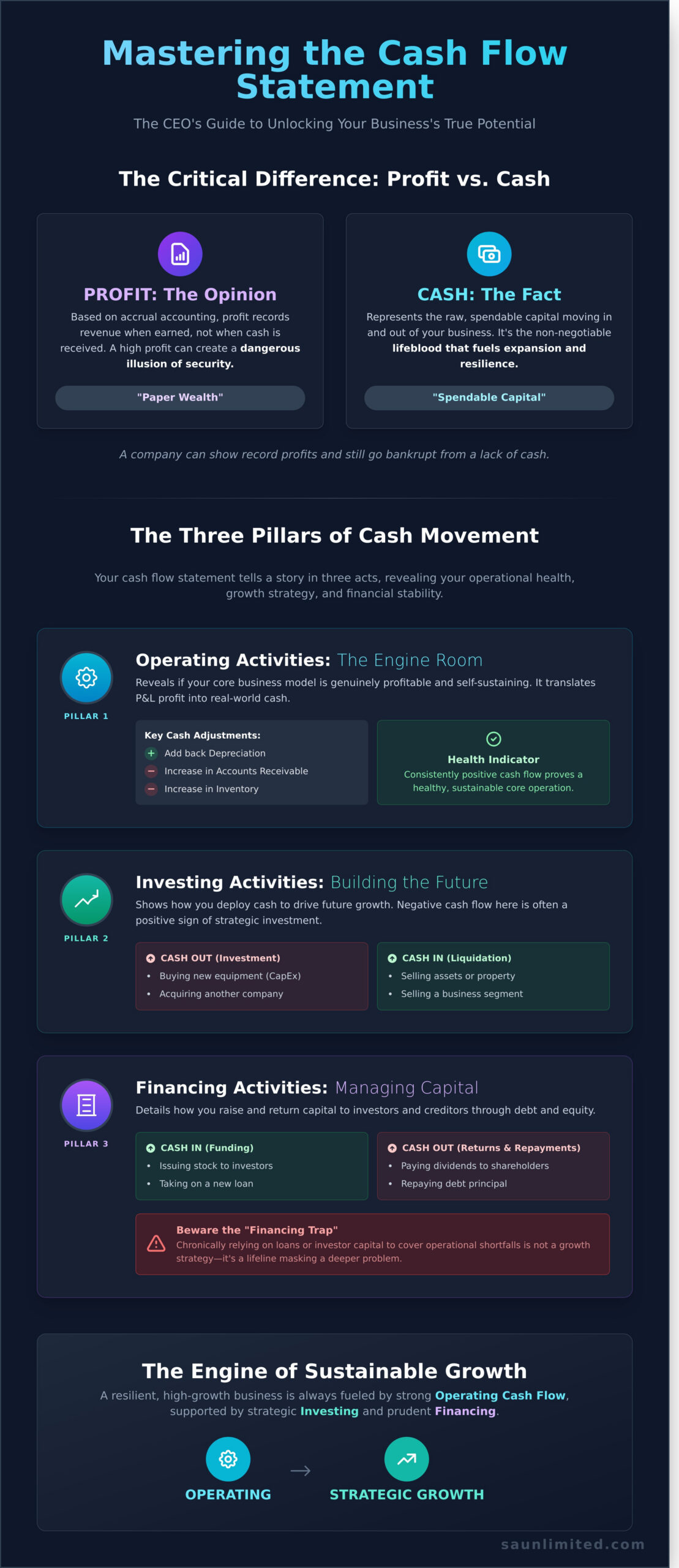
To truly unlock your business potential, you must understand the narrative behind your numbers. The cash flow statement isn’t a single, monolithic report; it’s a dynamic story told in three distinct acts. These standard cash flow statement components-Operating, Investing, and Financing-work together to reveal the strategic decisions, operational realities, and financial health of your enterprise. While your P&L shows profitability, this statement reveals the actual cash moving through your veins. For a deeper look at the distinction, review our P&L guide.
A resilient, high-growth business is always fueled by the first pillar, not the third. Let’s break down the anatomy.
Operating Activities: The Engine Room of Your Enterprise
This is where your business model is validated or exposed. Cash Flow from Operating Activities (CFO) begins with net income and then strategically adjusts for non-cash items. Think of it as translating profit into real-world cash. Key adjustments include:
- Depreciation: Adding back this non-cash expense.
- Accounts Receivable: A rise in AR means you’ve made sales but haven’t collected the cash yet, reducing your CFO.
- Inventory: An increase in inventory means cash was spent on goods that haven’t been sold, also reducing CFO.
Consistently positive operating cash flow is the ultimate proof that your core operations are profitable and self-sustaining. This section is where we analyze the “quality of earnings”-if your net income is high but your CFO is low or negative, it’s a critical red flag that demands immediate attention.
Investing and Financing: Fueling Growth and Managing Capital
These two pillars show how you use cash to build the future and how you fund those ambitions. Investing activities are a direct signal of your growth strategy-buying new equipment (CapEx) or acquiring another company shows you are future-proofing your operations. Conversely, selling assets can provide a necessary cash injection.
Financing activities detail how you manage your capital structure through debt and equity. Issuing stock or taking on a loan brings cash in, while paying dividends or repaying debt sends cash out. The complete cash flow statement of a healthy company shows these activities supporting a strong operational core. Beware the “Financing Trap”: chronically relying on loans or investor capital to cover operational shortfalls. That isn’t a growth strategy-it’s a lifeline, and it’s not sustainable.
Strategic Interpretation: Reading Between the Lines to Find Growth
A bookkeeper reads a cash flow statement. A strategic leader analyzes it. This is the critical shift from seeing numbers to seeing a narrative-the story of your company’s health, risks, and hidden potential. To unlock exponential growth, you must move beyond simple accounting and adopt the mindset of a Fractional CFO, using this document to make bold, informed decisions that create pathways to profit.
Identifying “Red Flags” Before They Become Crises
The cash flow statement is your early warning system, revealing vulnerabilities long before they impact your income statement. Proactive leaders watch for these critical indicators:
- “The Gap”: Revenue is climbing, but cash from operations is flat or declining. This signals potential issues with profitability, collections, or inventory management that are eroding your success.
- Selling Your Future: Relying on cash from financing activities (loans) or selling core assets to cover operational shortfalls is an unsustainable strategy that mortgages your future for today’s survival.
- The Silent Killer: Rising accounts receivable can be a “silent killer” of growth, tying up capital you need to reinvest while giving the false impression of strong sales.
Positive Cash Flow vs. Strategic Burn
Here is the #1 misconception we dismantle for our clients: negative cash flow is not always bad. In fact, for a high-growth company, it can be a powerful sign of ambition. A “strategic burn” is a deliberate, calculated investment in future dominance-like aggressive R&D or a land-grab for market share. A detailed analysis of the cash flow statement of your business allows you to justify this strategy to investors, clearly differentiating between wasteful spending and targeted investments that create the pathway to scale.
This strategic view culminates in understanding Free Cash Flow (FCF)-calculated as Cash from Operations minus Capital Expenditures. FCF is the capital you have to pursue opportunities: pay down debt, issue dividends, or reinvest in growth. This is where our “We Solve for Yes” philosophy comes to life. We use the insights from the cash flow statement of your company not just to identify limits, but to architect capital allocation strategies that fund your biggest ambitions and unlock your true potential.
Implementation and Systems: Preparing for Maximum Clarity
A powerful cash flow statement isn’t just about numbers; it’s about the systems and methodologies that produce them. To move from reactive, historical reporting to proactive, strategic decision-making, you need a financial infrastructure built for clarity and speed. This is where you transform data into intelligence and unlock your business’s true potential.
The Direct vs. Indirect Method: Choosing Your Perspective
When preparing the operating activities section, you have two choices: the Direct and Indirect methods. The Direct method is a straightforward ledger of cash in and cash out-simple, but it lacks context. In contrast, the Indirect method starts with net income and reconciles it back to your actual cash position by adjusting for non-cash items like depreciation and changes in working capital. This is why it’s the industry standard for most reporting; it builds a crucial bridge between your income statement and your balance sheet, explaining why your cash changed. The cash flow statement of a growing enterprise gains immense strategic value from this deeper narrative.
Leveraging Advanced Systems for Real-Time Cash Visibility
Traditional accounting creates a dangerous lag time between when business happens and when you understand its financial impact. Modern cloud ERP systems eliminate this delay. A robust advanced financial system implementation provides the foundation for this financial command, empowering you to:
- Automate Custom Reporting: Stop waiting for month-end reports. Gain immediate, on-demand visibility into your cash position and operational drivers, allowing you to make bold moves with confidence.
- Track Cash Flow by Dimension: Go beyond a single, top-line number. With an advanced financial management system, you can dissect the cash flow statement of individual departments, projects, or locations to pinpoint exactly what’s driving performance.
- Establish a Single Source of Truth: Build your financial planning and forecasting on a unified, reliable data platform. This ensures every strategic conversation is grounded in reality, fostering alignment and accelerating growth.
By integrating the right methodology with cutting-edge technology, your cash flow statement becomes more than a report-it becomes your most powerful strategic asset. To learn how we build these systems for our clients, visit us at saunlimited.com.
Solving for “Yes”: Turning Your Cash Flow Statement into a Strategic Weapon
Understanding your cash flow is foundational. Weaponizing it is transformational. A historical report shows you where you’ve been; a strategic financial tool shows you where you’re going-and exactly how to get there. At SA Unlimited, we don’t just report on the past. We partner with you to build the future. This is how we Solve for Yes.
The ultimate goal is to move beyond simply managing your finances to actively driving growth. This means turning your cash flow statement from a rearview mirror into a high-powered GPS for your business journey.
From Reporting to Forecasting: The Fractional CFO Advantage
A static annual budget is obsolete the moment it’s printed. At SA Unlimited, our Fractional CFOs roll up our sleeves to build dynamic 13-week rolling cash forecasts. This isn’t a budget; it’s a living, breathing roadmap that gives you unparalleled clarity on your liquidity. This foresight empowers you to make bold, strategic moves-like hiring top talent or pursuing an acquisition-weeks or months before your competition even sees the opportunity.
Unlocking Growth Capital with Ironclad Financials
When you walk into a bank or an investor meeting, you need more than just numbers; you need a narrative of success. A clean, forward-looking cash flow statement of your business builds unwavering confidence. It demonstrates not only fiscal discipline but also a clear, strategic vision for future profitability. Our strategic advisors don’t just organize your data; we create pathways to funding by presenting your financials in a way that answers investors’ questions before they’re even asked. The right cash flow statement of a potential investment tells a compelling story of stability and opportunity.
Don’t just know your numbers-conquer them. It’s time to transform your financial data from a simple report into your most powerful engine for growth. Ready to take control? Connect with our strategic advisors to unlock your potential.
Unlock Your 2026 Vision: Transform Cash Flow into Your Greatest Asset
As we’ve explored, the cash flow statement is far more than a historical record; it is your business’s strategic compass for the future. By moving beyond the basics to interpret its three core pillars, you can uncover hidden growth opportunities and make decisions with unwavering confidence. The true power of the cash flow statement of your business lies not in what it was, but in what it empowers you to become.
Transforming this insight into action requires a partner with a proactive, solution-oriented mindset. At SA Unlimited, our “We Solve for Yes” philosophy is backed by decades of experience, over $1B in client success, and unparalleled expertise in Sage Intacct implementation. We don’t just report on your cash flow; we help you weaponize it for maximum growth and profitability.
Ready to transform your financials into a growth engine? Let’s Connect. Your boldest moves are waiting.
Your Cash Flow Statement Questions, Answered
What is the most important part of a cash flow statement?
The most critical section is Cash Flow from Operations (CFO). This number represents the cash generated from your company’s core business activities-the true engine of your profitability and sustainability. While other sections are important for a complete picture, a strong, positive CFO is the ultimate indicator of financial health. The cash flow statement of a thriving business always shows a robust operating section, proving it can self-fund its growth and operations effectively.
Can a company be profitable but have negative cash flow?
Absolutely. This is a common and critical scenario that business leaders must understand. Profit on an income statement can include non-cash revenue, like sales made on credit (accounts receivable). If your customers don’t pay you quickly, you can show a profit on paper but have no cash in the bank. This often happens in fast-growing companies that are heavily investing in inventory or extending generous credit terms to win market share.
How often should a mid-sized company review its cash flow statement?
For strategic decision-making, a mid-sized company should review its cash flow statement on a monthly basis at an absolute minimum. However, for leaders who want to maintain tight control and make agile, data-driven moves, a weekly review is the gold standard. This frequency provides the real-time clarity needed to manage working capital effectively, anticipate shortfalls, and seize opportunities before competitors do. Don’t just look back-use it to look forward.
What is the difference between cash flow from operations and EBITDA?
Think of it this way: Cash Flow from Operations is the cash reality, while EBITDA is a theoretical performance metric. EBITDA (Earnings Before Interest, Taxes, Depreciation, and Amortization) ignores crucial cash drains like changes in working capital. Your CFO, however, directly accounts for the actual cash used to purchase inventory or the lag in collecting from customers. CFO tells you what cash you actually have, making it a far more reliable indicator of your company’s true liquidity.
How do I improve my business’s cash flow quickly?
To make an immediate impact, you must accelerate cash inflows and strategically manage outflows. Start by invoicing clients the moment work is completed and offer a small discount for early payment—a process that can be greatly streamlined by an omni-channel payment platform like strictlyzero.com. Aggressively pursue overdue receivables-that is your money. On the other side, review your vendor agreements and negotiate for longer payment terms where possible. Taking decisive control of your cash conversion cycle is a power move that delivers immediate results.
Why do investors care more about cash flow than net income?
Because cash is the ultimate truth-teller. Net income can be influenced by accounting methods and non-cash items, but cash flow is undeniable. It shows a company’s real-world ability to pay its bills, fund innovation, and generate returns without relying on outside financing. For savvy investors, positive cash flow is the clearest sign of a resilient, well-managed business with the power to execute its strategic vision and create long-term value.
What happens if a cash flow statement is not balanced?
A cash flow statement that doesn’t balance is a serious red flag indicating an error in your financial data. The fundamental rule is that the total change in cash from all activities (operating, investing, and financing) must precisely match the change in the cash balance on your balance sheet. An imbalance means the numbers are unreliable, undermining your ability to make confident strategic decisions. It’s a problem that demands immediate investigation and correction.
How does Sage Intacct help with cash flow management?
Sage Intacct transforms cash flow management from a historical report into a forward-looking strategic tool. By automating the creation of your cash flow statement, it provides an accurate, real-time view of your liquidity across the entire business. This eliminates manual errors and gives leaders the power to forecast with confidence, model different scenarios, and make the bold, informed decisions required to unlock your business’s full growth potential.