

Most fractional CFOs are just glorified bookkeepers with a premium price tag. You’ve likely felt the frustration of paying $5,000 a month only to receive a static balance sheet that offers zero strategic direction. It’s common to feel anxious about your 2026 cash runway or wonder if your messy data will scare off potential investors during your next $15M Series B round. Mastering the specific questions to ask a fractional cfo is the only way to filter out the noise and find a partner who truly drives growth.
You deserve a partner who moves beyond basic reporting to actually create pathways for your success. We believe your finance leader should do more than just manage numbers; they should unlock your business potential. This guide provides a comprehensive checklist to ensure you hire a leader who ‘solves for yes’. We’ll show you how to vet for high-level expertise, measure performance against a clear 2026 roadmap, and find a partner who rolls up their sleeves to scale your enterprise. We’re going to transform how you interview financial talent so you can make bold moves with unwavering confidence.
Key Takeaways
- Distinguish between “side-hustle” practitioners and dedicated firms to ensure your business has the institutional support and bench strength it needs to scale.
- Master the critical questions to ask a fractional cfo to separate reactive accountants from strategic partners who prioritize “solving for yes.”
- Evaluate your candidate’s technical depth to ensure they can leverage advanced systems like Sage Intacct rather than stalling your growth with manual spreadsheets.
- Set clear expectations for accountability by defining the specific KPIs and reporting rhythms that drive a successful first 90-day partnership.
- Learn to unlock your business potential by hiring a financial architect who combines high-level advisory with the technical expertise required for mid-cap success.
Vetting the Professional: Core Fractional CFO Interview Questions
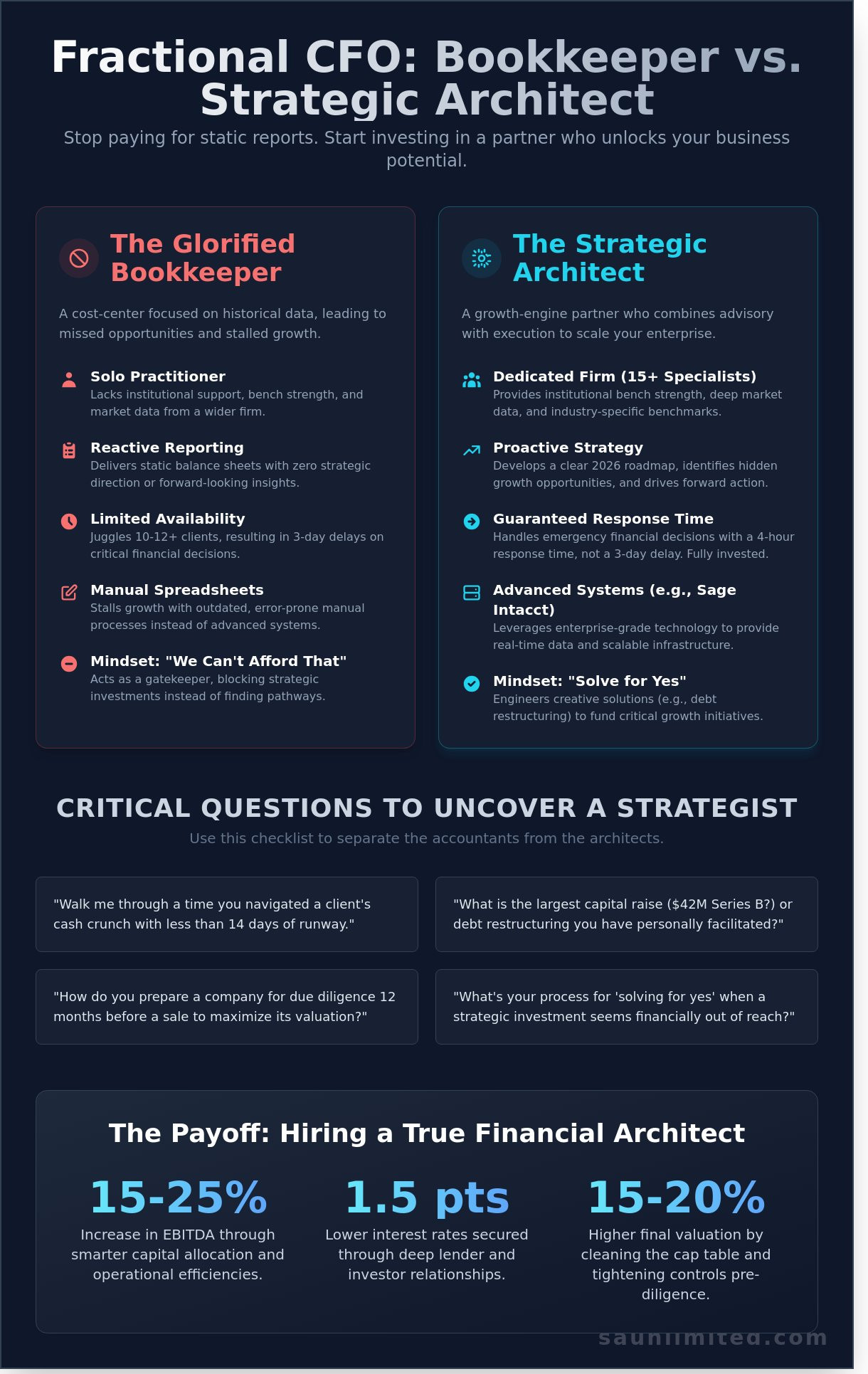
Choosing a financial partner is a high-stakes decision that dictates your growth trajectory. You aren’t just looking for someone to balance a ledger; you need a strategic architect who can transform your world. When evaluating candidates, your primary questions to ask a fractional cfo should focus on the distinction between a solo consultant and a dedicated firm. A solo practitioner often lacks the infrastructure to handle $50M+ operations. Before you dive into the numbers, understand What is a Fractional Executive? and ensure they have the bench strength to support your vision.
We Solve for Yes. That means finding a partner who handles emergency financial decisions with a 4-hour response time, not a 3-day delay. Ask about their team depth. A firm with 15+ specialists provides deeper market data and industry-specific benchmarks than any individual could. You need someone who rolls up their sleeves to create pathways to profitability. Probing for their access to real-time data from $1B+ in aggregate client transactions ensures they aren’t just guessing based on outdated textbooks.
Experience and Track Record
Numbers speak louder than promises. Ask: “Can you walk me through a time you helped a client navigate a cash crunch when they had less than 14 days of runway?” You need a leader who has stared down a crisis and won. Verify their scale. A CFO who thrives at the $5M revenue mark might struggle with the complexities of a $100M global enterprise. Ask: “What is the largest capital raise you have personally facilitated?” Look for specific answers like a $42 million Series B or a $15 million debt restructuring. This clarity builds unwavering confidence.
Capacity and Commitment
Availability is a feature, not an afterthought. Ask: “How many other clients are you currently advising, and what is your guaranteed response time?” If they manage 12 active clients alone, your business won’t get the attention it deserves. Your questions to ask a fractional cfo must probe for scalability. Ask: “Is your firm built to scale with us, or will I need to hire a new CFO in 18 months?” Our “Unlimited” partnership model provides proactive, comprehensive support for a fixed monthly investment that eliminates the restrictive barriers of hourly billing. This alignment ensures we are fully invested in your success as you unlock your business potential.
The Strategic Architect: Testing for a ‘Solve for Yes’ Mindset
Most business owners are tired of hearing “we can’t afford that.” A high-level partner moves beyond gatekeeping; they transform from a cost-center into a growth engine. When evaluating candidates, your questions to ask a fractional cfo should focus on their ability to find the “how” behind your “what.” They must bridge the gap between your vision and the balance sheet. While the core duties of a financial manager include monitoring accounts and preparing reports, a strategic architect goes further. They use those reports to engineer 15% to 25% increases in EBITDA through smarter capital allocation and creative problem-solving.
Proactive Financial Planning
Ask: “How do you identify growth opportunities that aren’t immediately obvious on the P&L?” You want a partner who sees a 10% drop in customer acquisition cost as a signal to double down on marketing spend immediately. Ask: “What’s your process for ‘solving for yes’ when a strategic investment seems out of reach?” A true architect doesn’t just cut costs. They restructure debt or optimize working capital to free up the $250,000 you need for a critical new hire or technology stack. This shift from historical accounting to forward-looking architecture is essential to unlock your business potential and drive sustainable scale.
Capital and Fundraising Strategy
Ask: “How do you prepare a company for due diligence 12 months before a sale or series round?” Waiting until the Letter of Intent is signed is a mistake that often costs founders 15% to 20% of their final valuation. Your CFO should be cleaning up the cap table and tightening internal controls today. Ask: “Which lending or investor relationships do you bring to the table?” A CFO with a deep network can often secure interest rates 1.5 points lower than a standard market offer. They must defend your company’s valuation by aggressively highlighting “add-backs” and normalized earnings that a buyer’s team might try to overlook during negotiations.
- Strategic Insight: Does the candidate simplify complex data into 3-5 actionable KPIs?
- EBITDA Growth: Can they point to a specific instance where they increased margins by at least 5%?
- Creative Funding: Have they successfully used non-dilutive capital to fund a project?
Your questions to ask a fractional cfo must reveal if they’re a historian or an architect. A historian tells you what happened; an architect tells you what’s possible and builds the framework to get there. It’s the difference between staying stagnant and making bold, profitable moves.
The Technology Stack: Questions About Systems and Sage Intacct
A CFO who lives exclusively in Excel is a liability for any company generating $10M to $100M in annual revenue. By 2026, manual data entry and disconnected spreadsheets aren’t just slow; they’re dangerous. Research indicates that manual accounting processes carry a 1% to 3% error rate, which translates to a $300,000 discrepancy for every $10M in volume. You need a partner who leverages cutting-edge technology to unlock your business potential. When preparing questions to ask a fractional cfo, you must focus on their ability to build a scalable, automated architecture that provides total clarity.
We solve for yes by replacing guesswork with hard data. If a candidate can’t explain how they’ll integrate your tech stack, they’ll become a bottleneck rather than a catalyst for growth. You aren’t just looking for someone to “do the books”; you’re looking for a strategist who uses real-time systems to empower you to make bold moves.
ERP and Software Proficiency
Ask: “What is your experience implementing robust, cloud-based ERP solutions for companies in our sector?” A generic answer is a red flag. You want to hear about 45-day implementation timelines or 40% reductions in manual overhead. Ask how they automate reporting to cut monthly close times from 15 days down to four. SA Unlimited specializes in moving companies beyond the limitations of QuickBooks and into robust, multi-entity cloud-based financial management environments to ensure your numbers are always audit-ready.
This proficiency should extend to your company’s specific technology stack. For instance, if your business runs on a major ERP like PeopleSoft, your financial leader must understand how to leverage its automation capabilities to streamline operations. To get a sense of what’s possible in that ecosystem, you can discover PS WebSolution.
Data Quality and Reporting
Ask: “How will you clean up our Chart of Accounts to reflect our true business drivers?” A cluttered ledger with 600 accounts obscures the truth; a strategic CFO will trim this to a lean, high-impact structure. Ask what specific custom dashboards they’ll build for your executive team to monitor daily cash flow and departmental KPIs. Standard reports document historical transactions, while strategic intelligence provides the predictive visibility needed to drive future profitability. We don’t just report the past; we create pathways for your future success.
Assessing a candidate’s technical depth is the only way to ensure your data integrity remains unwavering. These questions to ask a fractional cfo will reveal whether they have the top-notch talent required to transform your world.
Accountability and KPIs: Questions About Performance Measurement
A strategic partner doesn’t just report numbers; they drive them. When you’re evaluating candidates, you need to move past generalities and focus on concrete deliverables. High-level financial leadership is an investment, and like any investment, it requires a clear path to a return. These questions to ask a fractional cfo will help you determine if they can move the needle for your business or if they’ll just be another overhead cost.
The 90-Day Roadmap
The first three months are critical for setting the pace of your partnership. You’re looking for a transition from “cleaning the books” to “steering the ship.” Ask these specific questions to gauge their proactive mindset:
- “What are the first three things you will audit in our financial department?” Expect them to mention cash flow leaks, internal controls, or debt structures within the first 14 days.
- “When will I see the first version of our new 12-month rolling forecast?” A seasoned pro should have a preliminary model ready by day 45.
- “How do you define a successful first 90 days for this engagement?” Look for answers that include specific milestones, such as reducing the monthly close cycle by 3 days or identifying $50,000 in immediate cost savings.
Key Performance Indicators (KPIs)
You can’t manage what you don’t measure. Your CFO should provide clarity by distilling complex data into actionable insights. Use these questions to ask a fractional cfo to ensure they focus on growth, not just history:
- “Which 5 KPIs should I be watching daily to ensure we hit our EBITDA targets?” They should point to metrics like Days Sales Outstanding (DSO), Gross Margin per product line, or Customer Acquisition Cost (CAC) ratios.
- “How do you benchmark our performance against the top 20% of our industry peers?” They should have access to sector-specific data to show where you’re lagging.
- “Can you explain the difference between our leading indicators and lagging results?” You need a leader who watches the pipeline and sales velocity, not just last month’s P&L.
A true partner measures their own ROI by the value they unlock. If a CFO costs you $6,000 a month but identifies a tax strategy that saves you $80,000 annually, they’ve already paid for themselves. We believe in providing that level of transparency and results-driven leadership from day one.
Ready to see how strategic financial leadership can transform your bottom line? Let’s connect and solve for yes.
The Final Selection: Why SA Unlimited Solves for Yes
Choosing a partner to lead your financial strategy is one of the most consequential decisions you’ll make. At SA Unlimited, we don’t just provide reports; we provide a mindset. We’ve managed over $1B in transactions, giving us the perspective needed to navigate complex growth cycles. Our “Unlimited” approach means you get a strategic partnership focused on your future, minus the heavy executive price tag of a full-time hire. We believe that financial clarity shouldn’t be a luxury reserved for the Fortune 500.
The SA Unlimited Difference
We believe every company deserves elite financial guidance regardless of their current scale. Our multi-tiered service model offers three distinct paths: Hourly, Review, and Unlimited. This structure allows us to create specific pathways to “Yes” for emerging and mid-cap companies. We combine high-level CFO advisory with deep technical Sage Intacct expertise, ensuring your data is as sharp as your strategy. For a deeper look at how this works, explore our Fractional CFO Services: The Ultimate Guide to Scaling.
- Strategic Advisory: We focus on the “why” behind the numbers to empower bold moves.
- Technical Mastery: Our team optimizes Sage Intacct to provide real-time clarity and automated precision.
- Proven Results: Our $1B+ track record speaks to our ability to handle high-stakes environments and complex exits.
Your Next Move
The right partner should welcome your scrutiny. We invite you to schedule a discovery call to put these questions to ask a fractional cfo to the test in real-time. During this session, we’ll show you how we roll up our sleeves to unlock your business potential and move past the roadblocks that stall growth. Our team is ready to transform your financial department from a back-office function into a strategic powerhouse. Don’t let financial uncertainty hold your vision back. Unlock your business potential and connect with our team today.
“Finance isn’t just a record of the past; it’s the high-octane engine that drives your company toward ‘Yes’.”
Take Command of Your Financial Future
Hiring the right leadership is the single most important move you’ll make for your company’s trajectory in 2026. You need a strategic architect who masters the modern tech stack and drives accountability through rigorous KPI measurement. Using these questions to ask a fractional cfo ensures you identify a partner who moves beyond basic reporting to create genuine pathways for expansion. At SA Unlimited, we provide the clarity you need to make bold moves with confidence. We’ve managed over $1B in successful transactions and stand as Sage Intacct Implementation Specialists who know how to optimize your systems for scale. Our team brings decades of high-level executive experience to ensure your business remains profitable and resilient. Don’t settle for a financial gatekeeper who only identifies problems. You deserve an expert partner who rolls up their sleeves to unlock your business potential and drive measurable results.
Ready to move beyond ‘No’? Connect with SA Unlimited and let’s Solve for Yes.
Your vision for growth is within reach, and we’re ready to help you build it.
Frequently Asked Questions
What is the difference between a fractional CFO and a part-time bookkeeper?
A bookkeeper records historical data and manages daily transactions, while a fractional CFO creates future-focused strategy to drive profitability. Bookkeepers handle $25 to $60 per hour tasks like bank reconciliations and accounts payable. A CFO manages the strategic decisions that impact your bottom line. They unlock your business potential by analyzing margins and cash flow to ensure you’re scaling with precision.
How much should I expect to pay for a fractional CFO in 2026?
Expect to invest between $3,500 and $12,500 per month for high-level fractional CFO services in 2026. These rates reflect a 4.2% annual adjustment from 2024 benchmarks based on current labor market trends. Most mid-market firms allocate 1% to 2% of their gross revenue toward this partnership. This investment typically yields a 3x return through identified cost savings and optimized capital structures within the first 12 months.
Can a fractional CFO help my company raise venture capital or private equity?
Yes, a fractional CFO is essential for navigating the $5 million to $50 million capital raise process. They build the 3-year financial models and data rooms that institutional investors demand. We’ve seen companies with professional financial leadership secure 15% higher valuations during Series A rounds. When you have the right questions to ask a fractional cfo, you’ll discover they serve as the primary bridge between your vision and rigorous due diligence.
How many hours a week does a fractional CFO typically work for a mid-sized firm?
A fractional CFO typically dedicates 4 to 10 hours per week to a mid-sized firm with $10 million in annual revenue. This schedule includes a weekly 60-minute leadership meeting and deep-dive analysis into your core KPIs. They don’t need 40 hours to make a massive impact. By focusing on high-leverage activities, they deliver the same strategic value as a full-time executive at 25% of the total compensation cost.
Is it better to hire a solo fractional CFO or a firm?
Hiring a firm provides access to a collective $1 billion in managed transaction experience that a solo practitioner cannot match. While a solo CFO offers a single point of contact, a firm brings a deep bench of specialists in tax, M&A, and systems integration. If your solo CFO takes a vacation, your strategy stalls. A firm ensures your growth trajectory remains uninterrupted with 365-day coverage and diverse industry insights.
What happens if I need more support than a fractional CFO can provide?
You should transition to a full-time CFO once your annual revenue surpasses $50 million or your transaction volume requires daily executive oversight. Most firms hit this inflection point when they reach 75 employees. At SA Unlimited, we solve for yes by helping you manage this transition smoothly. We’ll even lead the recruitment process to find your permanent replacement, ensuring no loss of momentum during the handoff.
How does a fractional CFO work with my existing CPA or tax preparer?
Your fractional CFO acts as the strategic architect who directs the CPA’s technical execution. While your CPA focuses on the April 15th deadline and historical compliance, the CFO focuses on the other 364 days of growth. They translate your tax preparer’s reports into actionable business intelligence. This partnership ensures that 100% of your financial decisions align with both your tax strategy and your long-term exit goals.
Do I need to clean up my books before I interview a fractional CFO?
No, you don’t need to clean your books because identifying accounting gaps is one of the most critical questions to ask a fractional cfo during the interview. Approximately 85% of our new clients start with messy ledgers or incomplete data. A proactive CFO prefers to see the raw state of your finances to accurately assess the scope of work. We roll up our sleeves and fix the foundation so you can make bold moves with confidence.