

Your valuation isn’t a number pulled from a hat; it’s the direct result of a financial narrative that leaves no room for doubt. In the 2026 investment market, a great product is no longer enough to secure a term sheet. You need a bulletproof capital raising strategy for startups that solves for “yes” before you even enter the room. You’ve likely felt the frustration of messy spreadsheets or the nagging fear that you’re trading away 40% of your equity just to keep the lights on. It’s a common hurdle, as 82% of founders struggle to articulate their value during due diligence. We’re here to change that.
At SA Unlimited, we empower you to make bold moves. Know your numbers, and you’ll master the exact framework required to dominate this new landscape, ensuring you optimize your cap table while keeping the reins of your company. This playbook provides a clear roadmap to unlock your business potential through precision valuation and rigorous financial storytelling. We’ve helped partners secure over $1B in funding by focusing on clarity. We’ll show you how to clean up your books for a 100% pass rate on due diligence and craft a narrative that commands respect.
Key Takeaways
- Shift from a reactive search for cash to a proactive “Solve for Yes” mindset that positions your business as a high-value investment opportunity.
- Master the 2026 funding roadmap to build a bankable capital raising strategy for startups that scales from unit economics to a repeatable sales engine.
- Evaluate the trade-offs between equity, venture debt, and strategic capital to fuel rapid growth while protecting your ownership and control.
- Develop a dynamic, scenario-based financial model to de-risk your narrative and prove your business’s long-term scalability to investors.
- Unlock your business potential by leveraging strategic financial leadership that de-risks your raise and provides the expertise of a seasoned CFO.
Beyond the Pitch Deck: Why Every Startup Needs a Capital Raising Strategy
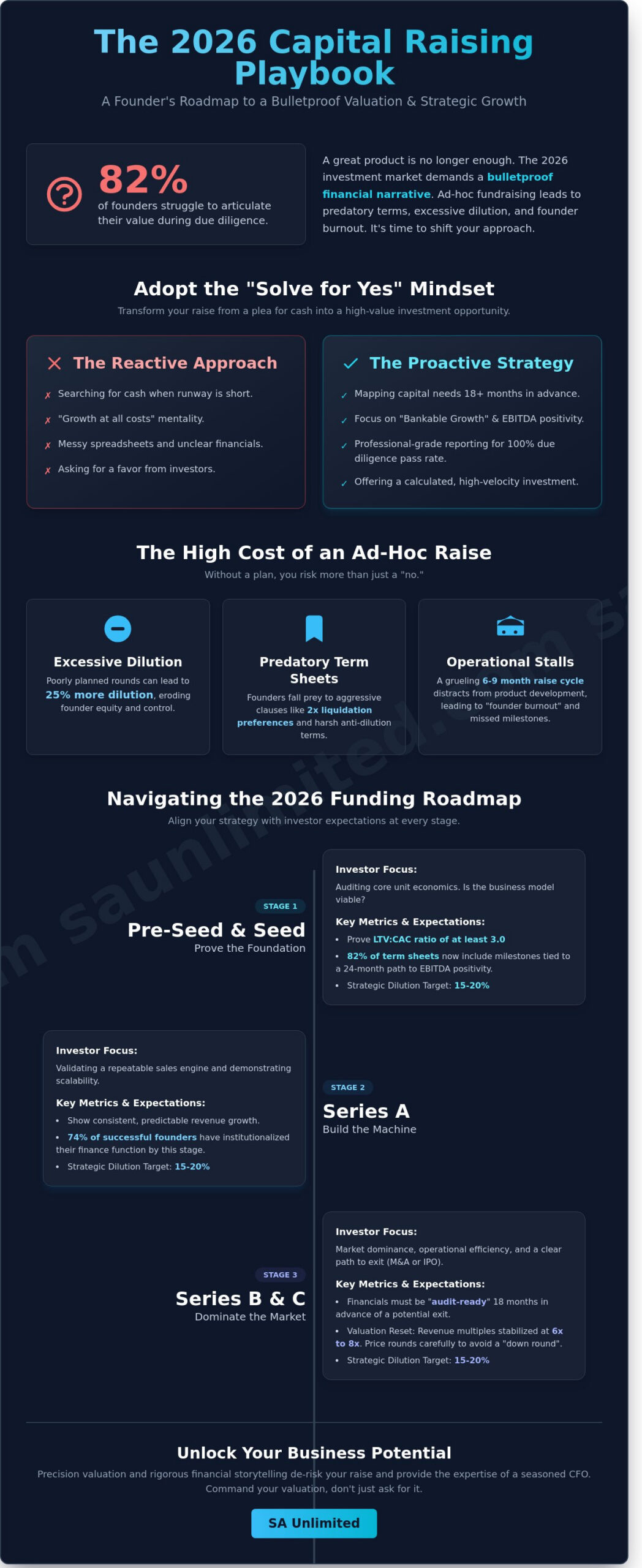
A capital raising strategy for startups isn’t a reactive search for cash when the runway hits three months. It’s a proactive financial roadmap. At SA Unlimited, we don’t just help you find funds; we help you command them. We operate with a “Solve for Yes” mindset. This shifts the dynamic from asking for a favor to offering a high-value investment opportunity. You aren’t begging for capital. You’re inviting partners to join a high-velocity vehicle designed for scale.
The 2026 investment climate has shifted. The era of “growth at all costs” died when interest rates stabilized at higher baselines in 2024. Today, VCs and private equity firms prioritize “Bankable Growth.” They want to see a clear path to EBITDA positivity, not just speculative burn rates. Financial clarity builds immediate trust. When you present a strategy backed by rigorous data, you transform from a risky bet into a calculated win. This clarity allows you to unlock your business potential by proving you can manage capital as effectively as you can innovate.
The High Cost of Raising Without a Strategy
Ad-hoc fundraising is expensive. Without a defined capital raising strategy for startups, founders often fall into the trap of predatory term sheets that include 2x liquidation preferences or aggressive anti-dilution clauses. Statistics show that poorly planned raises can lead to 25% more dilution than strategically timed rounds. The standard 6 to 9 month raise cycle is grueling. Without a roadmap, “founder burnout” becomes a legitimate operational risk that stalls product development. You risk falling into “bridge rounds to nowhere,” which are small infusions of cash that fail to reach a clear Series A milestone or exit trigger.
A well-planned strategy, on the other hand, not only secures funding but sets the stage for a successful exit, which for many founders translates into personal wealth and legacy investments. As an example of where that journey can lead, you can check out Westall Real Estate Team.
Knowing Your Numbers: The Foundation of Authority
Your P&L and Cash Flow Statement carry more weight than your slide deck. Investors in 2026 look past the “hockey stick” projections to see how you handle the cents. Moving beyond basic QuickBooks entries to professional-grade reporting, such as Sage Intacct, signals that your startup is ready for institutional-grade scrutiny. This level of sophistication proves you have the infrastructure to scale without breaking. It shows you’re a seasoned partner who values precision.
- Proactive Planning: Map your capital needs 18 months in advance to maintain leverage.
- Value Proposition: Position your raise as a strategic entry point for the investor.
- Operational Excellence: Use Sage Intacct to provide real-time visibility into burn and CAC/LTV ratios.
Navigating the 2026 Funding Roadmap: From Pre-Seed to Series C
The capital raising strategy for startups in 2026 requires a fundamental shift in mindset. Growth at all costs is dead. Today, your roadmap must demonstrate a relentless focus on unit economics from day one. At the Pre-Seed and Seed stages, investors aren’t just buying a vision; they’re auditing your “core unit economics.” You need to prove a Lifetime Value to Customer Acquisition Cost (LTV:CAC) ratio of at least 3.0 before asking for significant capital.
Series A is where the repeatable sales engine takes flight. This is the stage where a Fractional CFO becomes your most valuable asset. By 2026, 74% of successful Series A founders have institutionalized their finance function early to handle complex reporting. Moving into Series B and C, the conversation shifts toward market dominance and exit readiness. Whether you’re eyeing a strategic M&A or a 2028 IPO, your financials must be “audit-ready” 18 months in advance. The 2026 “Valuation Reset” means revenue multiples have stabilized at 6x to 8x, down significantly from the 100x anomalies of 2021. Price your round to ensure you aren’t trapped by a “down round” later. We help you unlock your business potential by building these rigorous financial foundations.
Startup Funding Stages and Investor Expectations
Angel investors still provide the initial spark, but VCs in 2026 have tightened their purse strings. A staggering 82% of Seed-stage term sheets now include milestones tied to a 24-month path to EBITDA positivity. You must align your “ask” with the fund’s specific mandate. If a fund specializes in Series A scale-ups, don’t pitch them on product discovery. Know your numbers and pitch the specific growth outcome their capital will buy.
The Dilution Dilemma: Managing Your Cap Table
- Strategic Equity Management: Aim to dilute no more than 15% to 20% per round. This ensures founders remain incentivized through a Series C exit.
- ESOP Power: Reserve a 10% to 12% employee stock option pool. This is non-negotiable for attracting the top 1% of talent required for rapid scaling.
- Proactive Forecasting: Use three-year financial models to predict your ownership stake after three rounds of funding. Avoiding surprises is key to maintaining long-term control.
Attracting top talent isn’t just about stock options; it’s also about fostering a culture of growth, which can include supporting team members in pursuing higher education. For founders considering how to build a world-class team through educational investment, you can learn more about SBUB Group Ltd and the pathways available.
At SA Unlimited, We Solve for Yes. By mastering these funding stages with precision, you transform your startup from a risky bet into a strategic powerhouse that investors can’t ignore.
Choosing Your Fuel: Comparing Equity, Debt, and Strategic Capital
Capital isn’t just cash on a balance sheet; it’s the high-octane fuel that determines your trajectory. Choosing the wrong source can stall your engine or lead to a total loss of control. A sophisticated capital raising strategy for startups in 2026 requires a surgical approach to these four primary levers.
- Equity Financing: This remains the gold standard for high-speed scaling. While you surrender 15% to 25% ownership in a typical round, you gain partners committed to a 10x exit.
- Venture Debt: Lenders have refined their models to leverage Monthly Recurring Revenue (MRR). This allows you to extend your runway by 6 to 9 months without additional dilution.
- Revenue-Based Financing: This is a 2026 favorite for SaaS companies maintaining a churn rate below 1.2%. You repay the capital as a percentage of gross revenues, keeping your equity intact.
- Strategic Partnerships: These go beyond the checkbook. Raising from industry leaders provides immediate distribution channels that traditional VCs cannot offer.
When to Choose Debt over Equity
Debt is often the superior choice when your unit economics are proven. The cost of debt usually sits between 10% and 14% interest. Compare this to the 30% or higher internal rate of return (IRR) that equity investors expect. In 2026, venture debt providers typically require a minimum of $400,000 in MRR and a 20% month over month growth rate. At SA Unlimited, we help you avoid “covenant traps.” A Fractional CFO ensures your debt structure doesn’t include restrictive “minimum cash” clauses that could freeze your operations during a pivot. A resilient capital raising strategy for startups utilizes debt to bridge the gap between equity rounds without sacrificing ownership.
The Rise of Hybrid Funding Models
Smart founders no longer choose just one path. They combine a $5 million equity round with a $2 million debt facility to maximize their “dry powder.” This hybrid approach provides a safety net for aggressive R&D. For B2C startups, community-led crowdfunding now accounts for 18% of early-stage capital, turning customers into brand evangelists. Strategic Capital provides market access and regulatory navigation that VCs cannot match. We solve for yes by identifying the exact mix that protects your cap table while fueling 100% year over year growth. Unlock your business potential by matching your capital source to your specific milestone.
The 5-Step Execution Plan: Building a Bankable Financial Narrative
Investors in 2026 demand more than a vision; they require a bulletproof financial engine. Your capital raising strategy for startups succeeds or fails based on the integrity of your narrative. We solve for yes by turning your raw data into a compelling, bankable story that withstands the most aggressive scrutiny. This isn’t just about showing growth; it’s about proving sustainability through five disciplined steps.
This professional presentation extends to all assets; even the audio in a product demo can subconsciously signal quality and attention to detail to an investor. For founders who need to transform their musical or audio ideas into world-class productions, you can visit Supreme Tracks.
- Step 1: Financial Audit. Clean up the balance sheet immediately. Resolve any 2025 tax discrepancies or messy cap table entries that could trigger red flags.
- Step 2: Dynamic Modeling. Build a 5-year forecast that accounts for market volatility.
- Step 3: The Equity Story. Connect your mission to the 2029 exit strategy, showing exactly how $1 of capital generates $8 in enterprise value.
- Step 4: Data Room Readiness. Centralize every legal, financial, and technical document before the first meeting.
- Step 5: Tiered Engagement. Target 12 high-fit “Tier A” investors first to build momentum and leverage.
Building the Financial Model Investors Can’t Ignore
Your model must prove you understand the Rule of 40. In the current market, 74% of successful Series B rounds in 2025 maintained a Burn Multiple below 1.3. We use Sage Intacct to pull real-time data, ensuring your LTV/CAC ratios are accurate to the cent. It’s vital to “stress-test” your projections against a 20% revenue dip. Investors want to see that your capital raising strategy for startups includes a pathway to profitability even if the economy stumbles.
Mastering the Due Diligence Process
The 30-day diligence window is a war of attrition. Your “Gold Standard” Data Room must house three years of audited financials, IP assignments, and localized tax filings across all jurisdictions. Don’t let a 4% churn spike kill the deal; be ready to explain it with cohort analysis. As your strategic partner, the CFO acts as the shield. We filter technical inquiries and defend your margins so the CEO can focus on closing the lead partner. Knowing your numbers isn’t enough; you have to own them under pressure.
Solving for Yes: How a Fractional CFO De-Risks Your Capital Raise
Hiring a full-time CFO too early is a $325,000 mistake that drains your runway before you even reach the launchpad. Many founders believe a high-priced executive hire signals maturity to investors, but it often just signals poor capital allocation. A startup doesn’t need a $300k+ salary overhead sitting on its balance sheet. You need the surgical precision of a partner who has managed high-stakes exits and massive scale without the permanent weight of a C-suite salary. At SA Unlimited, we provide strategic financial leadership that pays for itself by optimizing your burn and sharpening your pitch.
We transform your business from a scrappy venture into a global enterprise. This shift requires more than just a clean spreadsheet; it demands a mindset that proactively identifies obstacles. Our “We Solve for Yes” philosophy ensures that every financial decision aligns with your ultimate 2026 growth targets. We don’t just report on the past. We architect your future.
The Fractional Advantage for Fundraising
Investors buy into teams, not just ideas. When you place a seasoned CFO in front of a VC panel, you gain instant credibility. It shows you’re serious about fiscal discipline. You get high-level strategy and sophisticated modeling at a fraction of the cost of a full-time hire. This lean approach is a core part of a successful capital raising strategy for startups because it preserves equity and cash. Learn how our Fractional CFO Services prepare you for the boldest moves.
Unlock Your Business Potential with SA Unlimited
Our team doesn’t stay in the clouds. We roll up our sleeves to fix cash flow leaks, refine unit economics, and provide rigorous valuation support. We’ve seen the pitfalls that break a capital raising strategy for startups, and we know how to navigate them. Our track record is built on results, not theories:
- $1B+ in Capital: Over $1 billion in capital has been raised and managed by our team members.
- Strategic Clarity: We provide the data-driven confidence needed to negotiate from a position of strength.
- Global Readiness: We implement the systems required to scale across borders and regulatory environments.
Don’t let financial uncertainty stall your momentum. Your vision deserves a financial foundation that can support global ambitions. We are ready to help you bridge the gap between where you are and where you want to be. Let’s connect and solve for your “Yes” today.
Master Your 2026 Growth Roadmap
Scaling in 2026 requires more than a visionary idea; it demands a battle-tested capital raising strategy for startups that connects your roadmap to bankable numbers. You’ve seen why a pitch deck is only the beginning. Success now hinges on choosing the right mix of equity and debt while maintaining a clear financial narrative from Pre-Seed through Series C. Proactive scaling is about anticipating hurdles before they stall your momentum.
At SA Unlimited, we don’t just track your growth; we accelerate it. Our team brings decades of experience and a track record of $1B+ in successful transactions to your executive table. We leverage specialized expertise in Sage Intacct to ensure your financial systems are built for high-growth scaling from day one. Our “We Solve for Yes” mindset means we find the pathways to capital that others miss. It’s time to de-risk your next round and build a foundation that investors can’t ignore. You have the vision to lead. We have the strategic precision to fund it.
Unlock Your Business Potential: Partner with a Fractional CFO
Frequently Asked Questions
What is a capital raising strategy for startups?
A capital raising strategy for startups is a data-backed roadmap that defines how much capital you need, the specific funding instruments you’ll use, and the milestones required to secure investment. It’s the blueprint that aligns your financial goals with your growth trajectory. At SA Unlimited, we solve for yes by building strategies that maximize valuation while minimizing dilution. Your strategy should account for a 12 to 18 month runway to ensure you aren’t raising under duress.
When is the right time for a startup to start raising capital?
The right time to raise is when you have 6 months of cash runway remaining and have hit at least 80% of your previous milestone targets. Waiting until you have less than 90 days of liquidity forces you into unfavorable terms. Investors in 2026 prioritize companies showing 15% month-over-month growth. Start your outreach early to build relationships before the formal process begins. This proactive approach gives you the leverage to choose the right partners.
How much equity should founders give away in a Seed round in 2026?
Founders should expect to dilute between 15% and 25% of their equity during a 2026 Seed round. This range remains the industry standard for maintaining a healthy cap table for future Series A and B rounds. If you’re giving away more than 30%, you risk losing operational control too early. We help you know your numbers so you can negotiate from a position of strength and protect your long-term interests while scaling your vision.
What is the difference between venture debt and equity financing?
Venture debt is a loan that startups repay with interest and warrants, while equity financing involves selling ownership stakes in the company. Debt is typically 20% to 30% cheaper than equity in the long run because it doesn’t permanently dilute your ownership. However, equity provides permanent capital without monthly repayment obligations. Most successful 2026 startups use a blend of both to optimize their capital structure and unlock their business potential without over-leveraging the balance sheet.
How long does the average startup capital raising process take?
The average capital raising strategy for startups takes 6 to 9 months from the first pitch to cash in the bank. This timeline includes 2 months for deck preparation, 3 months for investor meetings, and 45 to 60 days for legal due diligence. You can’t rush this process if you want the best terms. Planning for this duration ensures you don’t run out of capital during negotiations or accept predatory deal structures from opportunistic lenders.
What are the most important financial metrics for investors in 2026?
Investors in 2026 focus on a Net Revenue Retention of 110% or higher and a LTV to CAC ratio of at least 3:1. They want to see a clear path to profitability within 24 months of the funding round. Burn multiple is also critical; a score below 1.5 indicates high capital efficiency. These numbers prove you can scale sustainably. We empower you to make bold moves by ensuring these metrics are rock solid before you pitch.
Can a fractional CFO help with my Series A pitch deck?
A fractional CFO provides the strategic financial modeling and data validation needed to build a Series A pitch deck that stands up to institutional scrutiny. We roll up our sleeves to ensure every chart and projection is defensible and accurate. This partnership increases your chances of a successful round by 40% compared to solo founders. We don’t just make slides; we create pathways to “yes” and build immediate trust with your future partners.
What documents are required for a startup due diligence data room?
Your data room must include 3 years of audited financial statements, a detailed capitalization table, and all executed intellectual property assignments. You also need 100% of your customer contracts and employment agreements organized for review. Missing even one document can delay your closing by 14 days or more. A clean data room signals to investors that your operation is professional and ready for scale. It’s about maintaining clarity during the final stretch of the deal.