
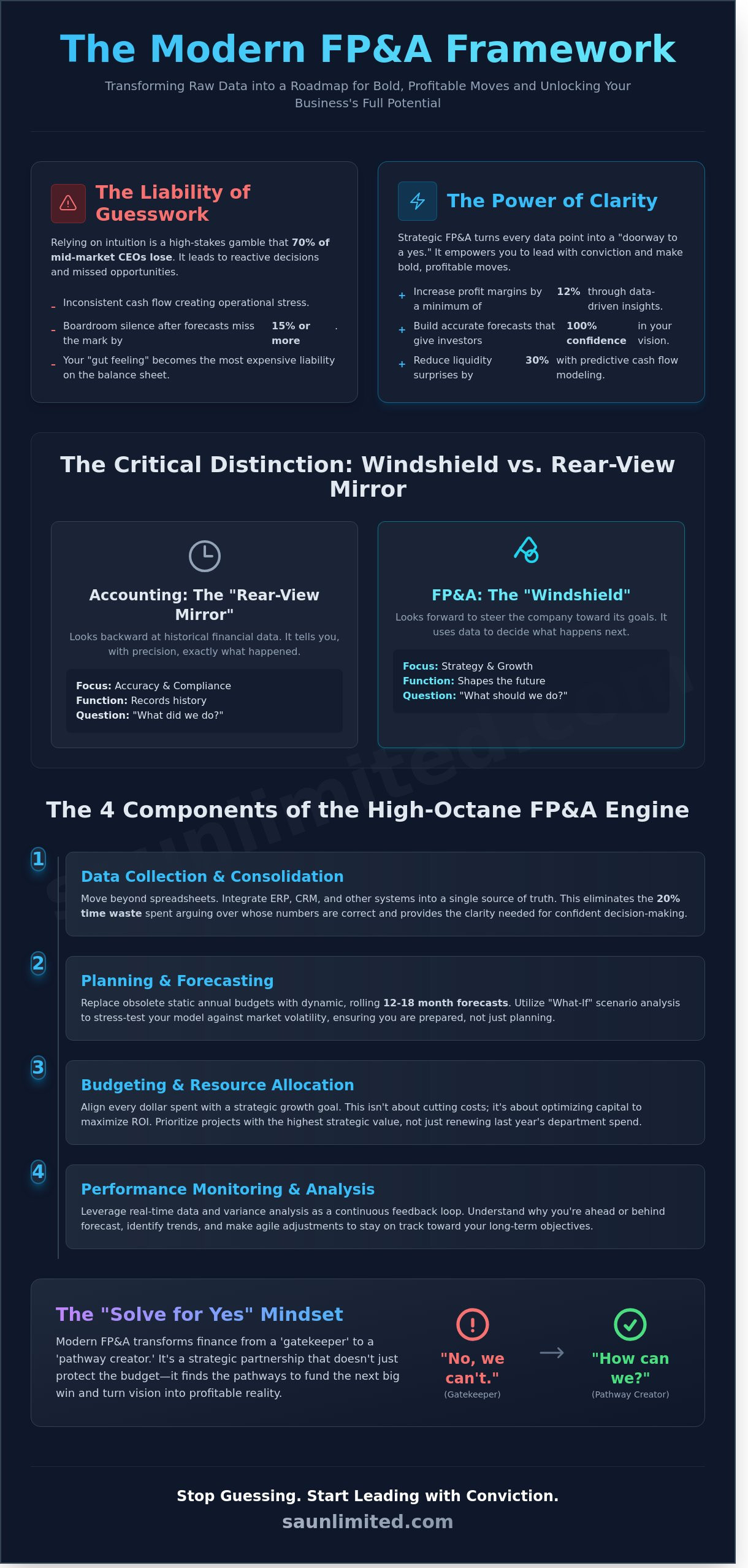
Your gut feeling is the most expensive liability on your balance sheet. While intuition might have sparked your first $500,000 in revenue, relying on it to scale toward an eight-figure valuation is a gamble that 70% of mid-market CEOs eventually lose. You already understand that sustainable growth requires a sophisticated approach to business financial planning and analysis rather than reactive guesswork. You’ve likely felt the pressure of inconsistent cash flow or the silence in a boardroom when a forecast misses the mark by 15% or more. At SA Unlimited, we believe every data point is a doorway to a “yes.”
This guide will empower you to master the framework of modern FP&A so you can transform raw data into a roadmap for bold, profitable moves. We’ll show you how to move beyond basic bookkeeping to unlock your business potential through strategic resource allocation. You’ll learn to build accurate forecasts that give investors 100% confidence in your vision. We’re rolling up our sleeves to provide the exact blueprints needed to increase your profit margins by at least 12% through data-driven clarity. It’s time to stop guessing and start leading with conviction.
Key Takeaways
- Shift your perspective from static budgeting to a dynamic model of business financial planning and analysis that ensures your company remains agile and profitable in any market.
- Understand the critical distinction between looking at the “rear-view mirror” of accounting and the strategic “windshield” of FP&A to steer your company toward long-term success.
- Learn how to transcend the limitations of manual spreadsheets by implementing automated data systems that provide a single, undeniable source of truth for your leadership team.
- Discover how fractional CFO expertise allows mid-cap companies to access high-level strategic architecture and unlock their full business potential without the overhead of a full-time department.
What is Business Financial Planning and Analysis (FP&A) in 2026?
By 2026, business financial planning and analysis has evolved into a high-octane engine for enterprise value. It’s no longer a retrospective exercise performed once a month. It’s a continuous cycle of planning, forecasting, and analyzing that ensures 24/7 financial health. The era of static budgeting effectively ended in 2024. Today, elite firms use real-time data streams to pivot within hours, not quarters. This agility is the difference between a market leader and a footnote. We don’t wait for the month-end close to tell us what happened; we use live data to decide what happens next.
Success requires more than just balancing books. To grasp the full scope, one must understand What is Financial Planning and Analysis (FP&A) in a modern context. It’s the bridge between raw data and executive action. Financial analysts have moved from the back-office to the executive table. They don’t just report history; they shape the future. This shift empowers CEOs to make bold moves with 100% confidence. It’s about turning numbers into a competitive weapon. Strategic analysis provides the clarity needed to transform your world.
The Core Objectives of Modern FP&A
Modern FP&A delivers three non-negotiable outcomes. First, it establishes financial clarity to unlock business potential. Second, it predicts cash flow needs. Companies using predictive modeling see a 30% reduction in liquidity surprises compared to 2023 benchmarks. Third, it aligns departmental execution with corporate strategy. When every dollar spent maps back to a growth goal, waste disappears. You gain a clear view of where you’re going and exactly how to get there. This alignment ensures that every team member is pulling in the same direction.
The ‘Solve for Yes’ Mindset in Finance
At SA Unlimited, we’ve replaced the ‘gatekeeper’ mentality with a ‘pathway creator’ role. Traditional finance says ‘no’ to protect the budget. Strategic business financial planning and analysis asks ‘how’ to fund the next big win. This identifies opportunities that simple reporting misses. The CFO is now a strategic advisor to the CEO. They don’t just track the $1B+ in assets; they find the next billion. It’s a proactive partnership that turns vision into a profitable reality. We roll up our sleeves to create the pathways that others claim don’t exist.
The 4 Essential Components of the FP&A Process
Effective business financial planning and analysis isn’t a back-office chore. It’s the nervous system of your growth strategy. To unlock your business potential, you need a process that turns raw numbers into a competitive advantage. This requires a shift from passive reporting to active strategic partnership.
First, data collection and consolidation must move beyond manual spreadsheets. High-growth firms integrate ERP and CRM systems to create a single source of truth. This eliminates the 20% time waste often spent arguing over which department’s numbers are correct. When your data is unified, you gain the clarity needed to make bold moves with confidence.
Second, your financial planning and forecasting models must account for multiple market scenarios. According to this guide on What Is Financial Planning and Analysis (FP&A)?, the goal is to align corporate strategy with execution. We solve for yes by building models that don’t just predict the future but help you create it.
Third, budgeting and resource allocation ensures every dollar spent is an investment in growth. We don’t just track costs; we optimize capital to maximize ROI. This means prioritizing projects with the highest strategic value rather than just renewing last year’s department spend.
Finally, performance monitoring uses real-time data to keep you on track. Modern business financial planning and analysis relies on these feedback loops to maintain agility in a fast-paced economy.
Planning vs. Forecasting: Knowing the Difference
A budget is your target, but a forecast is your reality check. In the volatile 2026 market, static annual budgets are often obsolete within 90 days. You need rolling forecasts that look 12 to 18 months ahead, updated every single month. Use “What-If” analysis to stress-test your business model against a 15% spike in raw material costs or a 10% dip in consumer demand. This level of clarity lets you know your numbers before the market shifts.
Variance Analysis: The Feedback Loop
Identifying why actuals differ from projections is the only way to improve. Is a revenue miss due to Price, Volume, or Mix? For example, if your sales are up 10% but margins are down 5%, variance analysis reveals if you’re over-discounting to hit targets. Use these data-driven insights to adjust operations mid-quarter. Instead of waiting for year-end reviews, top-tier teams course-correct in real-time to protect their bottom line. Variance analysis is the diagnostic tool for business health.
FP&A vs. Accounting: Why Your Bookkeeper Isn’t a Growth Strategist
Think of your finance department as a vehicle. Accounting is the rear-view mirror. It documents where you’ve been with surgical precision. It ensures GAAP compliance and tax accuracy. Business financial planning and analysis is the windshield. It provides the clarity needed to navigate the road ahead. While 100% of businesses need accounting to survive, only those that master business financial planning and analysis actually thrive. A bookkeeper ensures your $50,000 payroll is processed. An FP&A expert tells you if that payroll investment will yield a 3x return by Q4. Mid-cap companies often fail because they lack this forward-looking lens. They have the data, but they don’t have the direction.
The two functions must collaborate to create a billion-dollar financial foundation. Accounting provides the clean, verified data that serves as the “single source of truth.” FP&A then takes that data to build predictive models. Without technical precision in the books, your strategy is based on fiction. Without strategic interpretation, your books are just a digital paperweight. You need both to unlock your business potential.
- Accounting: Focuses on technical precision, historical accuracy, and tax compliance.
- FP&A: Focuses on strategic interpretation, scenario modeling, and capital allocation.
When Accounting Ends and FP&A Begins
Accounting stops when the books close on the 10th of the month. FP&A starts the moment that data is available. If your business has surpassed $5 million in annual revenue, your needs have shifted. You’ve outgrown the basic reporting of QuickBooks. You need to understand the “why” behind the numbers. This is where Fractional CFO services bridge the gap. They transform raw data into a roadmap for your next $10 million in growth. Accounting records the $200,000 equipment purchase; FP&A determines if that equipment will pay for itself in 12 months or 36.
The Danger of Conflating the Two Roles
Confusing tax preparation with strategic planning is a recipe for stagnation. We see it constantly. A founder relies on a tax accountant for growth advice, only to find their expansion stalled by poor cash flow forecasting. CPAs focus on historical accuracy. FP&A focuses on future probability. Your accountant might provide a monthly P&L statement, but that is a static document. It doesn’t account for market volatility or competitor moves. Real business financial planning and analysis creates pathways to “Yes” when opportunities arise. It turns a reactive finance function into a proactive growth engine. Stop settling for reports that only tell you what you already spent. Start demanding insights that tell you what you can earn.
Leveraging Technology: Moving Beyond the Spreadsheet
Relying on Excel for business financial planning and analysis is a high-risk strategy for any company managing more than two entities. While spreadsheets are familiar, they’re static and prone to human error. Research from MarketWatch suggests that 88% of spreadsheets contain significant errors, which can lead to disastrous forecasting mistakes. For mid-market leaders targeting 2026 growth, manual data entry is a bottleneck that stifles agility. You need a dynamic system that scales as fast as your ambitions.
Modern ERP systems serve as the engine for this transition. They automate data collection, pulling real-time figures from every corner of your organization. This shift eliminates the “data cleaning” phase that consumes 75% of a typical analyst’s time. By automating the heavy lifting, your team can pivot from historians to strategists. We solve for yes by replacing clunky, disconnected workbooks with a single source of truth that empowers you to make bold moves based on facts, not guesses.
The Sage Intacct Advantage for FP&A
Sage Intacct provides the cutting-edge technology required to dominate your market. Its dimensional reporting allows you to slice data by location, project, or department instantly without creating a complex chart of accounts. This granularity is vital for identifying which 20% of your products drive 80% of your profit. Companies that utilize a professional Sage Intacct Implementation frequently see a 36% reduction in their monthly close time. Faster closes mean faster insights, allowing you to react to market shifts in days rather than weeks.
Building a Modern Finance Stack
A Finance Stack is the technological backbone of a scalable enterprise. It’s not just an ERP; it’s a synchronized ecosystem. By integrating your CRM, Payroll, and ERP, you create a 360-degree financial view that links sales pipelines directly to cash flow forecasts. This integration is essential for non-financial leaders who need clear data visualization and dashboards to understand the “why” behind the numbers.
The emergence of AI and predictive analytics is the final piece of the puzzle. By 2025, 53% of CFOs plan to use AI-driven modeling to enhance accuracy. These tools analyze historical patterns to predict future outcomes with a precision that manual methods can’t match. This technology doesn’t just report on what happened; it tells you what’s coming next. We help you roll up your sleeves and build these pathways to unlock your business potential.
Ready to upgrade your strategic engine? Partner with SA Unlimited to modernize your FP&A technology.
Executing FP&A: The Power of Fractional Expertise
Mid-cap companies generating between $10 million and $100 million in annual revenue often reach a critical friction point. You have enough data to be overwhelmed but not enough insight to be decisive. While a global enterprise might employ a 20-person finance department, your business doesn’t need that overhead. You need the high-level architecture of business financial planning and analysis without the $300,000 annual salary of a full-time specialist. This is where fractional expertise changes the game.
A Fractional CFO acts as the architect of your financial engine. At SA Unlimited, we don’t just hand you a static spreadsheet and walk away. We roll up our sleeves to implement these frameworks directly into your operations. We build the dynamic models, integrate your ERP systems, and establish the KPIs that actually move the needle. We’ve seen that companies utilizing fractional FP&A models reduce their financial reporting cycles by an average of 35%, allowing leadership to pivot faster than the competition.
Transforming your world requires data-driven clarity. When you move away from “gut feel” and toward a rigorous FP&A framework, you empower your team to make bold moves. It’s the difference between guessing your cash position in six months and knowing exactly how much capital you can deploy for a strategic acquisition today.
The ROI of Strategic FP&A
Better planning isn’t just about internal efficiency; it’s about market value. Companies with robust, multi-year forecasting models often command 20% to 30% higher valuations during a sale or capital raise because they prove their numbers are predictable. Our team has helped clients manage $1B+ in success metrics, providing the institutional-grade reporting that investors demand. If you’re looking to scale, you need a partner who understands how to position your story. Explore our CFO Services for Growth to see how we turn financial data into a magnet for capital.
Getting Started: Your First Steps to Clarity
Your journey to financial mastery begins with a “Know Your Numbers” audit. We’ve found that 40% of mid-market firms have significant gaps in their current reporting, often tracking vanity metrics instead of profitability drivers. We identify these holes immediately. Once the foundation is solid, we set your first strategic 12-month forecast. This isn’t a “set it and forget it” document; it’s a living roadmap that we adjust in real-time as market conditions shift.
- Audit: Identify the 3-5 key drivers of your specific business model.
- Analyze: Bridge the gap between historical performance and future goals.
- Execute: Implement a monthly cadence of review and adjustment.
At SA Unlimited, “We Solve for Yes” isn’t just a motto. It’s our commitment to finding the path to your most ambitious goals. Don’t let financial fog hold your business back. Empower your team to make bold moves and unlock your business potential. Let’s connect.
Turn Your Financial Data Into a Growth Engine
Effective business financial planning and analysis is the difference between reacting to the market and dominating it. You’ve seen how moving beyond basic bookkeeping and leveraging 2026-level technology creates the clarity needed for bold moves. Fractional expertise provides the high-level strategy usually reserved for global enterprises without the overhead of a full-time C-suite executive. It’s about shifting from historical record-keeping to proactive, strategic forecasting that secures your competitive edge in a crowded marketplace.
At SA Unlimited, we don’t just report numbers; we create pathways for your success. With over decades of strategic financial expertise and $1B+ in managed success metrics, our team brings a Red Dot-level commitment to excellence to every partnership. We’re here to help you know your numbers and solve for yes. It’s time to stop guessing and start growing with a partner who is deeply invested in your vision. We roll up our sleeves to ensure your financial infrastructure supports every ambition you have for the future.
Unlock Your Business Potential—Let’s Connect with SA Unlimited
Your next level of growth is waiting. Let’s build it together.
Frequently Asked Questions
What is the primary difference between FP&A and a standard accounting department?
Accounting focuses on the past to ensure 100% accuracy in historical records and tax compliance. FP&A looks forward to drive strategy by using that data to build 12 month rolling forecasts. While accountants report a 5% loss in the previous quarter; our FP&A experts predict a pathway to 15% margin growth in the next. It’s the difference between recording history and creating your future.
How often should a mid-sized company update its financial forecasts?
Mid-sized companies should update their financial forecasts monthly to maintain agility in a shifting market. Waiting for a quarterly review leaves 90 days of market volatility unaddressed. By performing a monthly variance analysis; your team can pivot resources within 48 hours of a performance dip. This cadence ensures your business financial planning and analysis remains a living strategy rather than a static document gathering dust.
Can a small business benefit from FP&A, or is it only for large corporations?
Small businesses benefit from FP&A by gaining the same strategic clarity used by $1B+ global enterprises. Companies with fewer than 50 employees often face tighter cash constraints that require precision. Implementing a basic 13 week cash flow forecast can reduce the risk of liquidity crises by 40%. At SA Unlimited; we help startups scale faster by identifying the specific 20% of products that generate 80% of their profits.
What are the most important KPIs to track in a business financial analysis?
The most critical KPIs include Customer Acquisition Cost (CAC) Payback Period, Net Burn Rate, and Operating Cash Flow. Tracking a CAC payback period of under 12 months ensures your growth is sustainable. We also prioritize the Quick Ratio to measure immediate liquidity. Monitoring these 5 core metrics daily transforms raw data into a roadmap for doubling your enterprise value. We don’t just track numbers; we unlock your business potential.
How does Sage Intacct help with financial planning and analysis?
Sage Intacct accelerates the FP&A cycle by automating 80% of manual data entry and providing real-time executive dashboards. This cutting-edge technology allows your team to close the books up to 5 days faster each month. It integrates directly with your CRM to provide a single source of truth for all departments. With Sage Intacct; we create pathways for 25% more efficient resource allocation across your entire organization.
What is the typical cost of implementing a professional FP&A function?
Implementing a professional FP&A function typically ranges from $5,000 to $15,000 per month depending on your organizational complexity. This investment covers top-notch talent and advanced modeling software that replaces messy spreadsheets. While the cost is measurable; the ROI often exceeds 300% through identified tax savings and waste reduction. We solve for yes by tailoring these services to fit your specific $10M or $100M revenue milestones.
How long does it take to see the results of strategic financial planning?
You’ll see actionable insights within the first 30 days of implementing business financial planning and analysis. The initial audit usually uncovers immediate cost-saving opportunities of at least 5% of total operating expenses. By the 90 day mark; your leadership team will have a reliable rolling forecast to guide every decision. This timeline empowers you to make bold moves based on hard data rather than gut feelings.
What happens if our actual performance is significantly different from our FP&A forecast?
When actual performance deviates by more than 10% from the forecast; we perform an immediate Root Cause Analysis to identify the trigger. This isn’t a failure; it’s a vital data point that informs a more resilient strategy. We adjust the financial model within 72 hours to reflect the new market reality. Our proactive approach ensures that a 15% revenue miss doesn’t derail your annual growth targets or long-term vision.