
A 2024 analysis reveals that 82% of business failures stem directly from poor cash flow management and a lack of financial clarity. If your current accountant has hit a ceiling, you’re likely staring at messy data that makes scaling feel like a dangerous gamble. We understand the frustration of having a vision for 2026 but lacking the accurate forecasting needed to raise capital or optimize operations. It’s time to stop guessing and start leading. Determining whether you need a fractional cfo vs controller is the pivotal decision that will allow you to know your numbers and transform your world.
This guide provides a definitive roadmap to help you choose the right financial partner to support your growth. You’ll learn how each role impacts your bottom line and which hire will provide the operational efficiency required to scale confidently. We’re here to help you create pathways to success and finally unlock your business potential with a strategy that’s built to last. Let’s explore how the right financial leadership can empower you to make bold moves with unwavering confidence.
Key Takeaways
- Identify the fundamental shift from tactical oversight to strategic vision, ensuring your leadership looks through the windshield rather than just the rear-view mirror.
- Gain clarity on the fractional cfo vs controller distinction to determine whether your business needs tactical precision or a strategic partner to drive future profitability.
- Recognize the critical warning signs, such as late month-end closes or audit failures, that indicate your current accounting structure is hindering your growth potential.
- Discover how leveraging advanced financial software as a force multiplier provides the real-time visibility necessary to empower bold moves and confident decision-making.
- Learn why an integrated, tiered financial model allows you to solve for “yes” by aligning the right level of expertise with your specific stage of expansion.
Table of Contents
- The Financial Leadership Gap: Defining Fractional CFO vs. Controller Roles
- Strategic Vision vs. Tactical Precision: A Comparative Breakdown
- When to Hire: Identifying Your Business’s Current Inflection Point
- Bridging the Divide: How Systems Like Sage Intacct Power Both Roles
- Solving for Yes: Why an Integrated Fractional Approach Outperforms Siloed Roles
The Financial Leadership Gap: Defining Fractional CFO vs. Controller Roles
Business growth hits a ceiling when leadership mistakes reporting for strategy. In 2026, 74% of mid-cap enterprises utilize fractional leadership to maintain agility and elite financial oversight. Understanding the fractional cfo vs controller distinction is the first step toward scaling with confidence. One role protects your current assets. The other aggressively pursues your future valuation. Both are essential for a company generating $10 million or more in annual revenue.
By 2026, the standard for high-growth firms has shifted toward a partnership model. We don’t just look at where your money went. We solve for yes by finding creative ways to fund your next big move. This mindset moves beyond traditional accounting. It turns your finance department into a proactive engine that drives EBITDA expansion and market dominance.
What is a Fractional Controller?
Your controller is the tactical head of the accounting department. They function as the Guardian of Data. A traditional Comptroller or controller focuses on the integrity of the ledger. They own GAAP compliance, the month-end close process, and internal controls. Their goal is 100% accuracy. They ensure every dollar is tracked, every tax filing is timely, and every financial statement is audit-ready.
What is a Fractional CFO?
The fractional CFO is the strategic architect of your company’s financial future. This role isn’t about counting beans; it’s about planting them in the right soil. They focus on capital raising, multi-year forecasting, and identifying profitable exit strategies. As your Growth Partner, they translate raw data into bold business moves. They provide the high-level clarity you need to make decisions that unlock your business potential.
Combining these roles creates a single source of truth for your financials. When you understand the fractional cfo vs controller dynamic, you eliminate the friction between “can we afford this?” and “how do we grow?” The controller builds the foundation of clean data. The CFO uses that data to build the skyscraper. This dual-layered approach provides the unwavering commitment to excellence that modern CEOs demand. It gives you the power to make moves with total confidence.
Strategic Vision vs. Tactical Precision: A Comparative Breakdown
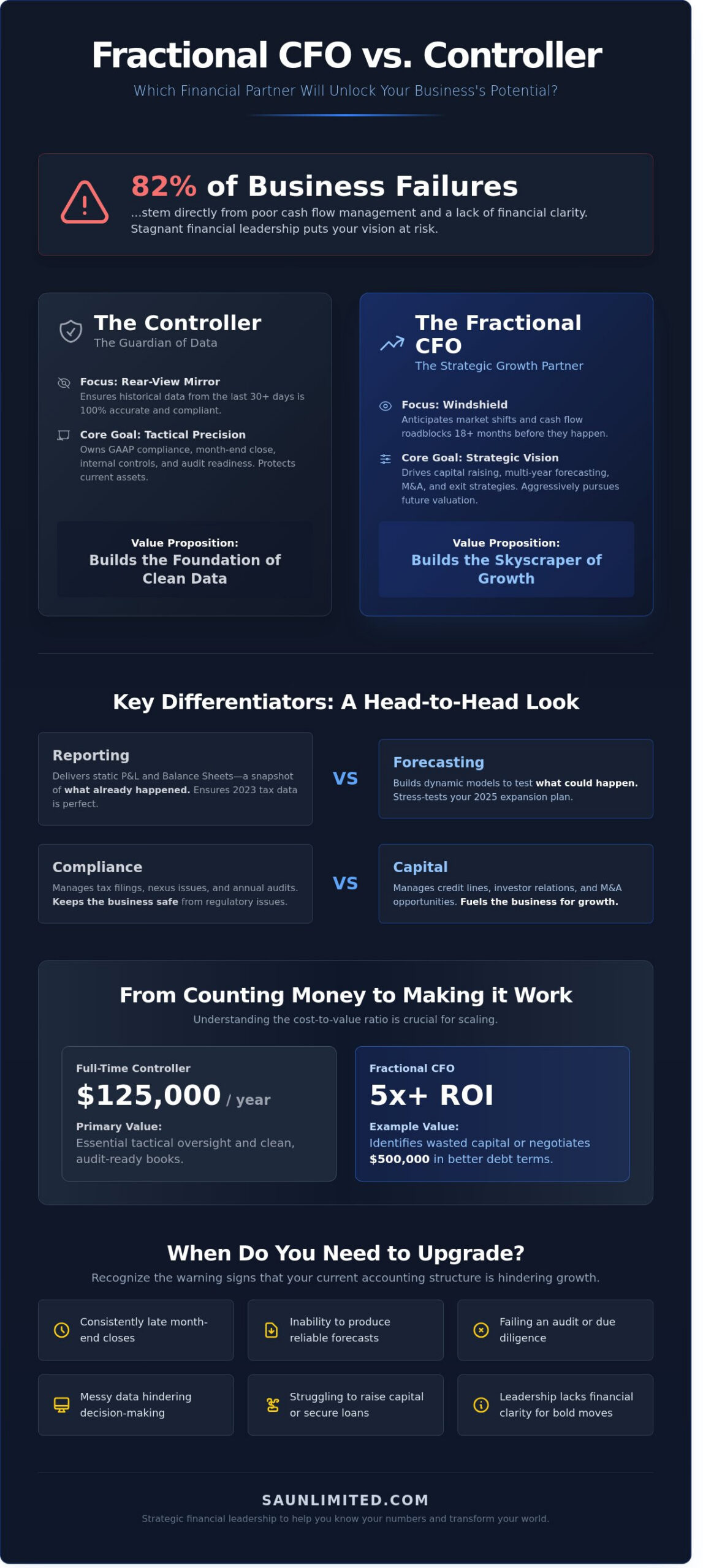
Your executive team’s velocity depends entirely on the clarity of your financial data. A Controller maintains the engine. A CFO charts the course. When you’re weighing the fractional cfo vs controller choice, it’s about shifting your focus from internal maintenance to external momentum. Controllers focus on the rear-view mirror. They ensure every transaction from the last 30 days is recorded with 100% accuracy, providing the stability your business needs to stay upright. CFOs look through the windshield. They anticipate market shifts and cash flow roadblocks 18 months before they hit your balance sheet.
The cost-to-value ratio is where the distinction becomes most visible. Hiring a full-time Controller might cost $125,000 annually, providing essential tactical oversight and clean books. Investing in a fractional CFO often yields a 5x return by identifying wasted capital or negotiating $500,000 in better debt terms. Understanding the fractional cfo vs controller dynamic allows you to stop paying for just “counting the money” and start paying for “making the money work.”
Reporting vs. Forecasting
Controllers deliver the P&L and Balance Sheet. These are static snapshots of what already happened. CFOs build dynamic models to test how a 20% increase in payroll affects your net margin by next December. Historical accuracy provides the integrity required to turn aggressive future projections into achievable realities. While the Controller ensures the 2023 tax data is perfect, the CFO is busy stress-testing your 2025 expansion plan.
Compliance vs. Capital
Controllers manage the 941 filings, sales tax nexus, and annual audits. They keep the regulatory wolves away from your door. CFOs manage the $5M credit line, investor relations, and M&A opportunities. You know you need a CFO’s touch when you hit specific capital-ready signals:
- Your debt-to-equity ratio exceeds 2.5.
- You’re preparing for a $2M+ Series A or B round.
- You’ve identified a competitor for a potential $10M acquisition.
At SA Unlimited, we don’t believe you should have to choose between tactical precision and strategic growth. We’ve managed $1B+ in successful transactions because we solve for yes. Our team bridges the gap, providing the high-level strategy that empowers you to make bold moves while ensuring your day-to-day accounting is flawless. You can explore our strategic partnerships to see how we unlock your business potential.
When to Hire: Identifying Your Business’s Current Inflection Point
The revenue range between $5M and $50M represents a dangerous “no man’s land” for scaling firms. Your legacy bookkeeping processes, which functioned perfectly at $2M, will likely buckle by the time you hit $12M in annual recurring revenue. This is the stage where generic accounting fails. It stops providing clarity and starts creating a bottleneck that stifles growth. To navigate this, you must recognize whether your hurdles are operational or strategic. Understanding the fundamental Controller vs. CFO Differences is the first step in breaking through that $20M ceiling.
Deciding between a fractional cfo vs controller depends on your current friction points. A controller builds the foundation; a CFO builds the future. If you’re struggling with messy data, you need a controller. If you’re struggling with a stagnant bottom line despite rising sales, you need a CFO. Many $30M companies realize they actually need both, but they don’t have the $450,000 budget required for two full-time executive salaries. This is where the fractional model changes the game, allowing you to deploy the right talent at the exact moment your inflection point demands it.
The Controller Trigger Points
You need a Controller when your financial engine starts smoking. If your books take more than 15 days to close each month, you’re making decisions based on stale data. Accuracy is the priority here. You’ll know it’s time to hire when you’re outgrowing QuickBooks and need a seamless transition to a robust ERP like Sage Intacct. Without this transition, internal fraud risks increase significantly. Statistics show that mid-sized businesses without a dedicated Controller lose an average of 5% of annual revenue to occupational fraud and simple clerical errors.
The CFO Inflection Points
A CFO is necessary when you need to “Solve for Yes” on complex growth initiatives. If your EBITDA isn’t scaling in proportion to your 20% revenue growth, you have a structural margin problem that a Controller cannot fix. You need a CFO to unlock your business potential during high-stakes moments, such as preparing for a 2025 exit or a major acquisition. They provide the strategic narrative for capital raising projects, ensuring your financial model stands up to the intense scrutiny of Series B investors or institutional lenders.
The hybrid approach is the most efficient path for the modern CEO. By leveraging a fractional team, you get the tactical precision of a Controller and the high-level strategy of a CFO for the price of one mid-level hire. It’s about getting the right eyes on the right numbers at the right time.
Bridging the Divide: How Systems Like Sage Intacct Power Both Roles
Technology serves as the ultimate force multiplier for your financial leadership team. When comparing a fractional cfo vs controller, the quality of your underlying data determines the success of both roles. We’ve managed over $1B in successful transactions by leveraging cutting-edge tools to create pathways for growth. Without a robust system, your Controller is buried in manual reconciliations; your CFO is making decisions based on 30-day-old information. Sage Intacct transforms this dynamic by providing real-time visibility that turns financial data into a competitive advantage.
At SA Unlimited, we’ve seen companies reduce their monthly close time by 40% simply by migrating to a cloud-based ERP. This efficiency allows the Controller to focus on internal controls and risk mitigation while the CFO shifts their gaze toward the strategic horizon. Our approach ensures that your technology doesn’t just record history, it predicts the future. We roll up our sleeves to ensure your tech stack is an asset, not a bottleneck.
Moving Beyond QuickBooks
QuickBooks is a fantastic tool for startups, but it fails mid-cap businesses that manage multiple entities or international currencies. When evaluating the needs of a fractional cfo vs controller, you must realize that entry-level software lacks the depth required for strategic scale. Businesses scaling past $15M in annual revenue often find that manual data entry leads to a 12% increase in reporting inaccuracies. Sage Intacct eliminates these bottlenecks through automated consolidations. This shift empowers your CFO to move with speed, making bold moves based on live data rather than gut feelings. We solve for yes by removing the technical barriers that stall your growth.
Custom Reporting for Clarity
Clarity is the fuel for confidence. A CFO’s dashboard must highlight the KPIs that drive the bottom line, such as gross margin trends and EBITDA growth. Conversely, a Controller needs a dashboard focused on operational health, tracking metrics like Days Sales Outstanding (DSO) and accounts payable aging with surgical precision. Our team specializes in Sage Intacct Implementation to ensure these insights are always a click away. We build custom reporting structures that reflect your unique business model, providing the transparency needed to unlock your business potential.
Ready to see what your data is really telling you? Let’s connect and build your roadmap to clarity.
Solving for Yes: Why an Integrated Fractional Approach Outperforms Siloed Roles
Hiring a fractional CFO from one firm and a controller from another often creates a communication vacuum. This siloed approach leads to data discrepancies and conflicting strategic advice. When these roles don’t share a unified vision, your business pays the price in lost momentum and 20% higher operational friction. Comparing a fractional cfo vs controller isn’t about choosing one over the other; it’s about how they work together to drive growth.
We solve for yes by removing the friction between strategy and execution. At SA Unlimited, we’ve seen how fragmented leadership stalls companies. By integrating these functions, we’ve helped clients achieve a combined $1B+ in success metrics, from massive capital raises to profitable exits. We transform financial confusion into unwavering confidence.
The SA Unlimited Advantage
Our Unlimited tier provides a high-level strategic partnership without the restrictive hourly tax. You get unrestricted access to top-notch talent that has seen every growth hurdle imaginable. We don’t just provide advice; we execute. Our team handles the heavy lifting to ensure the strategy we build together becomes your reality. We’ve managed over 50 successful growth transitions, proving that our hands-on approach works better than a simple advisory model.
- Strategic Partnership: Unlimited access to experts who’ve managed $1B+ in transactions.
- Execution-Focused: We roll up our sleeves to implement the systems we recommend.
- Scalable Tiers: Leadership that grows alongside your revenue.
Your Next Move
Assess your current team’s ceiling. If your financial reporting can’t support your next 24 months of growth, you’ve outgrown your current structure. Understanding the fractional cfo vs controller dynamic is the first step toward a more robust foundation. In the first 90 days, we focus on radical clarity. We establish clean data, build a 12-month roadmap, and implement the reporting structures needed for your next bold move.
Secure Your Strategic Advantage
Deciding on a fractional cfo vs controller marks a pivotal moment for your business’s 2026 expansion. You need the tactical precision of a controller to anchor your operations and the strategic vision of a CFO to pilot your growth. By leveraging our decades of high-level strategic experience, you can stop managing spreadsheets and start leading your industry. We serve as Expert Sage Intacct Implementation Partners to ensure your data flows seamlessly across every department.
Our track record includes $1B+ in successful client outcomes, proving that a proactive financial mindset changes everything. We don’t believe in siloed roles that slow you down. Instead, we create an integrated approach that provides the clarity you need to move fast and unlock your business potential. You deserve a partner who’s as invested in your results as you are.
Ready to make bold moves? Let’s connect and Solve for Yes.
The path to your most profitable year starts with a single decisive step.
Frequently Asked Questions
Can a Controller eventually become a CFO?
Yes, a Controller can transition into a CFO role by shifting their focus from historical reporting to forward looking strategy. This evolution typically requires 10 to 15 years of financial leadership and a proven ability to drive enterprise value. At SA Unlimited, we help leaders bridge this gap by teaching them to solve for yes. You’ll need to master capital structure and investor relations to make this professional leap successfully.
How much does a fractional CFO cost vs. a fractional Controller?
A fractional CFO typically costs between $3,000 and $10,000 per month, while a fractional Controller usually ranges from $1,500 to $4,500. This 50% price difference reflects the level of strategic oversight provided. When weighing the fractional cfo vs controller investment, remember that a CFO focuses on ROI and growth. A Controller ensures your $1.2 million in annual revenue is accounted for with 100% accuracy and compliance.
Is it possible to have a fractional CFO without a Controller?
It’s possible but highly inefficient to hire a CFO without a Controller or strong bookkeeper in place. Without a Controller to manage the $50,000 monthly close, your high level CFO will spend 40% of their time on basic data entry. We recommend building a foundation first. This ensures your strategic partner focuses on $10 million growth targets rather than reconciling bank statements or chasing down missing invoices.
What is the primary difference between a CPA and a Controller?
A CPA is a professional certification, whereas a Controller is a specific management role within your company. While 75% of effective Controllers hold a CPA license, their daily focus is on internal financial health and departmental budgets. A CPA at a public firm might only see your books once a year for tax season. Your Controller stays in the trenches every day to maintain 100% data integrity and operational flow.
How many hours a month does a typical fractional CFO work?
A typical fractional CFO works between 10 and 40 hours per month depending on your business complexity. For a company with $5 million in annual recurring revenue, 15 hours is often the sweet spot for strategic planning. This flexible model allows you to access $1 billion in collective expertise without the $250,000 annual salary of a full time executive. It’s about high impact results, not just clocking in for forty hours.
What happens if my business outgrows fractional services?
We guide you through the transition to a full time hire once your revenue exceeds the $50 million mark. Our team manages the recruitment process and ensures a 90 day handoff period to maintain momentum. We don’t just fill a gap; we build the systems that empower you to make bold moves. Outgrowing us is a sign of success, and we ensure your internal team is ready for the challenge.
Can a fractional CFO help with Sage Intacct implementation?
Yes, a fractional CFO provides the strategic roadmap for a Sage Intacct implementation to ensure the system scales with your growth. Companies using expert oversight typically see a 20% faster rollout and fewer data migration errors. We roll up our sleeves to define the reporting dimensions and KPIs you need. This ensures your $15,000 software investment delivers the clarity required to unlock your business potential and drive profitability.
Do I need a CFO if I’m not currently raising capital?
You need a CFO to optimize profitability and cash flow even if you aren’t raising capital this year. Strategic financial leadership often uncovers a 15% improvement in operating margins through better cost controls. In the fractional cfo vs controller debate, the CFO is the one who finds the hidden capital already inside your business. We create pathways to higher valuation so you’re ready when the right $20 million opportunity appears.