

If your finance team spends 15 hours every month manually consolidating entities in Excel, you aren’t just losing time; you are losing the strategic ability to scale. Your business has likely hit the ceiling where transaction volume limits and system lag turn daily operations into a productivity bottleneck. Migrating from QuickBooks to Sage Intacct is the strategic pivot that moves your team from reactive data entry to proactive leadership. You deserve a financial foundation that grows as fast as your ambitions.
We understand the pressure of preparing for a 2026 audit or a capital raise when your financials lack the necessary transparency. It’s frustrating to feel held back by legacy tools when you are ready to make bold moves. This guide promises to show you how to transform your financial operations into a high-octane growth engine. We will explore the exact roadmap for a seamless transition, focusing on automated multi-entity reporting and the real-time clarity required for successful M&A activity. It’s time to unlock your business potential and finally solve for yes.
Key Takeaways
- Recognize the “Glass Ceiling” signals, such as the spreadsheet trap and reporting delays, that prove your business is ready for an audit-ready financial foundation.
- Discover how migrating from QuickBooks to Sage Intacct allows you to leverage Dimensional Accounting, replacing a bloated Chart of Accounts with a streamlined, strategic architecture.
- Eliminate the risk of “Garbage In, Garbage Out” by implementing a rigorous data cleanup strategy before your ERP transition begins.
- Navigate a proven 5-phase roadmap to align your team and ensure a seamless, high-impact implementation that scales with your 2026 goals.
- Unlock your business potential by partnering with a fractional CFO who “Solves for Yes,” turning a software migration into a powerful engine for profitable growth.
Recognizing the QuickBooks ‘Glass Ceiling’: When to Pivot to Sage Intacct
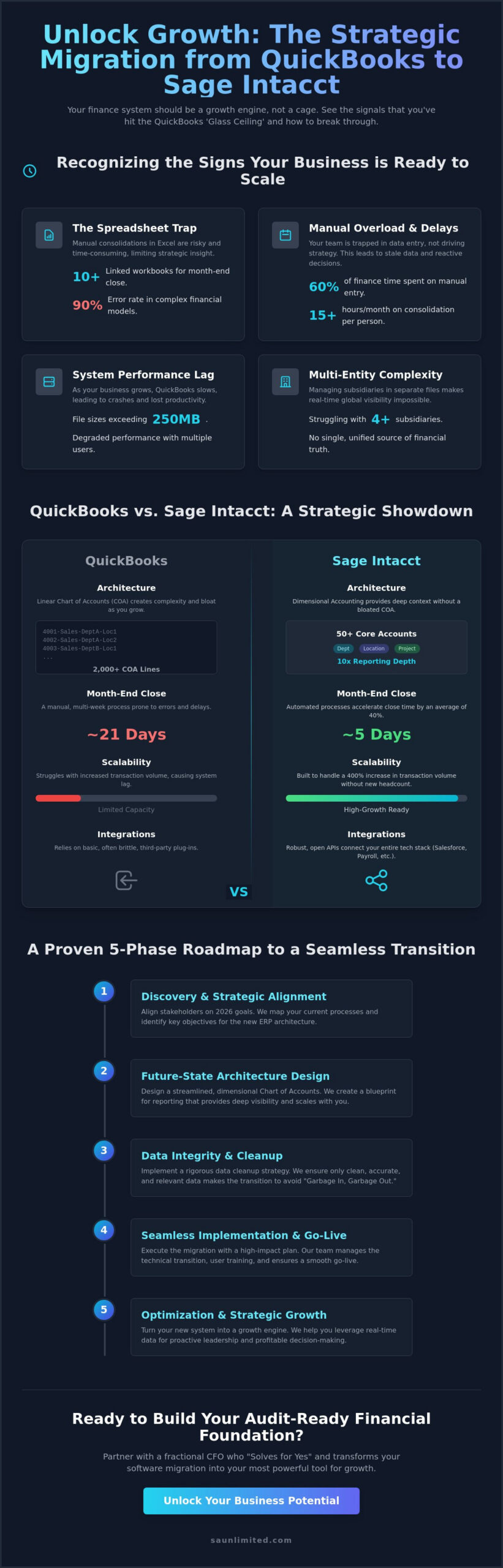
Growth is a double-edged sword for the modern finance leader. While top-line revenue expansion signals success, it often exposes the structural weaknesses of entry-level accounting software. You hit a “glass ceiling” where QuickBooks no longer supports your ambition. This isn’t just a technical glitch; it’s a strategic bottleneck. When your team spends 60% of their time on manual data entry rather than analysis, your system has officially become a liability. Recognizing this inflection point is the first step in migrating from QuickBooks to Sage Intacct to unlock your business potential.
The “spreadsheet trap” is the most visible symptom of this ceiling. If your month-end close requires 10 or more linked Excel workbooks to handle consolidations, you’re operating at high risk. Manual workbooks carry a 90% error rate in complex financial models. Relying on these for GAAP compliance or audit-readiness is a dangerous gamble. Beyond the errors, transaction volume will eventually degrade performance. Once your file size exceeds 250MB or your concurrent user count climbs, QuickBooks often experience significant lag, leading to system crashes and lost productivity.
Multi-entity complexity is the final breaking point. Managing 4 or more subsidiaries in QuickBooks forces your team to log in and out of separate company files. This decentralization makes real-time global visibility impossible. Moving to a true Enterprise Resource Planning (ERP) system is the only way to maintain integrity across a growing corporate structure. We solve for “yes” by replacing these fragmented processes with a single, unified source of truth.
The Cost of Doing Nothing
The “invisible” cost of manual labor in a stagnant finance department is staggering. If three senior accountants spend 15 hours each per week on manual reconciliations, you’re losing over 2,300 hours of strategic capacity annually. This delay creates stale financial data. Decisions made on 14-day-old numbers aren’t strategic; they’re reactive. Outdated systems also signal a lack of sophistication to investors. During a Series B or C funding round, a 20-day close process can decrease investor confidence and potentially impact your valuation by 5% to 10%.
Sage Intacct vs. QuickBooks: A Strategic Comparison
The fundamental difference lies in the architecture. QuickBooks uses a linear Chart of Accounts (COA), which forces you to create a new account code for every location, department, or project. This leads to a bloated COA with thousands of entries. Sage Intacct utilizes dimensional accounting. This allows you to tag transactions with context, reducing a 2,000-line COA to just 50 core accounts while providing 10x the reporting depth.
- Real-time visibility: Sage Intacct users typically reduce their close time by 40%, moving from a three-week slog to a five-day sprint.
- Integration capabilities: While QuickBooks relies on basic plug-ins, Sage Intacct offers robust APIs that connect your ERP to your entire tech stack, from Salesforce to specialized payroll platforms.
- Scalability: Successfully migrating from QuickBooks to Sage Intacct ensures your infrastructure can handle a 400% increase in transaction volume without adding headcount.
At SA Unlimited, we know that your accounting system should be a growth engine, not a cage. Transitioning now ensures you have the clarity and confidence to make bold moves in 2026 and beyond.
The Strategic Migration Framework: Designing Your Future Financial Architecture
Migrating from QuickBooks to Sage Intacct isn’t just a software swap; it’s a structural renovation. Most finance teams make the mistake of treating the new system like a faster version of the old one. This leads to “garbage in, garbage out” scenarios that haunt your 2026 growth plans. You need a framework that prioritizes data integrity and strategic scalability from day one. When migrating from QuickBooks to Sage Intacct, focus on stakeholder alignment early to avoid friction during the go-live phase.
Architecture Before Action
Don’t drag your messy QuickBooks Chart of Accounts (COA) into your new environment. QuickBooks forces you to create a unique account for every possible combination of department and location, leading to a bloated, 50-page COA that’s impossible to manage. Sage Intacct solves this through its multi-dimensional ledger. Dimensions act as independent tags for every transaction, allowing you to slice and dice data by department, location, or project without creating a massive, unmanageable list of accounts.
Planning for 2026 requires looking ahead at your expansion goals. If you expect to add three international subsidiaries or five new revenue streams by Q4, your architecture must support those now. You’re building for the company you’ll become, not the one you were yesterday. This proactive design ensures your financial data stays clean as you scale.
The Role of the Fractional CFO in System Design
A fractional cfo acts as the architect who ensures your technical setup matches your strategic KPIs. They bridge the gap between the accounting team’s need for precision and the Board’s demand for high-level visibility. At SA Unlimited, our “We Solve for Yes” mindset means we don’t just identify technical roadblocks; we create pathways for complex financial maneuvers that traditional setups can’t handle.
Define your victory before you start the migration. Your primary success metrics should include:
- Trial Balance Parity: Achieving 100% accuracy between systems within the first 30 days of migration.
- Reporting Speed: Reducing the time to generate monthly board decks by 60% or more.
- Stakeholder Alignment: Securing sign-offs from IT and Operations to ensure data flows don’t create new silos.
Achieving these metrics gives you the clarity to make bold moves. If you want to unlock your business potential, your financial foundation must be unshakable. Know your numbers, trust your data, and design a system that works for your future, not your past.
Data Integrity and Cleanup: The Foundation of a Successful ERP Transition
Your migration is only as strong as your weakest data point. Migrating from QuickBooks to Sage Intacct offers a fresh start, but carrying over “financial debt” in the form of messy records will stall your growth. We follow a strict rule at SA Unlimited: Garbage In, Garbage Out. If your current ledger contains duplicates or unallocated expenses, those errors will simply scale in a more powerful system. We solve for yes by ensuring your foundation is rock solid before the first byte of data moves.
Strategic CFOs don’t move everything. Industry benchmarks from 2024 suggest that 60% of data migration delays stem from trying to move too much historical baggage. Focus on the last 24 to 36 months of transactional detail. Archive the rest in a read-only format. This lean approach ensures your new system remains agile and high-performing. It’s about clarity, not just volume.
Standardizing your lists is the next non-negotiable step. QuickBooks often hides duplicate entries under slight naming variations. Before you begin migrating from QuickBooks to Sage Intacct, consolidate your vendor and customer lists. A single source of truth prevents the “double payment” trap that plagues roughly 15% of mid-market companies during software transitions. We roll up our sleeves to help you identify these redundancies early.
The Financial Hygiene Checklist
Start by scrubbing the “undeposited funds” account. This is often where QuickBooks data goes to die. You must clear out every pending transaction to ensure a clean cutover. Standardize your naming conventions across all dimensions. If “Marketing” is “MKTG” in one ledger and “Marketing Dept” in another, your reporting will break. Verify your opening balances down to the penny. We aim for 100% accuracy on the cutover date. Anything less compromises your confidence in the new numbers.
Mapping Data to the New Dimensions
Sage Intacct replaces the rigid QuickBooks sub-account structure with flexible, powerful dimensions. You’ll translate old, bloated charts of accounts into streamlined tags. Don’t guess during this phase. Test your data imports with a 5% subset of transactions first. This pilot import catches mapping errors before they infect your entire database. Proper mapping ensures you can still run year-over-year comparisons without a manual spreadsheet exercise. We create pathways that keep your historical context intact while we unlock your business potential.
Executing the Move: A 5-Phase Roadmap for Seamless Integration
Transitioning your financial engine isn’t a simple plug-and-play task. Successfully migrating from quickbooks to sage intacct requires a disciplined, multi-phase approach to ensure 100% data integrity and team buy-in. At SA Unlimited, we solve for yes by turning complex transitions into predictable, high-performance outcomes. Follow this 5-phase roadmap to unlock your business potential.
- Phase 1: Planning and Scoping. Define your migration team and establish a 90-day timeline. We identify every integration point, from payroll to CRM, to prevent mid-project bottlenecks.
- Phase 2: Configuration. This is where we build your environment. We replace the flat chart of accounts in QuickBooks with a multi-dimensional structure tailored to your specific reporting needs.
- Phase 3: Data Migration and Testing. We move your historical balances and open transactions. Rigorous testing ensures that every penny matches between systems before you flip the switch.
- Phase 4: Training and User Acceptance. We empower your team through hands-on sessions. Your staff must demonstrate proficiency in the new workflows before the system goes live.
- Phase 5: Go-Live and Optimization. After the initial 30-day “hyper-care” period, we stabilize the system and begin refining your custom reports for maximum clarity.
Managing the Cutover Period
Timing is everything. Approximately 65% of mid-market firms choose a year-end or quarter-end cutover because it provides a clean break for audit trails and tax reporting. Running parallel systems for at least 15 days is a common safety net, though it requires significant team bandwidth. To prevent burnout, we recommend reallocating 20% of your accounting team’s daily tasks to temporary support or automation during the transition window. This ensures your staff stays focused on the strategic move without dropping the ball on daily operations.
Post-Implementation Optimization
Don’t stop at the basic general ledger. Once you’ve stabilized, it’s time to implement advanced features like automated revenue recognition or AP automation, which can reduce manual entry by 60%. Customizing dashboards is also vital. A CEO needs high-level cash flow visibility, while Department Heads require granular budget-to-actuals. Ongoing education is the final piece. As your team evolves with the Sage Int platform, they’ll discover new ways to drive profitability and operational efficiency.
Ready to leave the limitations of QuickBooks behind and scale with confidence? Connect with our strategic experts today to start your migration journey.
Why a Fractional CFO Partner is Essential for Your Sage Intacct Migration
Migrating from QuickBooks to Sage Intacct is more than a technical upgrade; it’s a declaration of your intent to scale. While a software installer focuses on data mapping and field migrations, a strategic cfo consulting partner focuses on your business trajectory. We don’t just install software. We architect financial engines. At SA Unlimited, we’ve leveraged over $1B in transaction experience to help leaders move past the limitations of entry-level accounting. Our team doesn’t just identify roadblocks; we “Solve for Yes” by creating pathways through complex multi-entity consolidations and automated revenue recognition. We implement enterprise-grade controls that protect your margins and prepare you for rigorous audits. This proactive approach turns your financial stack into a strategic asset rather than a back-office burden.
Expertise Without the Full-Time Executive Cost
Fractional models allow mid-cap firms to tap into top-tier talent without the heavy overhead of a full-time C-suite executive. It’s a high-ROI strategy that ensures your Intacct setup is built for 2026 and beyond. A botched implementation can cost a company 15% of its annual revenue in lost productivity and data cleanup. We eliminate that risk. Our team partners with you for the long haul, providing the advanced financial modeling and capital raising support needed to fuel your next phase of expansion. We ensure your chart of accounts isn’t just organized, but optimized for the specific KPIs that investors and board members demand.
- Strategic Alignment: We map your software to your five-year growth plan, not just your current needs.
- Risk Mitigation: Our billion-dollar expertise ensures your internal controls meet enterprise standards from day one.
- Value Creation: We transform your accounting department from a cost center into a predictive growth engine.
Ready to Unlock Your Business Potential?
The transition when migrating from QuickBooks to Sage Intacct gives you the clarity to make bold moves with confidence. You’ll stop chasing data and start driving strategy. Our mission is to empower you to unlock your business potential by providing the visibility you’ve been missing. We’ve helped dozens of companies bridge the gap between “knowing numbers” and “solving for yes.”
Don’t let a legacy system or a basic software installation hold back your 2026 growth targets. It’s time to move toward a future of profitable growth and unwavering financial confidence. Let’s connect today for a strategic consultation to ensure your migration is the catalyst for your most successful year yet.
Architect Your Financial Future
Breaking through the QuickBooks glass ceiling is a pivotal moment for every mid-cap leader. Transitioning to a sophisticated ERP requires a rigorous 5-phase roadmap and a commitment to data integrity that most internal teams aren’t equipped to handle alone. Successfully migrating from quickbooks to sage intacct isn’t just about moving numbers; it’s about engineering a scalable architecture that supports your next decade of growth. You need a partner who understands the strategic why behind every how to ensure your new system delivers immediate clarity and long-term profitability.
At SA Unlimited, we bring decades of experience in mid-cap financial architecture to your side. We’ve managed over $1B in successful financial transactions, giving us the unique insight needed to navigate complex ERP transitions with precision. Our team of Sage Intacct implementation specialists doesn’t just install software; we solve for yes. We roll up our sleeves to ensure your financial foundation is rock solid, empowering you to make bold moves with confidence. Let’s build the pathway to your most profitable year yet.
Let’s solve for your next growth phase. Connect with SA Unlimited today.
Frequently Asked Questions
How long does it typically take to migrate from QuickBooks to Sage Intacct?
A standard implementation takes 60 to 120 days depending on your data complexity and the number of entities involved. Migrating from QuickBooks to Sage Intacct requires a strategic phased approach to ensure total data integrity. We focus on clean cutovers that minimize operational downtime. Most mid-market firms complete the full transition in under 90 days when they utilize dedicated project management resources.
Can I migrate my entire financial history from QuickBooks?
You can migrate your full history, but 85% of strategic CFOs choose to bring over 2 years of historical detail and opening balances. This approach keeps your new system lean and high-performing. We recommend archiving older data in a searchable, read-only format to maintain compliance. This strategy ensures you maintain clear audit trails while you unlock your business potential through an optimized ledger structure.
Is Sage Intacct significantly more expensive than QuickBooks Online?
Sage Intacct is a premium investment because it offers enterprise-grade automation that basic software cannot match. While the annual subscription cost is higher, companies often see a 250% return on investment through reduced manual labor and faster closing cycles. You’re moving from a simple record-keeping tool to a robust financial management platform. It’s a move that trades a cost center for a strategic growth engine.
What is the biggest mistake companies make during an ERP migration?
The biggest error is “lifting and shifting” a messy Chart of Accounts into the new environment. According to 2024 industry surveys, 40% of migration delays stem from poor data hygiene in the legacy system. Don’t just replicate your QuickBooks flaws in a more powerful platform. Use this transition to re-engineer your workflows. We solve for yes by cleaning your data before it ever touches your new production environment.
Do I need a consultant to implement Sage Intacct, or can I do it myself?
You need a certified implementation partner to ensure your system architecture supports long-term scale. Sage Intacct is a sophisticated platform that requires expert configuration to unlock its full power. DIY attempts often lead to 50% higher costs later when fixing structural errors or broken integrations. Partnering with seasoned experts ensures you get it right the first time. We roll up our sleeves to build a foundation that lasts.
How does Sage Intacct handle multi-entity consolidations differently than QuickBooks?
Sage Intacct automates multi-entity consolidations in seconds, whereas QuickBooks often requires hours of manual work in spreadsheets. It handles intercompany eliminations and currency conversions instantly across dozens of entities. This typically reduces the monthly close time by 4 to 10 days for complex organizations. You gain real-time visibility into global performance without the headache of manual data entry. It’s about achieving total clarity in your numbers.
What happens to my QuickBooks data after the migration is complete?
You should maintain your QuickBooks data in a read-only format for at least 7 years to satisfy IRS audit requirements. Most firms keep a single user license or a local backup for historical reference. Once your new system is live, QuickBooks becomes your secondary archive. This strategy protects your past while you focus on a profitable future. We help you create pathways for secure data retention and easy access.
Will my team need extensive training to use Sage Intacct?
Your team will typically need 20 to 40 hours of targeted training to master the new dimensional reporting and automation features. While the interface is intuitive, the shift from linear accounting to multidimensional analysis is a significant change. We provide top-notch talent to guide your staff through the learning curve. This investment empowers your team to make bold moves with better data and increased confidence.