
Your month-end close shouldn’t feel like a forensic investigation into a dozen disconnected spreadsheets. When your finance team spends 10 to 15 days every month manually reconciling intercompany transfers, you aren’t just losing time; you’re losing the competitive edge required to scale. Implementing sage intacct for multi-entity businesses isn’t just a software upgrade. It’s a strategic move to unlock your business potential and reclaim your most valuable asset: financial clarity.
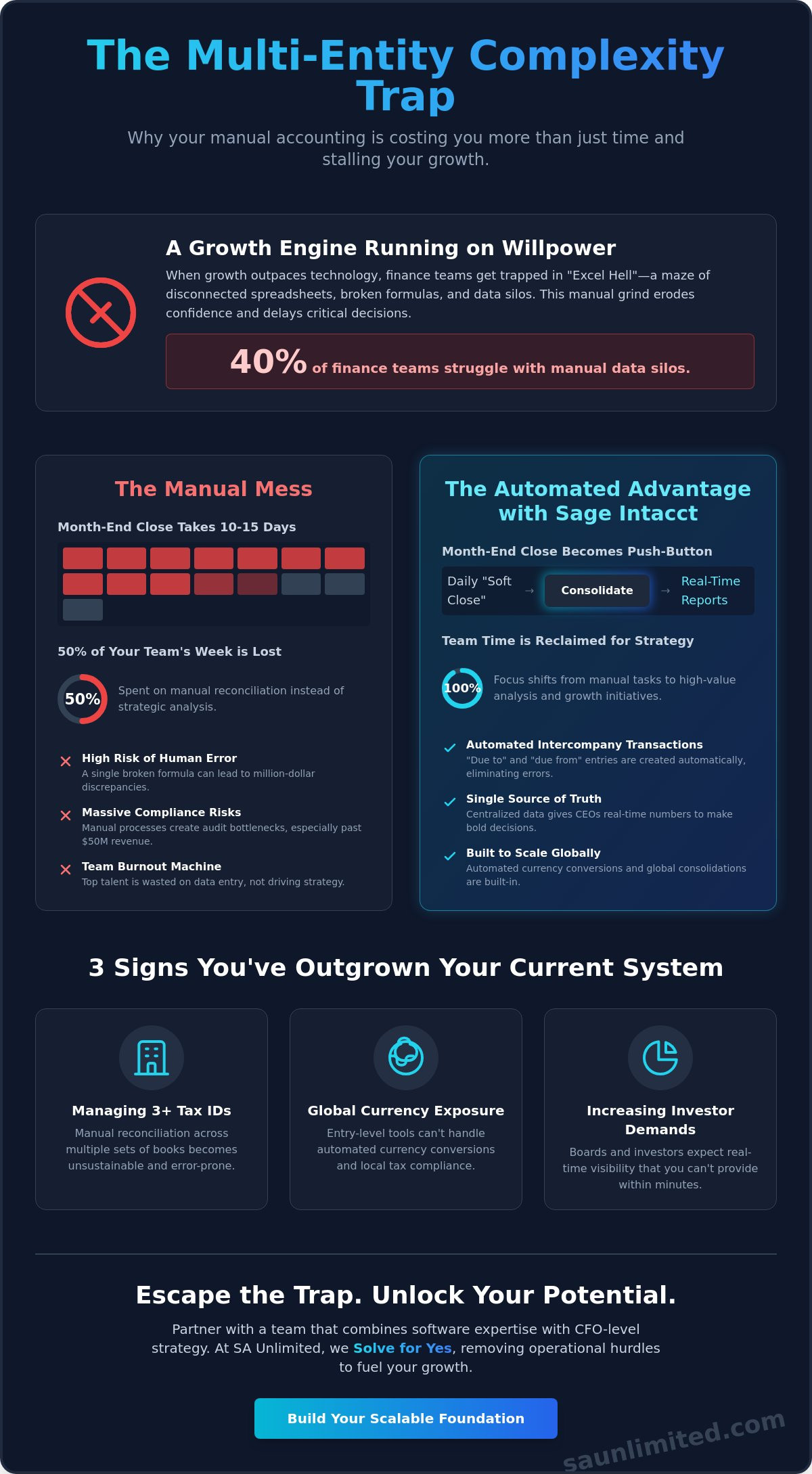
We understand the frustration of managing complex currency conversions and entity structures that feel like they’re held together by sheer willpower. It’s a common bottleneck, as recent industry data shows 40% of finance teams still struggle with manual data silos that delay critical decision-making. This guide will show you how to transform that complexity into a strategic advantage with push-button consolidations and real-time global visibility. You’ll discover the roadmap to a scalable foundation that fuels investor confidence and slashes your reporting cycles. We’ll break down the specific features that drive global growth and prepare your organization for the demands of 2026.
Key Takeaways
- Escape the multi-entity complexity trap by uncovering the hidden operational costs of manual, spreadsheet-based consolidations that stall mid-cap growth.
- Discover how sage intacct for multi-entity businesses leverages a sophisticated “Top Level” hierarchy to automate inter-entity transactions and ensure global financial control.
- Learn to leverage high-integrity financial data to win investor confidence, secure debt financing, and fuel rapid M&A through “plug-and-play” entity setup.
- Follow a proven two-phase implementation roadmap to design a shared environment that aligns your entity structure with your 2026 growth targets.
- Understand why partnering with a team that combines software expertise with CFO-level strategy allows you to “Solve for Yes” and unlock your full business potential.
The Multi-Entity Complexity Trap: Why Traditional Accounting Fails
Growth is the ultimate goal, but for mid-cap companies, it often carries a hidden tax: the multi-entity complexity trap. This phenomenon occurs when a business expands into new markets, adds subsidiaries, or acquires competitors, only to find their financial foundation crumbling. Traditional accounting systems, built for single-entity linear growth, cannot handle the multidimensional demands of a modern enterprise. When your finance team spends 50% of their week manually reconciling accounts instead of analyzing performance, your growth has officially outpaced your technology.
The reliance on manual, spreadsheet-based workflows is a primary driver of this trap. Finance leaders frequently find themselves trapped in “Excel Hell,” attempting to build consolidated financial statements across dozens of tabs. A single broken formula or a missed entry can lead to million-dollar discrepancies. This fragmented approach creates data silos where entry-level software like QuickBooks fails. These systems require separate logins for every tax ID, forcing teams to export and re-import data constantly. This lack of integration erodes CEO confidence. When a leader cannot “Know Your Numbers” in real time, they hesitate to make the bold moves required to dominate their sector. Implementing sage intacct for multi-entity businesses solves this by centralizing data and automating the heavy lifting.
The Anatomy of Intercompany Friction
Intercompany transactions (IET) are the friction points that slow down global operations. In a manual environment, every transfer between entities requires two separate entries, doubling the margin for human error. These bottlenecks create massive compliance risks during audits, especially as revenue climbs past the $50 million mark. Beyond the numbers, there is a significant emotional toll. A 20-day month-end close isn’t just a technical delay; it is a burnout machine that drains the energy of your top-notch talent. At SA Unlimited, we believe your team should focus on strategy, not data entry. We Solve for Yes by removing these operational hurdles.
Signs You Have Outgrown Your Current System
Recognizing the breaking point is essential to protect your margins. Most businesses realize they need a more robust solution when they hit these specific milestones:
- Managing 3+ Tax IDs: Handling separate sets of books manually becomes unsustainable once you move beyond two entities.
- Global Currency Exposure: Operating across multiple borders requires automated currency conversions and local tax compliance that entry-level tools cannot provide.
- Investor Demands: Boards and investors in 2026 expect real-time visibility. If you cannot provide a consolidated dashboard within minutes, you are losing credibility.
By leveraging sage intacct for multi-entity businesses, you provide your leadership with the clarity needed to scale. It is time to move past the limitations of the past and unlock your business potential with a system designed for your future.
Sage Intacct: The Architecture of Global Financial Control
Scaling a multi-entity organization requires more than just a ledger; it demands a structural DNA built for expansion. Sage Intacct for multi-entity businesses provides this through a sophisticated “Top Level” and “Entity Level” hierarchy. The Top Level serves as your strategic command center, while the Entity Level allows individual units to operate with the necessary autonomy. This architecture ensures that as you add your 10th or 50th location, your administrative overhead doesn’t grow at the same rate. You maintain central control while empowering local managers to execute.
Manual inter-entity transactions often lead to accounting errors and delayed closings. Sage Intacct eliminates this friction by automating inter-entity transactions (IETs). When one entity pays a bill for another, the system automatically creates the “due to” and “due from” entries across both sets of books. This automation allows finance teams to achieve a “soft close” every day, providing a 24/7 view of the company’s true financial health. You don’t have to wait 15 days after month-end to know your numbers; the data is ready when you are.
Global operations introduce the headache of fluctuating exchange rates and complex reporting requirements. Sage Intacct automates global consolidations by pulling live exchange rates for over 100 currencies. This ensures your reporting aligns with U.S. GAAP consolidation standards without the need for external spreadsheets or manual adjustments. We solve for yes by providing the cutting-edge technology that makes international growth feel as simple as local operations.
Shared Master Data: One Version of the Truth
Maintaining a centralized Chart of Accounts (COA) is the only way to ensure data integrity across a diverse portfolio. With Sage Intacct for multi-entity businesses, you manage customers, vendors, and items from a single point of entry. This shared master data approach prevents the data silos that typically plague growing firms. It ensures consistent regulatory compliance and allows your team to roll up their sleeves and focus on strategy rather than cleaning up duplicate vendor records or reconciling mismatched accounts.
Real-Time Dashboards for Multi-Entity Visibility
Clarity is the precursor to confidence. Sage Intacct’s dashboards allow you to generate side-by-side entity comparisons in seconds. You can instantly drill down from high-level consolidated totals directly into individual transactions to see exactly what is driving your performance. This transparency empowers department heads to own their budgets while giving the C-suite total oversight. If you want to unlock your business potential, you need this level of granular visibility to make bold, profitable moves in real-time.
Strategic Advantage: How Multi-Entity Clarity Fuels Growth
Visibility is the engine of expansion. When you’re managing a complex portfolio, knowing your numbers isn’t enough; you must use them to create pathways for new capital. Using sage intacct for multi-entity businesses transforms fragmented data into a unified strategic asset. This clarity allows CFOs to secure debt financing and equity investments by presenting a single version of the truth. You aren’t just reporting history. You’re proving your future capacity to scale with unwavering precision.
Proactive cash planning becomes a reality when you eliminate the manual lag of spreadsheets. By the time most firms consolidate their month-end, the data is already 15 days old. With real-time insights, you move from reactive accounting to solving for yes. This mindset shift means having the confidence to greenlight a new market entry or a capital expenditure because you see the exact liquidity across every subsidiary instantly. It’s about taking control of your narrative and unlocking your business potential through data-driven certainty.
Empowering the Strategic Leader
Strategic leaders win when they stop acting as data aggregators. By automating intercompany eliminations and consolidations, you reduce administrative overhead by as much as 40 percent. This shift lets your team focus on high-level growth initiatives rather than chasing down discrepancies in local ledgers. A critical part of this focus involves tracking EBITDA across all entities. When you can compare the profitability of a New York branch against a London office in real-time, you make bold moves based on hard evidence. Our goal is to empower you to lead with authority, backed by cutting-edge technology that supports your vision.
Investor Confidence and Valuation
Transparency is the bedrock of high valuations. Investors pay a premium for businesses that demonstrate operational excellence and rigorous financial control. During due diligence, the ability to produce audited, standardized financials can shorten the closing process by weeks. This level of sophistication is often tied to compliance with International Financial Reporting Standards (IFRS), which ensures your global entities speak the same financial language.
Sage Intacct supports a plug-and-play model for rapid M&A. You can onboard a new acquisition and have it reporting into the master group within hours. This rapid integration maximizes your company’s valuation by proving that your infrastructure is built for 2026 and beyond. It shows partners that you’ve built a scalable machine ready for billion-dollar success. We roll up our sleeves to ensure your ERP isn’t just a tool, but a strategic partner in your growth journey.
Implementing Sage Intacct for Multi-Entity Success
Deploying sage intacct for multi-entity businesses is a high-stakes evolution that requires more than just technical migration. It demands a strategic overhaul of your financial architecture. To scale successfully toward 2026 goals, we follow a disciplined five-phase roadmap designed to eliminate friction and unlock your business potential.
- Phase 1: Assessing Structure and COA. We start by auditing your current Chart of Accounts. Inconsistent data structures across subsidiaries account for 70% of reporting delays. We standardize these to ensure every entity speaks the same financial language.
- Phase 2: Designing for Scalability. We build a shared environment that allows for “top-level” visibility. This design ensures that adding a new entity in the future takes minutes, not weeks.
- Phase 3: Migration and Configuration. We execute data migration with an unwavering commitment to integrity. This phase focuses on mapping historical data to new dimensions for deep-dive analytics.
- Phase 4: Training and Change Management. We empower your team to move beyond manual entry. Training focuses on leveraging automation so your staff can transition into strategic advisory roles.
- Phase 5: Go-Live and Optimization. After the switch, we fine-tune reporting dashboards. The goal is to provide CFOs with real-time consolidated insights the moment the books close.
Choosing Your Implementation Partner
Technical setup is only 50% of the project. A partner who simply maps fields is a liability. You need a collaborator who understands CFO-level strategy and the nuances of multi-currency configuration. Mistakes in functional currency settings can lead to 12% variances in consolidated reports. We solve for yes by ensuring your partner understands the strategic implications of every system toggle.
The Roadmap Beyond QuickBooks
QuickBooks usually becomes a bottleneck once a company manages more than five entities. Growth plateaus occur when your team spends 60% of their time on manual intercompany eliminations. Integrating outsourced CFO guidance during this transition provides a massive cost-benefit advantage. It ensures your team adopts a sophisticated financial mindset, moving from “knowing the numbers” to making bold, data-driven moves. Leveraging sage intacct for multi-entity businesses ensures you never outgrow your software again.
Ready to transform your financial architecture and scale with confidence? Let’s connect.
The SA Unlimited Approach: We Solve for Yes
At SA Unlimited, “We Solve for Yes” isn’t just a catchy motto; it’s our core DNA. We don’t just implement software. We build financial engines. By combining deep technical mastery of Sage Intacct with high-level CFO advisory, we turn accounting from a back-office function into a strategic weapon. Our team rolls up their sleeves to ensure your multi-entity structure doesn’t just function, it thrives. We’ve seen businesses scale from $10 million to $500 million by leveraging the right data at the right time. Our commitment is to unlock your business potential by removing the friction between your vision and your financial reality.
We create pathways to growth through tailored financial ecosystems. This means we don’t believe in out-of-the-box solutions that ignore your unique operational hurdles. We transform your world by providing unwavering financial clarity, allowing you to make bold moves with confidence. Whether you’re managing five entities or fifty, our approach ensures that every dollar is accounted for and every growth opportunity is visible.
A Partnership, Not a Cost Center
Most firms treat software as a one-time setup. We don’t. Our fractional CFOs live inside your data. They use sage intacct for multi-entity businesses to build predictive models that look three years ahead, not just thirty days back. We create customized reporting dashboards that speak the language of CEOs, focusing on unit economics and consolidated margins across every subsidiary. This isn’t about looking at spreadsheets; it’s about gaining the strategic advantage necessary to lead your industry.
Our ongoing support ensures your system evolves with your growth. As you enter new markets or acquire new assets in 2026, your financial stack must adapt. We provide the top-notch talent and cutting-edge technology required to keep your reporting seamless. We’ve helped organizations manage $1B+ in transactions by ensuring their systems never lag behind their ambitions. We’re your partner in success, invested in your long-term profitability.
Ready to Transform Your Multi-Entity Management?
Complexity is the enemy of scale. When you move away from manual consolidations and fragmented data, you gain the freedom to execute on your highest-level goals. The shift from managing chaos to driving strategy happens when you have a partner who understands the nuances of sage intacct for multi-entity businesses. We’ve spent decades refining the art of financial clarity, and we’re ready to apply that expertise to your organization.
Your financial future shouldn’t be a question mark. It should be a roadmap. By integrating strategic advisory with the world’s leading cloud accounting software, we empower you to see further and move faster. Stop settling for “no” from your current systems and start solving for “yes.”
Transform Complexity into Your Competitive Edge
Scaling a global enterprise requires more than just a ledger; it demands a real-time command center. By moving beyond the limitations of legacy systems, sage intacct for multi-entity businesses provides the consolidated visibility and automated intercompany eliminations necessary to lead in 2026. You’ve seen how the right architecture doesn’t just manage data; it fuels bold strategic moves and provides the clarity needed to navigate a volatile market.
At SA Unlimited, we don’t just install software. We roll up our sleeves to ensure your financial infrastructure is a true growth engine. Our specialized implementation team brings decades of strategic financial expertise and a track record of $1B+ in successful financial outcomes to your table. We’re here to create pathways where others see roadblocks because we solve for yes. It’s time to know your numbers with absolute confidence and own your future.
Unlock your business potential; schedule a Sage Intacct consultation today.
Frequently Asked Questions
How does Sage Intacct handle intercompany eliminations?
Sage Intacct automates intercompany eliminations by identifying transactions between entities and removing them during the consolidation process. This eliminates the manual 40-hour month-end grind often found in spreadsheet-based accounting. The system tracks due-to and due-from balances in real time; this ensures your consolidated financial statements reflect only external business activity. You gain absolute clarity without the risk of manual entry errors.
Can I manage multiple currencies and global entities in Sage Intacct?
You can manage unlimited global entities and currencies using sage intacct for multi-entity businesses. The platform uses automated daily exchange rate feeds from providers like OANDA to handle conversions instantly. It supports local reporting requirements for over 100 countries. This allows your team to close books for international subsidiaries in minutes rather than days; it provides a unified view of your global performance.
How long does a Sage Intacct implementation for multi-entity businesses take?
A standard implementation for a complex organization using sage intacct for multi-entity businesses typically spans 12 to 24 weeks. The timeline depends on the number of entities and the complexity of your existing data migration. We focus on a phased approach to ensure zero downtime. By the 90-day mark, most firms see a 50% reduction in manual data entry. We roll up our sleeves to meet these deadlines with precision.
Is Sage Intacct better than QuickBooks Enterprise for multiple companies?
Sage Intacct outperforms QuickBooks Enterprise by offering a true multi-dimensional general ledger and automated consolidations. While QuickBooks requires logging into separate files for each company, Intacct manages all entities in a single environment. This architectural difference saves finance teams an average of 15 hours per week on reporting. It provides the strategic depth needed for businesses managing more than 5 distinct legal entities.
Can I restrict user access to specific entities within the system?
You can set granular user permissions to restrict access to specific entities, departments, or even individual accounts. This security model ensures that a manager in your London office only sees data relevant to their location. Our team configures these roles to maintain strict internal controls. It protects your sensitive financial data while empowering local leaders with the specific insights they need to drive growth.
Does Sage Intacct support consolidated reporting for different fiscal year-ends?
Sage Intacct supports consolidated reporting for entities with different fiscal year-ends by aligning data into a single reporting period. The system uses sophisticated mapping to bridge the gap between varying calendars. This feature is vital for firms that acquire companies with established 12-month cycles that don’t match the parent company. You get a synchronized view of your total enterprise performance without manual adjustments.
How does Sage Intacct help with audit readiness for multi-entity firms?
Sage Intacct ensures audit readiness by maintaining a permanent, digital audit trail for every transaction across all entities. Every change is timestamped and linked to the originating user. This level of transparency has helped organizations reduce audit costs by up to 25% annually. Auditors can access the system with view-only permissions; this streamlines the verification process and builds unwavering confidence in your numbers.
What is the role of a Sage Intacct consultant during implementation?
A consultant acts as your strategic architect to design a system that fits your specific business model. They handle the heavy lifting of data migration, workflow configuration, and team training. At SA Unlimited, our experts bring experience from $1B+ in successful transitions to ensure your setup is scalable. We don’t just install software; we create pathways for your future profitability and operational excellence.