

In any high-stakes conversation about your company’s value-with investors, bankers, or your board-one acronym surfaces faster than any other. But what is EBITDA, and why does it command so much attention? For too many leaders, it remains a piece of intimidating jargon, a number they hear but don’t fully leverage to their advantage.
It’s time to solve for clarity. This guide is your definitive playbook, designed to move you from uncertainty to authority. We will demystify the acronym, providing a straightforward formula to calculate it directly from your own financial statements. We’ll show you how to look beyond the number and understand the powerful story it tells about your company’s core operational health and profitability.
By the end of this guide, you won’t just understand EBITDA; you’ll wield it with confidence in every strategic conversation. You’ll be equipped to measure performance accurately, drive a higher valuation, and make the bold moves that unlock your business’s true potential.
Key Takeaways
- View EBITDA as a powerful lens to measure your company’s core operational health, stripping away the noise from financing and accounting decisions.
- Go beyond the numbers; leverage this metric as a strategic tool to drive higher company valuations and inform bold growth initiatives.
- Master two straightforward formulas to calculate your company’s EBITDA quickly, giving you immediate clarity on operational profitability.
- Recognize the common pitfalls and valid criticisms of this metric to use it effectively and avoid making critical strategic errors.
What is EBITDA? A Plain-English Definition for Business Leaders
As a leader, you’re judged on results. But not all profit metrics tell the same story. It’s time to move beyond the acronym and see EBITDA for what it truly is: a powerful lens for viewing your company’s core operational health. It strips away the noise of financing decisions, government policy, and accounting conventions to reveal one thing: your company’s unadulterated operational profitability.
Think of it like this: Net Income is the car’s final arrival time, influenced by traffic (taxes) and the route taken (financing). EBITDA is the raw horsepower of the engine itself. It measures the pure performance potential of your business operations, separate from external factors.
Earnings Before…
The calculation typically starts with your bottom line-Net Income-and strategically adds back the subsequent items. This isn’t about creative accounting; it’s about achieving strategic clarity. We are systematically removing non-operational expenses (interest, taxes) and non-cash expenses (depreciation, amortization) to isolate the true profit-generating power of your day-to-day business activities.
Interest & Taxes
Removing interest and taxes isolates operational efficiency from two critical variables: financial strategy and government policy. Adding back Interest shows how your business performs regardless of its debt structure, allowing for fair comparison against companies with different financing strategies. Excluding Taxes enables you to benchmark performance against competitors in different states or countries, without results being skewed by varying tax codes.
Depreciation & Amortization
These two items account for the cost of your assets being used over time-Depreciation for tangible assets like machinery and Amortization for intangible assets like patents. While the formal EBITDA definition recognizes them as expenses, they are non-cash charges. Adding them back provides a clearer proxy for the actual cash your operations are generating, a vital metric for assessing liquidity and funding future growth.
How to Calculate EBITDA: The Two Formulas You Need to Know
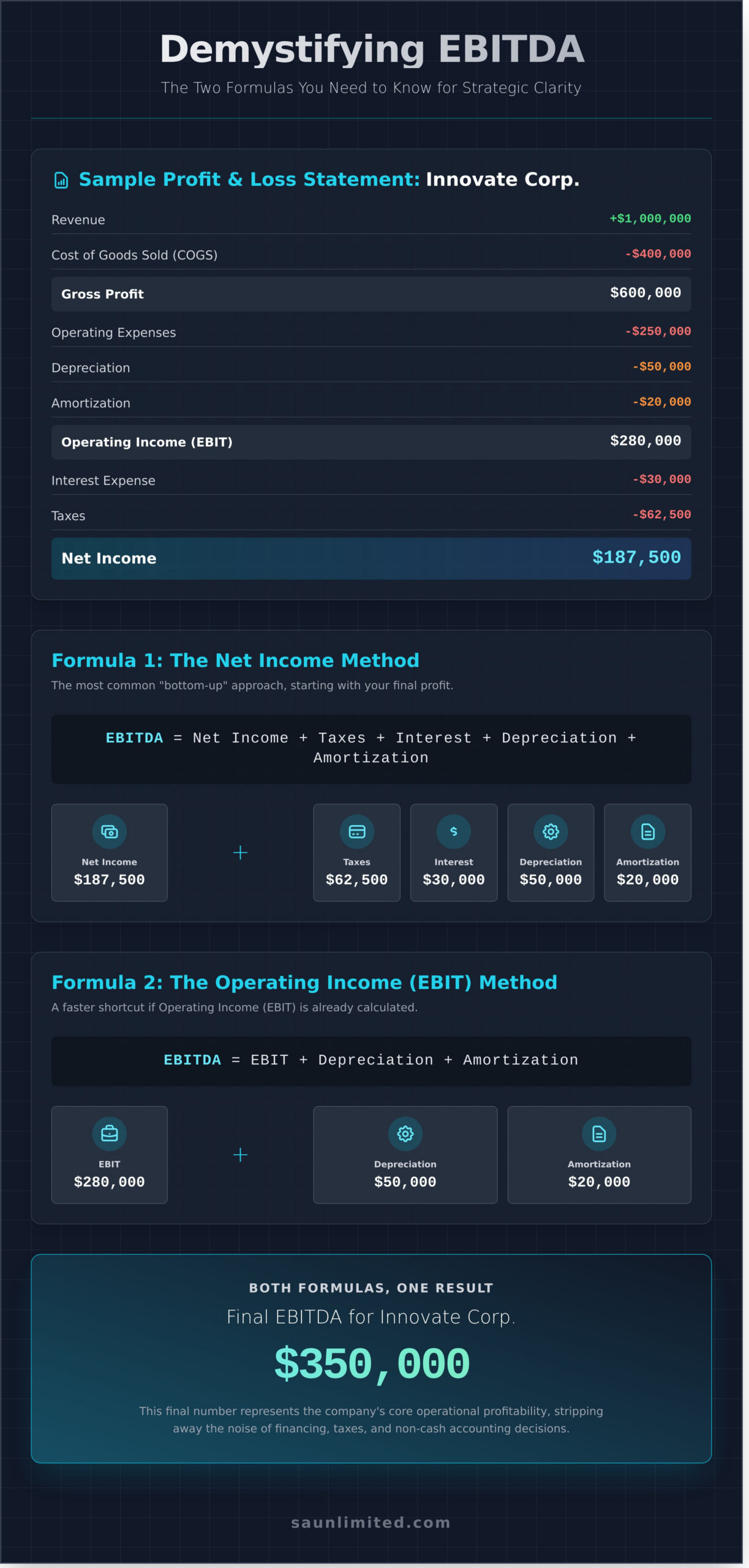
To unlock strategic clarity, you must first know your numbers. Fortunately, calculating this core metric isn’t complex. While the concept is straightforward, mastering the nuances of calculating EBITDA is crucial for accurate financial analysis. There are two primary, reliable formulas to get you to the same powerful number. Let’s walk through them using a simplified Profit & Loss (P&L) statement for a hypothetical company, Innovate Corp.
Innovate Corp. – Sample Profit & Loss Statement
- Revenue: $1,000,000
- Cost of Goods Sold (COGS): -$400,000
- Gross Profit: $600,000
- Operating Expenses: -$250,000
- Depreciation: -$50,000
- Amortization: -$20,000
- Operating Income (EBIT): $280,000
- Interest Expense: -$30,000
- Taxes: -$62,500
- Net Income: $187,500
Formula 1: The Net Income Method
This is the most common, “bottom-up” approach, starting with your company’s net income-the bottom line on your P&L statement. You simply add back the non-operating and non-cash expenses that were removed to arrive at net income.
Formula: EBITDA = Net Income + Taxes + Interest + Depreciation + Amortization
Using Innovate Corp’s numbers:
- Start with Net Income: $187,500
- Add back Taxes: + $62,500
- Add back Interest: + $30,000
- Add back Depreciation: + $50,000
- Add back Amortization: + $20,000
- Final EBITDA: $350,000
Formula 2: The Operating Income (EBIT) Method
This method is a faster shortcut if your P&L already provides a subtotal for Operating Income, also known as EBIT (Earnings Before Interest and Taxes). This figure represents your profit from core business operations before deducting interest and taxes.
Formula: EBITDA = EBIT + Depreciation + Amortization
Again, using Innovate Corp’s P&L:
- Start with Operating Income (EBIT): $280,000
- Add back Depreciation: + $50,000
- Add back Amortization: + $20,000
- Final EBITDA: $350,000
Both formulas deliver the exact same result. The method you choose simply depends on which figures are most readily available on your financial statements. The result is a clear, actionable number representing your company’s core operational profitability.
Why EBITDA Matters: Your Strategic Tool for Growth and Valuation
For a decisive leader, financial metrics are not just numbers on a spreadsheet; they are instruments of strategic power. EBITDA is one of the most potent. It moves beyond standard net income to give you a clean, unvarnished view of your company’s core operational profitability. While it is crucial to understand the dangers and criticisms of EBITDA as a non-GAAP measure, when wielded correctly, it unlocks clarity and empowers you to make bold moves that drive real value. This is how you transform a simple calculation into a cornerstone of your growth strategy.
Benchmarking Core Performance
How does your operational engine stack up? EBITDA provides the answer by stripping away the noise of financing decisions and tax strategies. This creates a level playing field for comparison, giving you a clear-eyed view of your competitive position and internal progress.
- Industry Comparison: Directly measure your operational efficiency against competitors, regardless of their capital structure or tax jurisdiction.
- Historical Tracking: Analyze your own performance trends over time to see if core profitability is truly improving.
- Early Warning System: Identify emerging issues in operational health before they impact your bottom line.
Driving Business Valuation
In the high-stakes world of mergers, acquisitions, and capital raises, your company’s valuation is paramount. Investors, particularly in private equity, often rely on the Enterprise Value to EBITDA (EV/EBITDA) multiple as a primary valuation method. The logic is simple and powerful: a higher, more consistent ebitda directly translates to a higher sale price. By focusing on and improving this metric, you are actively building a more valuable, more attractive asset for potential investors and acquirers.
Assessing Debt Capacity and Covenants
Growth often requires capital, and capital often means debt. Lenders use EBITDA as a key proxy for your ability to generate the cash needed to service debt obligations. They will scrutinize your Debt/EBITDA ratio to determine how much they are willing to lend and under what terms. Maintaining a healthy ratio is not just about securing new financing; it’s critical for staying in compliance with existing loan covenants. Proactively managing this metric ensures you maintain financial flexibility and a strong relationship with your banking partners.
The Dangers of EBITDA: Common Criticisms and Pitfalls to Avoid
To make bold, strategic moves, you must see the full picture. While EBITDA is a powerful tool for analyzing core operational performance, relying on it exclusively is a critical leadership error. True financial clarity comes from understanding a metric’s limitations. Even legendary investors like Warren Buffett have famously warned against its overuse, questioning managers who act as if capital expenditures are paid for by a “tooth fairy.”
An intelligent leader uses ebitda as a supplement to, not a replacement for, foundational GAAP metrics. To protect your business and unlock sustainable growth, you must be aware of these common pitfalls.
It Overstates Cash Flow
The most significant flaw is that this metric ignores changes in working capital. Profit on paper does not equal cash in the bank. Imagine a rapidly growing company that sells millions in products on 120-day payment terms. Its EBITDA might look spectacular, but with all its cash tied up in accounts receivable, it could struggle to make payroll. Always remember: a business can show a high EBITDA and still be cash-flow negative.
It Ignores Capital Expenditures (CapEx)
Depreciation may be a non-cash expense, but the assets it represents-the machinery, technology, and facilities-require very real cash to maintain and replace. For capital-intensive industries like manufacturing, tech, or logistics, EBITDA can paint a deceptively rosy picture of profitability by ignoring the massive, ongoing investment needed to simply stay in business. For a more accurate measure of cash generation, leaders should turn to Free Cash Flow (Operating Cash Flow minus CapEx).
It’s a Non-GAAP Metric
EBITDA is not standardized under Generally Accepted Accounting Principles (GAAP). This means companies can define “Adjusted EBITDA” however they see fit, often adding back expenses like stock-based compensation or restructuring costs. This makes direct comparisons between companies treacherous. Your most powerful move is to demand transparency: always ask for the reconciliation from Net Income to the adjusted figure to see exactly what has been excluded.
Need clarity on your numbers? We help leaders find the real story.
Putting EBITDA to Work: From Metric to Momentum
You’ve mastered the definition and the calculation. Now, it’s time to transform that knowledge into strategic action and sustainable growth. As a CEO, your role isn’t just to understand metrics but to wield them as tools to shape the future. EBITDA is one of the most powerful instruments in your arsenal, offering an unfiltered view of your company’s core operational profitability by stripping away the noise of financing and accounting decisions. But like any data point, its true value is revealed only in context and when used to drive decisive, forward-looking strategy. It’s not just a number; it’s a catalyst.
Your EBITDA Action Plan
Don’t let this knowledge sit on a spreadsheet. Put it to work immediately with this focused, three-step plan to turn insight into impact:
- Establish Your Baseline: Calculate your Trailing Twelve Months (TTM) ebitda. This gives you a clear, current picture of performance by smoothing out seasonality and one-time anomalies, providing a stable foundation for strategic analysis.
- Benchmark for Context: A number without context is meaningless. Compare your TTM performance against industry benchmarks to understand if you’re leading the pack or falling behind. Sources like industry associations, private data providers, and the financial reports of public competitors can provide this critical perspective.
- Analyze the Drivers: Convene your leadership team to ask the most important question: Why? Is your margin driven by strong pricing power, superior supply chain efficiency, or lean operational costs? Digging into these drivers is where real strategy begins.
Beyond the Calculation: The SA Unlimited Advantage
Knowing your number is a start. Knowing how to strategically and systematically improve it is where true momentum is built. This is the gap where ambitious leaders get stuck-and it’s precisely where SA Unlimited delivers transformative value. We don’t just report the numbers; we partner with you to rewrite them.
Our seasoned fractional CFOs do more than just analyze your financials. They embed themselves in your business to dissect the drivers behind your performance, identifying hidden opportunities to boost operational profitability and create clear pathways for sustainable growth. We translate complex metrics like EBITDA into an actionable roadmap-a step-by-step plan for scaling your business with confidence and clarity. We don’t see obstacles; we solve for yes, unlocking your company’s true potential.
Let’s solve for your company’s true potential. Connect with us today.
From EBITDA Insight to Unstoppable Momentum
Understanding EBITDA is a critical first step for any forward-thinking leader. You now grasp how it provides a powerful lens on your company’s core operational profitability and its crucial role in valuation and strategic conversations. More importantly, you recognize its potential pitfalls, ensuring you can wield this metric with the wisdom and caution it demands, avoiding the common traps that can derail growth.
But knowledge is only potential energy. The real challenge is converting that financial clarity into a decisive action plan. This is where we excel. As your dedicated partner with decades of experience driving profitable growth, SA Unlimited has a core philosophy: We ‘Solve for Yes.’ We leverage our deep expertise in strategic financial planning to transform your understanding of ebitda from a static number into a dynamic engine for your business.
Don’t let your strategic advantage remain on paper. It’s time to build your legacy. Unlock your business potential. Let’s connect and build your strategic financial plan.
EBITDA: Your Questions, Answered
What is a good EBITDA margin?
A “good” EBITDA margin is entirely dependent on your industry. A capital-intensive sector like manufacturing might see 10-15% as strong, while a high-growth SaaS company could target 30% or more. The goal isn’t a universal number but strategic benchmarking. We empower leaders to measure their margin against direct competitors and industry averages to identify opportunities for profitable growth and operational excellence. Know your numbers, then outperform them.
Can EBITDA be negative, and what does it signify?
Yes, and it is a critical red flag. A negative EBITDA signals a fundamental flaw in a company’s core operational profitability. It means that before accounting for interest, taxes, depreciation, and amortization, your business isn’t generating enough revenue to cover its essential operating expenses. This situation demands immediate strategic intervention to restructure operations, aggressively manage costs, or pivot the business model to create a clear pathway back to profitability.
Why do investors and private equity firms focus so heavily on EBITDA?
Investors and PE firms use this metric as a powerful proxy for a company’s cash-generating potential and operational efficiency. By removing non-cash expenses (D&A) and the effects of financing and tax structures (I&T), it provides a clearer, more comparable view of core business performance. This clarity is crucial for valuation, especially in leveraged buyouts, where the ability to service debt from operational cash flow is the foundation of the entire deal structure.
What is ‘Adjusted EBITDA’ and how is it different?
Adjusted EBITDA is a strategic refinement of the standard calculation. It further normalizes earnings by removing non-recurring, irregular, or one-time expenses like restructuring costs, legal settlements, or acquisition fees. The objective is to present a truer picture of a company’s sustainable, ongoing operational performance. While a powerful tool, this metric requires scrutiny, as companies can be overly aggressive in their “adjustments” to paint a rosier picture than reality.
Is EBITDA the same thing as operating cash flow?
No, they are fundamentally different metrics telling different stories. While both measure performance, EBITDA ignores crucial changes in working capital (like accounts receivable and inventory) and taxes paid in cash. Operating cash flow captures these real cash movements, making it a far more accurate measure of the actual cash a company generates. Confusing the two can lead to flawed strategic decisions about liquidity and capital allocation. Gaining clarity here is non-negotiable.
What is the difference between EBIT, EBT, and EBITDA?
Think of them as progressive layers of profitability, each providing a different strategic lens. EBT (Earnings Before Tax) is simply your profit before tax obligations. EBIT (Earnings Before Interest and Tax) goes a step further, removing both to isolate operating profit. Finally, the EBITDA calculation removes non-cash depreciation and amortization from EBIT to offer the purest view of core operational performance, independent of financing, accounting, and tax strategies. Each serves a distinct analytical purpose.