

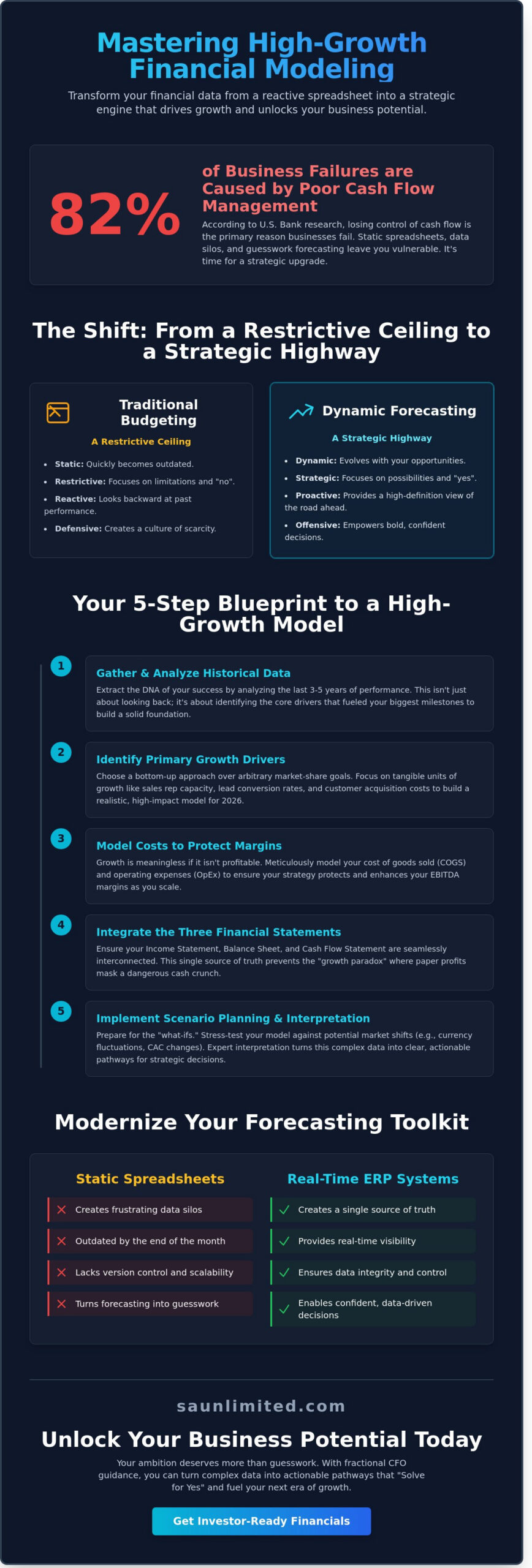
According to research from U.S. Bank, 82% of businesses fail because they lose control of their cash flow. You’ve likely felt that tension when your static spreadsheets are already outdated by the time you’ve finished the monthly close. It’s exhausting to manage data silos between accounting and operations that turn building a financial forecast model into a frustrating exercise in guesswork. At SA Unlimited, we know that your ambition deserves more than a reactive spreadsheet; it requires a strategic engine that drives growth.
Mastering the architecture of high-growth financial modeling is the definitive way to gain the clarity and confidence needed to unlock your business potential in 2026. This guide provides the blueprint you need to transform your financial data into a dynamic tool for strategic decision-making. We’ll show you how to create investor-ready financials and clear pathways to profitability. It’s time to stop guessing and start leading with a professional framework designed to solve for yes.
Key Takeaways
- Shift your mindset from restrictive budgeting to dynamic forecasting to gain the clarity and confidence needed for bold, strategic moves.
- Master the architecture of building a financial forecast model by identifying your primary growth units and modeling costs to protect your EBITDA margins.
- Evaluate the transition from manual spreadsheets to real-time ERP systems like Sage Intacct to eliminate data silos and ensure version control as you scale.
- Implement a structured five-step process to transform raw historical data into a high-growth model ready for internal planning or capital raising.
- Discover how expert interpretation from a fractional CFO turns complex data into actionable pathways that “Solve for Yes” and unlock your business potential.
What is a Financial Forecast Model and Why Does Your Strategy Depend on It?
Know your numbers. It’s the foundational requirement for any leader aiming to dominate their industry. Building a financial forecast model isn’t a passive administrative task; it’s the creation of a strategic blueprint that defines your trajectory for the next 36 months. At SA Unlimited, we view this model as a dynamic tool. It projects future financial outcomes by synthesizing your historical data with aggressive, yet calculated, strategic assumptions. This isn’t about looking in the rearview mirror. It’s about high-definition visibility into the road ahead.
The distinction between traditional budgeting and modern forecasting is the difference between a ceiling and a highway. Budgets are often restrictive, static, and outdated by the second quarter. They focus on limitations. Conversely, a What is a Financial Forecast focuses on possibilities. It allows you to transform your world by shifting from a defensive posture to an offensive strategy. In the 2026 market environment, where volatility is the only constant, static models fail because they can’t breathe with the market. You need a model that evolves as quickly as your opportunities do.
The Three Pillars of a Strategic Model
- Historical context: We don’t just look at past performance; we extract the DNA of your success. By analyzing metrics from the last 3 to 5 years, we identify the core drivers that fueled your $1B+ milestones.
- Forward-looking assumptions: This is where we map your growth trajectory. We lean into cutting-edge technology and market trends to set realistic, high-impact targets for 2026 and beyond.
- Scenario planning: Scaling requires preparing for the “what-ifs.” We build models that test your resilience against 15% currency fluctuations or 20% shifts in customer acquisition costs, ensuring you’re never caught off guard.
Forecasting as a Decision-Making Catalyst
At SA Unlimited, “We Solve for Yes” is our core DNA. When you’re faced with a complex investment, like a $5 million expansion into a new territory, you don’t need a “maybe.” You need the clarity to make bold moves. A robust model acts as a proactive strategic advisory tool. It moves your finance department away from reactive accounting and into a partnership role. This shift empowers you to unlock your business potential with unwavering commitment.
Real-time visibility is the ultimate fuel for CEO confidence. When you can see the impact of a decision on your cash flow 18 months before it happens, your stress levels drop and your execution speed doubles. You stop guessing and start leading. By building a financial forecast model that serves as a living document, you ensure your team is always aligned with the most profitable path forward. We don’t just provide data; we provide the pathways to your next era of growth.
The Architecture of Building a Financial Forecast Model
Building a financial forecast model is the strategic nervous system of your 2026 expansion. It transforms abstract goals into a concrete roadmap for success. Mastering the art of building a financial forecast model allows you to anticipate obstacles before they appear, ensuring your business remains resilient in a shifting economy. This process begins by identifying the specific units of growth that will power your journey over the next 24 months.
True financial clarity requires the seamless integration of the Three Statements. Your Income Statement, Balance Sheet, and Cash Flow Statement must be interconnected; a change in sales should automatically update your accounts receivable and cash reserves. This level of connectivity ensures that your growth projections are grounded in actual liquidity. Without this integration, you risk a “growth paradox” where high paper profits lead to a cash crunch that stalls your operations. We solve for yes by creating pathways that link these statements into a single, cohesive source of truth.
Forecasting Revenue with Precision
A revenue driver is the primary lever that dictates top-line growth. Identifying these drivers requires a strategic choice between bottom-up and top-down modeling. For most businesses eyeing 2026 goals, a bottom-up approach is superior because it starts with individual units, such as sales rep capacity or lead conversion rates, rather than arbitrary market share percentages. By utilizing sophisticated financial forecasting methods, you can account for 15% to 20% swings in seasonal demand or unexpected market volatility.
- Bottom-up Modeling: Builds revenue from the ground up based on tangible operational capacity.
- Top-down Modeling: Estimates revenue based on total addressable market size and historical trends.
- Volatility Buffers: Includes “stress-test” scenarios to protect against 2026 economic shifts.
Expense Modeling and Margin Protection
Protecting your EBITDA margins is non-negotiable when scaling. You must distinguish between fixed costs that stay flat and variable costs that rise with every new customer acquisition. If your infrastructure costs grow faster than your revenue, your break-even point will constantly drift out of reach. In high-growth phases, headcount often represents 65% of total operating expenses, making it the most critical variable to model with precision. See our guide on EBITDA explained for deeper margin analysis and strategies to keep your profitability intact as you add talent and technology.
Granularity is a double-edged sword. You should go deep on high-impact areas like payroll and marketing spend, but stay high-level on minor administrative costs to maintain speed. This balance allows you to make bold moves without getting lost in the weeds. If you are ready to unlock your business potential, connect with our team to refine your 2026 strategy and build a model that wins.
Spreadsheets vs. ERP: Modernizing Your Forecasting Approach
Static spreadsheets are the silent killers of scale. While Excel remains a staple for early-stage ventures, it becomes a strategic liability as your organization matures toward 2026. Building a financial forecast model on legacy tools invites version control chaos and data silos that stifle growth. Research from the University of Hawaii indicates that 88% of spreadsheets contain significant errors; in a multi-million dollar forecast, a single broken cell can lead to catastrophic capital allocation decisions.
Modernizing your approach means moving beyond the “Complexity Wall.” This is the point where manual data entry consumes 70% of your finance team’s time, leaving only 30% for high-level strategy. Sage Intacct transforms this dynamic by serving as a real-time business intelligence engine. By automating data feeds from your bank, payroll, and inventory systems, you ensure your model remains “current” without a single manual keystroke. You shift from being a historian of past performance to an architect of future revenue.
Why Mid-Cap Companies Outgrow Spreadsheets
As you scale past the $10M revenue mark, the risk of “human error” in financial planning increases exponentially. Manual models lack the audit trails and permissions needed for institutional-grade reporting. To maintain clarity and confidence, proactive leaders are turning to Sage Intacct consulting to bridge the gap between messy data and actionable insights. This transition reduces the time spent on monthly closes by up to 40%, allowing your team to focus on profitable expansion rather than fixing broken formulas.
The Power of Integrated Financial Systems
True strategic power lies in connectivity. When you link your CRM, such as Salesforce, directly to your ERP, your revenue projections update in real time based on your actual sales pipeline. This creates a single source of truth that speaks the language of the boardroom. By 2026, leveraging AI-driven insights within these integrated systems will be the standard for predictive accuracy. These tools analyze historical patterns to identify risks before they manifest on the balance sheet. We solve for yes by providing the cutting-edge technology required to unlock your business potential and make bold moves with unwavering commitment.
- Eliminate Data Silos: Centralize information to ensure every department works from the same numbers.
- Real-Time Updates: Building a financial forecast model that refreshes automatically saves hundreds of labor hours annually.
- Enhanced Accuracy: Remove the 10% to 15% variance typically caused by manual entry lag.
- Strategic Alignment: Shift your CFO’s focus from data validation to driving $1B+ success metrics.
The leap from data entry to strategic analysis isn’t just a technical upgrade; it’s a mindset shift. You deserve a system that works as hard as you do. Stop fighting with tabs and start leading with data.
5 Steps to Constructing Your First High-Growth Model
Success isn’t an accident. It’s the result of a deliberate strategy. When building a financial forecast model, you’re creating a roadmap that guides every hire, every marketing dollar, and every expansion move. At SA Unlimited, we solve for yes by turning raw numbers into actionable intelligence that empowers you to make bold moves with unwavering confidence.
Step 1 & 2: Setting the Foundation
First, define your “why.” A model built for a Series B capital raise in October 2025 looks different than one used for internal 2026 budget planning. Aligning your model with your fractional CFO services strategy ensures your financial vision matches your operational reality. The process of building a financial forecast model requires more than just Excel skills; it requires a deep understanding of your unit economics.
You must identify the 3 to 5 KPIs that drive 80% of your results. For SaaS companies, this often means focusing on Net Revenue Retention and Customer Acquisition Cost (CAC). For manufacturing firms, it’s about gross margin per unit and inventory turnover. Identifying these levers allows you to allocate capital with precision. For instance, if you know that every $1,000 in ad spend generates 50 qualified leads, your model becomes a predictable engine for scaling. We help you isolate these variables so your 2026 projections aren’t just guesses; they’re mathematical certainties.
Clean your historical data for at least the last 24 months. If your starting point is messy, your forecast will be fiction. We eliminate the “garbage in, garbage out” risk by auditing your chart of accounts before the first formula is written. This ensures your baseline is grounded in verified, historical truth.
Step 3, 4 & 5: Execution and Iteration
Build your base case first. This reflects the most likely outcome based on current market trends and your historical 12% to 15% growth rates. Once the foundation is firm, move to scenario modeling. We believe in preparing for every outcome. Consider these scenarios:
- The Downside: What happens if your top customer, representing 22% of annual revenue, departs?
- The Upside: What if a new market opens in Q3 and triples your lead volume?
- The Pivot: How does a 10% increase in labor costs affect your 2026 bottom line?
Stress-testing these variables gives you the clarity to lead through volatility. Finally, establish a monthly review cadence. A static forecast is a dead forecast. High-growth companies don’t just look at the bank balance; they look at the delta between their forecast and their actuals. If your December 2025 revenue was 5% lower than projected, you need to know why immediately. By implementing a rolling 12-month forecast, you update assumptions based on real-time performance every 30 days. This practice keeps your business agile and ready to pivot when opportunities emerge.
Don’t leave your growth to chance. Connect with our team to build a model that unlocks your business potential and secures your financial future.
Unlock Your Business Potential with Fractional CFO Guidance
A static spreadsheet won’t scale your company to the heights you envision for 2026. While building a financial forecast model is a critical first step, the true value lies in the expert interpretation of that data. A model acts as a map, but a Fractional CFO is the seasoned navigator who knows how to avoid pitfalls and capitalize on shortcuts. We transform your finance department from a reactive cost center into a proactive growth driver that anticipates market shifts before they happen. Our approach ensures your numbers aren’t just figures on a page; they’re the foundation for your next big win.
At SA Unlimited, we don’t just track your spend. We “Solve for Yes.” This means we look at your financial data to find the pathways that others miss. If your goal is to double your headcount or acquire a competitor, we don’t just look at the cost. We build the strategy to make it happen profitably. Statistics show that 82% of small businesses fail due to cash flow mismanagement. We ensure you’re part of the successful 18% by providing the clarity you need to move fast and with total confidence.
Beyond the Numbers: Strategic Interpretation
Strategic interpretation means looking past the rows and columns to find the “Yes” in every scenario. Your Fractional CFO uses the model to advise you on bold moves, such as a 25% increase in marketing spend or a pivot in your product roadmap. This level of foresight is essential for investor readiness. When you enter a room for due diligence, you need more than just numbers; you need a narrative backed by 100% accurate data. You can learn more about CFO consulting to see how this strategic blueprint works for long-term growth.
Our team prepares you for the high-stakes environment of capital raising by ensuring your valuation is supported by logic and historical performance. We’ve seen how a well-interpreted model can be the difference between a mediocre seed round and a massive Series A. We provide the valuation support and strategic partnership required to stand out in a crowded market.
The SA Unlimited Advantage
At SA Unlimited, we bring more than just advice to the table. We bring a legacy of results. Our team applies decades of experience and over $1B in success metrics directly to your business. When we’re building a financial forecast model for your organization, we’re using the same high-level strategies used by global enterprises. We roll up our sleeves to ensure your business remains profitable, resilient, and ready for whatever 2026 brings.
- Capital Raising Support: We identify the right valuation to protect your equity.
- Operational Efficiency: Our insights often identify waste, allowing for a 10% to 15% improvement in bottom-line margins.
- Unwavering Commitment: We act as your internal partner, fully invested in your profitable growth.
Don’t let your data sit idle. Use it to fuel your expansion and secure your legacy. Unlock your business potential and connect with our team today.
Master Your Growth Trajectory for 2026
Success in 2026 demands more than just a vague plan. It requires a rigorous architecture that turns data into a competitive advantage. Transitioning from manual spreadsheets to integrated ERP systems ensures your data remains accurate and actionable. By building a financial forecast model that prioritizes scalability, you move from reactive guessing to proactive leadership. You gain the clarity needed to make bold moves with absolute confidence.
At SA Unlimited, we bring decades of high level strategic expertise to your team. We’ve driven over $1B in success metrics for our partners and stand as specialized Sage Intacct implementation partners. We don’t just provide reports; we create pathways to profitability. Our mission is to unlock your business potential by rolling up our sleeves and solving the complex challenges that hold you back. We’re a seasoned, strategic partner invested in your long term wins.
It’s time to stop wondering what’s possible and start executing with precision. Ready to Solve for Yes? Let’s connect and build your strategic blueprint. Your next billion dollar milestone starts with the right numbers today.
Frequently Asked Questions
What is the difference between a financial forecast and a budget?
A budget is a static plan for a fiscal year while a forecast is a dynamic projection of where the business is actually heading. Think of the budget as your 12 month roadmap and the forecast as your real time GPS. While 82 percent of businesses fail due to cash flow issues according to a 2021 U.S. Bank study, a forecast helps you adjust to market shifts that a fixed budget simply cannot see.
How far in advance should a financial forecast model project?
You should project your financial model three to five years into the future to capture long term growth trends. A three year model provides the granular detail needed for operational scaling, while a five year model is standard for Series B or C funding rounds. Building a financial forecast model with this 36 to 60 month horizon allows you to visualize the ROI of capital expenditures and strategic hires before you commit the capital.
What are the most common mistakes when building a financial model?
The most frequent mistake is overestimating revenue growth by ignoring historical customer acquisition costs (CAC). Many founders project 100 percent year over year growth without accounting for the 5 to 10 percent churn rate typical in SaaS or retail sectors. Other errors include failing to link the three core financial statements or using hard coded numbers instead of dynamic formulas, which makes the model brittle and prone to manual errors.
Can I build a financial forecast model in Excel, or do I need software?
You can start with Excel, but scaling companies often require specialized FP&A software to maintain accuracy. Excel remains the industry standard for custom logic and is used by 90 percent of finance professionals for its flexibility. However, as you scale past 50 employees, software solutions like Adaptive Planning or Mosaic reduce manual data entry errors by 30 percent and provide a single source of truth for your entire leadership team.
How often should I update my financial forecast assumptions?
Update your assumptions at least once a month to ensure your model reflects current market reality. Monthly reviews allow you to compare your actual performance against your 2026 projections, identifying variances early. If you wait 90 days to adjust for a shift in supplier costs or lead conversion rates, you risk making strategic decisions based on outdated data that no longer serves your growth goals.
How do investors use my financial forecast during due diligence?
Investors use your model to test the stress points of your business and verify your path to profitability. During a 2023 venture capital survey, 75 percent of investors cited financial clarity as a top factor in closing a deal. They’ll run sensitivity analyses on your building a financial forecast model to see how a 20 percent drop in sales or a 15 percent increase in operating costs impacts your runway and valuation.
What is a ‘rolling forecast’ and why is it better for growth?
A rolling forecast is a management tool that adds a new month to the end of the projection as each current month closes. Unlike a static annual budget, this method ensures you always have a 12 to 18 month view of the future. It’s better for growth because it eliminates the fiscal year end cliff and allows for continuous resource reallocation based on the most recent 30 days of performance data.
Do I need a full-time CFO to maintain a financial forecast model?
You don’t need a full-time CFO to maintain a sophisticated model, especially when fractional experts can provide the same strategic oversight. Many startups with 10 to 50 employees opt for a fractional CFO to save 60 percent on executive compensation while still gaining billion dollar insights. This approach gives you the high level clarity needed to solve for yes without the overhead of a permanent C-suite salary.