

According to research from CB Insights, 38% of startups fail simply because they run out of cash or fail to raise new capital. It’s a sobering reality that transforms the “Valley of Death” from a metaphor into a looming threat. You understand that every dollar spent must be a strategic investment, yet the pressure of high headcount costs and aggressive growth targets often makes managing burn rate startup operations feel like a defensive struggle rather than a calculated offensive. At SA Unlimited, we believe your financial metrics should empower you to make bold moves, not hold you back.
We solve for yes by providing the strategic clarity you need to master your numbers and secure your path to the next funding round. This guide will help you transform your financial mindset and unlock your business potential. You’ll learn exactly how to extend your runway without sacrificing your growth trajectory and how to build investor-ready reports that command respect. We’re going to dive into the specific levers you can pull to gain total control over your capital, ensuring you move forward with the unwavering confidence of a seasoned partner who knows exactly where every cent is going.
Key Takeaways
- Define the “Gold Standard” of runway and why maintaining 12-18 months of liquidity is the non-negotiable benchmark for strategic founders in 2026.
- Gain total clarity on your financial health by mastering the calculation of net versus gross figures-a fundamental skill for managing burn rate startup sustainability.
- Learn to identify “high-conviction” spending, shifting your perspective from viewing capital as a constraint to using it as a strategic tool that solves for “yes.”
- Discover five tactical steps to immediately extend your runway, from renegotiating vendor contracts to implementing rigorous spend-approval workflows.
- Understand the fractional CFO advantage and how professional advisory turns raw metrics into the investor-ready narratives needed to secure your next round.
What is Startup Burn Rate and Why Does It Matter in 2026?
Your burn rate represents the velocity at which your company consumes its capital reserves before reaching positive cash flow. In the fast-moving 2026 economy, managing burn rate startup success depends on precision, not guesswork. When founders ask What is burn rate? they are essentially measuring their survival clock. It is the raw monthly net loss that determines how much time you have to prove your business model before the lights go out.
Think of runway as your most critical strategic asset. While the industry gold standard remains 12 to 18 months of cash on hand, this period isn’t just about survival; it’s about optionality. Founders with a healthy runway can negotiate from a position of strength. Those with only three months left are often forced into predatory terms or desperate fire sales. Data from CB Insights reveals that 29% of startups fail because they run out of cash. This collapse rarely happens because of a bad product. It happens because leadership lost sight of the math.
The Psychological Impact of Burn on Founders
Watching your bank account hit zero creates a specific type of cognitive load that can paralyze a leadership team. High burn rates trigger a scarcity mindset, often leading to frantic, short-term decisions like cutting essential talent or over-discounting products to grab quick revenue. This pressure clouds your vision and prevents you from making the bold moves necessary to scale. Burn rate is a metric of sustainability, not just spending. At SA Unlimited, we believe that when you Know Your Numbers, you eliminate the fear that prevents strategic breakthroughs.
Burn Rate vs. Growth: The Delicate Balance
The era of growth at all costs is a relic of the past. The 2026 venture landscape demands “efficient growth,” where every dollar spent must yield a clear return. Scaling a company that loses money on every transaction is no longer a viable path to a billion-dollar valuation. Managing burn rate startup operations requires a meticulous cash flow statement to track every dollar entering and exiting the business.
- Efficient Growth: Prioritizing unit economics over raw user acquisition.
- Strategic Clarity: Using cash reserves to build long-term moats, not just temporary hype.
- Financial Discipline: Reviewing burn metrics weekly to catch bloat before it becomes fatal.
At SA Unlimited, We Solve for Yes by helping you find the equilibrium between aggressive expansion and fiscal responsibility. We roll up our sleeves to ensure your financial foundation is strong enough to support your highest ambitions. It’s time to Unlock Your Business Potential by mastering the flow of your capital.
Gross Burn vs. Net Burn: Calculating the Numbers That Matter
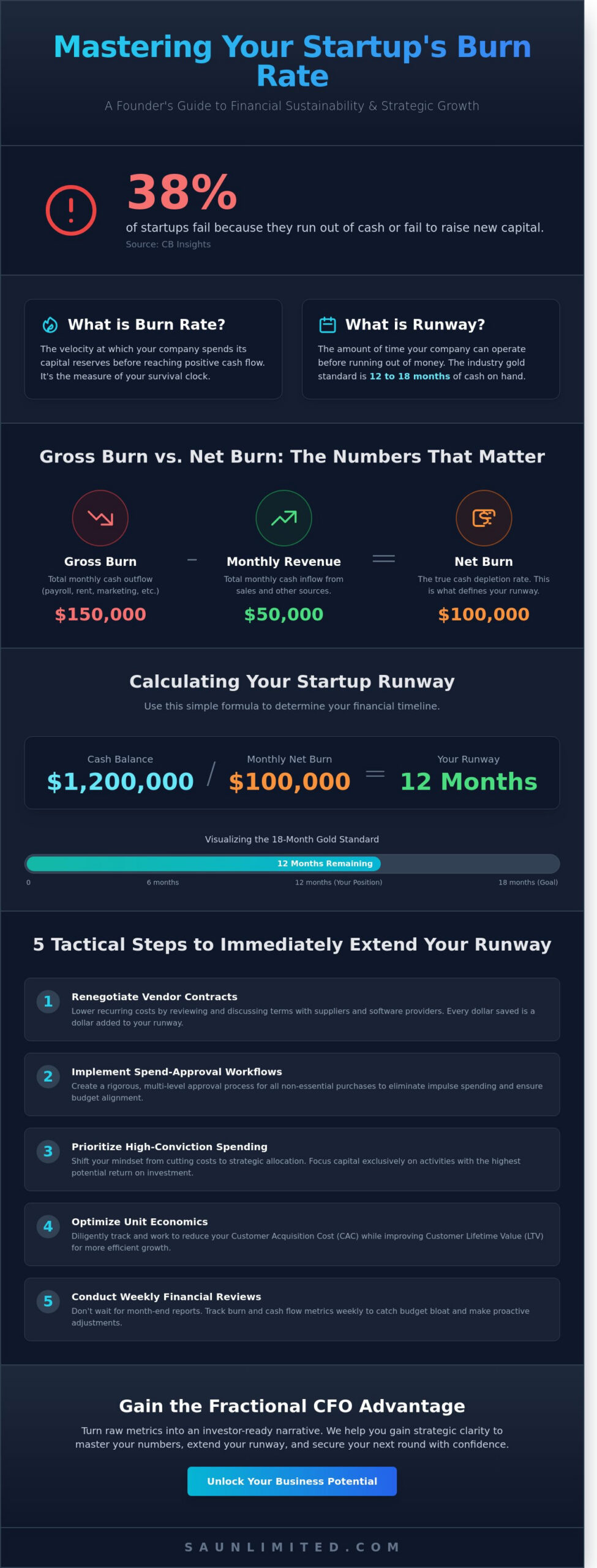
Precision in finance isn’t a luxury; it’s the foundation of every scalable enterprise. To master managing burn rate startup operations, you must distinguish between your gross and net figures. Gross burn represents the total monthly cash outflow from your accounts. It includes everything from payroll and rent to software subscriptions and marketing spend. If your startup spends $150,000 every month on operations, your gross burn is $150,000. It’s a measure of your total operational footprint.
Net burn is the metric that truly defines your survival. This is your gross burn minus your monthly revenue. If that same startup generates $50,000 in monthly revenue, the net burn is $100,000. This “real” loss represents the rate at which you’re depleting your capital reserves. For venture-backed companies, net burn is the primary metric because it dictates your runway. Calculate your runway by dividing your current cash balance by your average monthly net burn. If you have $1.2M in the bank and a $100,000 net burn, you have exactly 12 months to reach profitability or secure your next round of funding. This HBR case study on cutting burn rate highlights how quickly these timelines can shift without proactive management.
Unit Economics: The Hidden Driver of Burn
Your burn rate isn’t just about overhead; it’s fueled by your unit economics. Customer Acquisition Cost (CAC) is a massive driver of monthly spend. If you spend $500 to acquire a customer with a Lifetime Value (LTV) of only $400, you’re literally paying to lose money. A healthy LTV/CAC ratio, typically 3:1 or higher in SaaS, acts as a predictor of future burn reduction. Scaling a business with poor unit economics doesn’t lead to growth; it accelerates failure by compounding losses with every new user. We help founders unlock your business potential by identifying these leaks before they drain your reserves.
Common Calculation Pitfalls to Avoid
Accuracy requires looking past surface-level data. Many founders mistake “bookings” for “cash.” If you sign a $120,000 annual contract but the client pays in monthly installments, you only have $10,000 in the bank this month, not $120,000. Relying on accrual accounting instead of cash accounting is a dangerous path when managing burn rate startup cash flow.
- One-time expenses: Don’t forget to amortize annual software renewals, tax preparation fees, or insurance premiums. These “surprises” can spike your burn by 20% in a single month.
- Timing gaps: Account for the 30 to 60 day delay between making a sale and receiving the actual cash.
Accounting profit represents a theoretical calculation of performance, whereas cash burn measures the literal depletion of your bank balance. Understanding this distinction allows you to make bold moves with confidence, ensuring your strategic vision is always backed by hard currency.
Strategic Burn Management: Beyond the Spreadsheet
At SA Unlimited, “We Solve for Yes” isn’t just a catchy phrase; it’s our core operating philosophy. Effective strategies for managing a startup’s burn rate treat capital as a high-performance tool rather than a restrictive constraint. Instead of looking for reasons to say no, elite founders look for ways to make the right investments happen. This mindset shifts the focus from survival to strategic dominance. You aren’t just spending money; you’re buying speed, market share, and data.
Leadership teams must distinguish between high-conviction and low-conviction spending. High-conviction costs are those that directly accelerate your primary value proposition, such as core engineering or proven sales channels. Low-conviction costs are the “nice-to-haves” that often creep into a budget during periods of easy funding. Building a proactive spend culture means every department head acts like an owner. They should understand how their specific budget impacts EBITDA and long-term valuation. When your team knows the numbers, they make better decisions without constant oversight.
Variable vs. Fixed Costs: Creating Flexibility
Rigidity is the enemy of the modern startup. In 2026, the most resilient companies favor variable costs over fixed ones. By utilizing contractors and scalable cloud tools, you can “flex” your budget instantly. If market conditions shift, you can reduce these expenses by 20% or 30% within a single billing cycle. The biggest threat to success in managing a startup’s burn rate is headcount bloat. Payroll typically accounts for 70% to 80% of total burn. Once you hire a full-time employee, that cost is locked in. Use specialized talent for project-based needs to keep your core team lean and your runway long.
The Cost of Growth: Is Your Burn Working for You?
Not all burn is created equal. Good burn fuels R&D and customer acquisition with a clear path to return. Bad burn disappears into excessive overhead, ego-driven marketing campaigns, or over-engineered office spaces that sit empty. You need to set hard benchmarks for ROI on every dollar that leaves your accounts. Since the venture capital pullback in late 2022, investors now demand unit economics that make sense from day one. Many founders use CFO consulting to validate their growth assumptions and ensure their burn is actually building equity. If you can’t trace a dollar of burn to a specific growth metric, it’s time to cut it.
5 Tactical Steps to Extend Your Startup Runway
Managing burn rate startup success requires more than defensive accounting; it demands a proactive, aggressive approach to capital preservation. You’ve built momentum. Now you must protect it. Transitioning from a “spend to grow” mindset to a “strategic efficiency” model is what separates survivors from statistics. Here are five tactical moves to secure your future.
- Renegotiate SaaS and Vendor Contracts: Audit your tech stack immediately. Industry data shows companies waste roughly 30% of their software budget on ghost seats or redundant tools. Request annual discounts or volume pricing to shave 10% to 20% off your monthly recurring costs.
- Implement Rigorous Spend Controls: End the “ask for forgiveness” culture. Deploy approval workflows for any expense exceeding $500. This creates a psychological barrier that prevents unnecessary capital leakage.
- Optimize Accounts Receivable: Cash in the bank beats a high valuation every time. Shorten your payment terms or offer a 2% discount for payments made within 10 days to pull cash forward.
- Pivot to Contribution Margin Positive: Stop subsidizing growth with venture capital. If a customer segment doesn’t cover its own variable costs, it’s a liability. Focus your energy on your most profitable cohorts.
- Leverage R&D Tax Credits: Don’t leave money on the table. The federal R&D tax credit allows eligible startups to offset up to $500,000 in payroll taxes annually. This is non-dilutive cash that extends your runway without giving up a single point of equity.
The Power of Scenario Planning
Static budgets fail in volatile markets. You need three distinct models: a “Base Case” for steady growth, a “Best Case” for aggressive scaling, and a “Nuclear Case” for survival. Identify specific revenue or funding “Trigger Points” that dictate exactly when to cut costs or freeze hiring. Maintaining clarity through financial forecasting ensures you aren’t surprised by a shrinking bank balance. We roll up our sleeves to help you see the road ahead with 100% clarity.
Improving Cash Conversion Cycles
Speed is your greatest asset. Shorten the gap between spending a dollar and collecting it back. Efficiently managing burn rate startup operations means mastering the timing of your cash flow. Incentivize customers to pay for annual plans upfront to inject immediate liquidity. If your business carries inventory, reduce your “work-in-progress” lag times by 15% to 20%. Every day shaved off your cycle is a day added to your survival. We solve for yes by turning your balance sheet into a strategic weapon.
The Fractional CFO Advantage: Solving for Yes
A dashboard is a useful tool, but a fractional CFO is a strategist. While software can show you that you’re losing $150,000 a month, it can’t tell you which product line to pivot or which departmental spend is actually driving your enterprise value. Managing burn rate startup operations requires more than just reactive monitoring. It demands a forward-looking lens that turns raw data into a narrative of growth. We don’t just report the numbers; we interpret them to create pathways where others see dead ends.
System optimization is the foundation of this clarity. By implementing robust financial management systems, we provide your team with real-time visibility into every dollar. This isn’t about looking at last month’s losses. It’s about having a single source of truth that allows you to make bold moves today. In a tight capital market, the ROI of professional financial management is measured in months of additional runway and the ability to dodge expensive mistakes before they happen. We roll up our sleeves to ensure your financial infrastructure is built for scale, not just survival.
Preparing for Your Next Capital Raise
Investors have shifted their focus from “growth at all costs” to sustainable unit economics. During due diligence, they’ll scrutinize your burn rate to see if you’re a steward of capital or a reckless spender. Our team helps you prove your “Path to Profitability” by building rigorous financial models. We show investors exactly how their capital will be deployed to hit specific milestones. When you can articulate how every dollar of new funding translates into a specific increase in valuation, you move from a position of need to a position of power.
Unlock Your Business Potential
Professional clarity leads to founder confidence. When you stop worrying about when the cash will run out, you can focus on the vision that started the company. The shift from “surviving” to “thriving” happens the moment you have an unwavering commitment to your numbers. At SA Unlimited, we believe strategic finance is the key to your future. We don’t just identify obstacles; we create solutions that empower you to scale with certainty. Let’s connect to solve for your startup’s “Yes” and ensure your next chapter is your most profitable one yet.
Transform Your Runway Into a Launchpad
Mastering the art of managing burn rate startup isn’t about cutting costs until the lights go out. It’s about surgical precision. You’ve seen how distinguishing between gross and net burn provides the clarity needed to make bold moves in a volatile 2026 market. By implementing tactical steps like optimizing vendor contracts and leveraging cutting-edge technology, you transition from playing defensive survival to driving aggressive growth. Strategy wins where spreadsheets alone fail.
Don’t leave your financial future to chance. At SA Unlimited, we bring a “We Solve for Yes” mindset to every challenge. We’ve managed $1B+ in successful financial outcomes, helping emerging companies navigate complex scaling hurdles with unwavering confidence. Our deep expertise in Sage Intacct implementation ensures your data is as sharp as your vision. We don’t just report numbers; we roll up our sleeves to create pathways for your success. It’s time to move beyond the basics and secure your legacy.
Unlock your business potential with strategic CFO advisory. Let’s connect.
Your vision deserves a financial foundation that’s built to keep pace with your highest ambitions.
Frequently Asked Questions
What is a “good” burn rate for a Series A startup?
A healthy burn rate for a Series A startup typically targets 18 to 24 months of runway. Data from Kruze Consulting indicates the average Series A company burned between $350,000 and $400,000 per month throughout 2023. We help you benchmark these figures against your specific industry. This ensures you’re investing aggressively enough to capture market share without risking insolvency.
How often should I recalculate my startup burn rate?
You must recalculate your startup burn rate every 30 days at a minimum. For companies in rapid scaling phases, weekly tracking is the gold standard for managing burn rate startup effectively. Since 82% of business failures stem from cash flow mismanagement according to U.S. Bank research, real-time visibility is non-negotiable. We help you know your numbers so you can lead with confidence.
Can a high burn rate ever be a good thing?
A high burn rate is strategic when it fuels a T2D3 growth trajectory, which means tripling revenue for two years and doubling for three. If your Customer Acquisition Cost remains below your Life Time Value by a factor of three, burning cash is a proven path to a billion-dollar valuation. We solve for yes by identifying when aggressive spending translates into permanent competitive advantages for your brand.
What is the difference between burn rate and cash flow?
Burn rate measures the negative cash position of an unprofitable company, while cash flow tracks the total movement of money in and out of the business. While a company can have positive cash flow through financing, burn rate focuses on operational sustainability. At SA Unlimited, we provide the clarity you need to distinguish between temporary cash injections and long-term, profitable growth.
How do I explain a high burn rate to potential investors?
Explain a high burn rate by highlighting a Life Time Value to Customer Acquisition Cost ratio of at least 3:1. Investors care about the efficiency of capital, so you must show them that every dollar burned generates a predictable return in future revenue. Presenting a 24-month financial model with specific milestones proves you’re in command of your numbers and ready to unlock your business potential.
What are the first costs I should cut if my runway is under 6 months?
Eliminate unutilized software licenses and non-essential marketing experiments first to preserve your remaining capital. A 2023 Gartner report found that companies often waste 30% of their software budget on unused tools. Cutting these ghost costs immediately extends your runway without impacting your core headcount. We roll up our sleeves to find these hidden efficiencies, ensuring every dollar spent serves your strategic growth goals.
Should I include depreciation in my burn rate calculation?
You should exclude depreciation from your burn rate because it’s a non-cash accounting entry. Burn rate is a metric designed to track the actual cash leaving your bank account each month to determine your survival timeline. Focus on your cash burn to maintain an accurate view of your runway. This prevents you from confusing standard accounting rules with your actual liquidity and operational capacity.
How does a fractional CFO help with burn rate management specifically?
A fractional CFO provides the strategic forecasting and scenario modeling necessary for managing burn rate startup during volatile market shifts. By analyzing your burn against a $1B+ success framework, a partner from SA Unlimited identifies cost-saving opportunities before they become crises. This proactive approach creates pathways for growth. It gives you the confidence to make bold moves while protecting your company’s financial future.