
Paying a full-time CFO salary in 2026 is no longer a badge of corporate maturity. For many mid-market firms, it’s a massive drain on enterprise value that obscures the true cost savings of a fractional CFO. You already feel the burden of $250,000 base salaries and 40% benefit loads, especially when inefficient financial systems and high capital costs stall your momentum. It’s a common frustration: you need elite strategy, but you don’t need the permanent overhead that typically comes with it.
This strategic analysis demonstrates how a fractional expert eliminates executive bloat while driving enterprise value through strategic financial arbitrage. By shifting to a fractional model, you don’t just cut expenses. You invest in a proactive partner who scales with your ambition. We’ll show you exactly how to replace high-level overhead with high-level results.
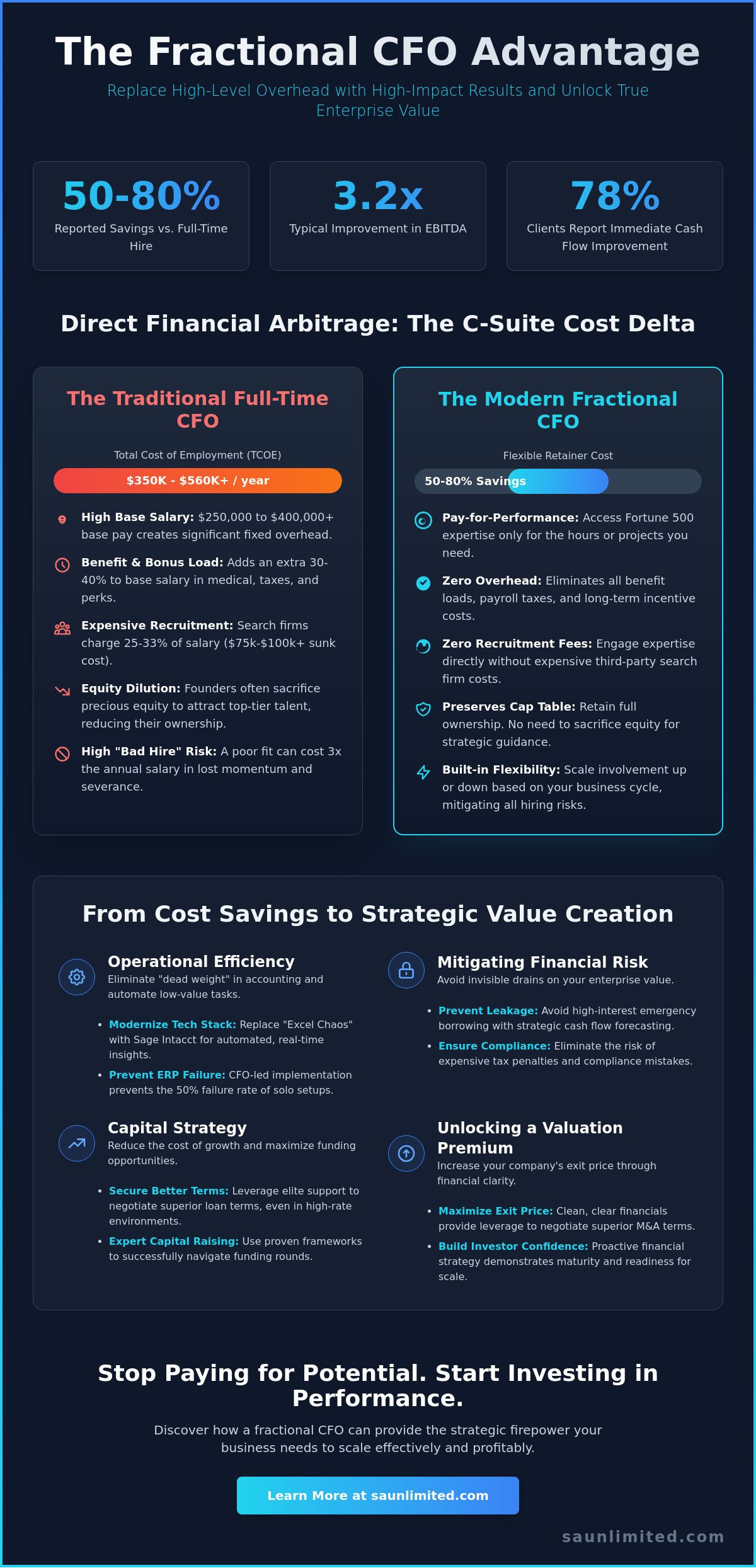
We will break down the data-driven framework for measuring ROI, including the 50% to 80% savings reported by firms that have ditched the traditional hire. You’ll learn how these organizations are achieving a 3.2x improvement in EBITDA, securing better loan terms in a 6.75% prime rate environment, and why 78% of clients report immediate improvements in cash flow management.
Key Takeaways
- Calculate the true Total Cost of Employment to see how eliminating executive overhead and benefit loads immediately strengthens your bottom line.
- Learn how to optimize your financial infrastructure with Sage Intacct to transform basic bookkeeping into a high-speed engine for automated insights.
- Discover the cost savings of a fractional cfo through strategic cash flow forecasting that prevents high-interest emergency borrowing and financial leakage.
- Unlock a Valuation Premium by using elite capital raising support and clean financials to negotiate superior terms and increase your company’s exit price.
- Explore a partnership model that scales from project-based support to unlimited strategic advisory, providing a proactive solution for every growth stage.
Direct Financial Arbitrage: Fractional vs. Full-Time CFO Total Cost
The 2026 executive talent market has reached a boiling point. Base salaries for full-time CFOs now routinely range from $250,000 to over $400,000 annually. When you factor in bonuses and benefits, the financial weight can crush a scaling enterprise. This is where the cost savings of a fractional cfo become a competitive necessity rather than a luxury. By engaging a Fractional executive, you access high-level financial leadership without the permanent “Executive Tax” that drains your operating capital. You stop paying for potential and start paying for performance.
Fractional models offer a unique form of financial arbitrage. You secure the same caliber of expertise found at Fortune 500 companies but only for the hours or projects your business actually requires. This eliminates the “dead time” associated with full-time hires who may only spend 20% of their week on high-level strategy. The time-to-value advantage is equally stark. While a traditional hire requires a six-month ramp-up to understand your systems, a fractional partner hits the ground running on day one. They bring a toolkit of proven frameworks that deliver immediate clarity to your balance sheet.
Breaking Down the C-Suite Salary Delta
Total Cost of Employment (TCOE) represents the comprehensive sum of an executive’s base salary, medical benefits, payroll taxes, and long-term incentives. For a full-time CFO, this often includes an additional 30% to 40% on top of the base salary for perks and insurance. Fractional retainers bypass these burdens entirely. Perhaps most importantly, fractional models preserve your cap table health. You don’t have to sacrifice precious equity to attract top-tier talent. This “Equity Savings” ensures that founders retain more ownership while still benefiting from the strategic guidance necessary to scale toward an exit.
Recruitment and Retention Savings
Hiring a C-suite executive is an expensive gamble. Executive search firms typically charge between 25% and 33% of the candidate’s first-year salary. For a $300,000 CFO, that is a $100,000 sunk cost before they even attend their first board meeting. If that hire doesn’t work out, the “bad hire” cost can be triple the original salary due to lost momentum and severance. Fractional engagements mitigate this risk through built-in flexibility. You can scale your CFO’s involvement up during a capital raise or down during steady-state operations. This elasticity ensures your leadership costs always align with your current business cycle, preventing the bloat that often precedes a cash crunch.
Operational Efficiency: Savings Through Technology and Process
True cost savings of a fractional cfo aren’t just found on the payroll ledger. They’re found in the elimination of “dead weight” within your accounting department. Many mid-market companies carry high-cost staff for low-value tasks that could be automated or outsourced. A fractional CFO audits these internal processes to ensure you’re paying for results, not just hours. This is a cost-efficient solution that shifts your focus from historical recording to forward-looking strategy.
The cost of financial errors is another invisible drain on your capital. When you rely on basic bookkeeping, you risk expensive tax penalties and compliance mistakes that can cost thousands. By integrating Sage Intacct, a fractional CFO replaces manual, labor-intensive reporting with a scalable cloud infrastructure. This move shifts your business beyond the limitations of QuickBooks and into a world of automated insights. It’s a proactive way to build a foundation that supports expansion rather than hindering it. You stop chasing data and start owning your outcomes.
Modernizing the Tech Stack for Maximum ROI
“Excel Chaos” is a silent killer of productivity. Manual data entry drains company resources every single month, leading to a higher cost of capital and delayed decision-making. A CFO-led ERP setup prevents the 50% failure rate typically seen in solo implementations. You get real-time visibility that allows you to make decisions today based on today’s data. This immediate access to financial truth is a primary driver of the cost savings of a fractional cfo, as it prevents the expensive guesswork that often plagues growing firms. Consider these tech-driven benefits:
- Elimination of redundant data entry across departments.
- Automated revenue recognition that ensures compliance with ASC 606.
- Dynamic dashboards that provide a 360-degree view of your cash position.
Streamlining Accounting Operations
You don’t always need a CFO for every task. Sometimes, right-sizing your team with Fractional Controller services is the smartest way to lower your total accounting spend. These automated workflows can reduce your month-end close time by as much as 40%, freeing up your team for more strategic work. Beyond internal processes, a fractional CFO acts as a powerful advocate in vendor management. They renegotiate contracts and audit service agreements to find immediate bottom-line savings that often pay for the fractional engagement itself. This results-oriented approach ensures your finance function is an asset, not just an overhead expense.
Mitigating Financial Risk: The ‘Invisible’ Cost Savings
Financial risk is the silent tax on your growth. While salary arbitrage provides immediate relief, the most profound cost savings of a fractional cfo often come from what doesn’t happen. You avoid the catastrophic cash crunches, the predatory interest rates of emergency loans, and the devastating impact of internal fraud. A fractional leader doesn’t just record your history. They build a defensive perimeter around your capital. This proactive risk management ensures that your enterprise value remains intact during market volatility.
Internal leakage is another area where capital quietly vanishes. Without rigorous internal controls, mid-market firms are vulnerable to everything from simple accounting errors to sophisticated fraud. A fractional CFO implements a system of checks and balances that a standard bookkeeper simply cannot provide. They also shift your tax approach from reactive preparation to proactive strategy. Filing forms is a compliance cost; planning for a 21% flat corporate tax rate and navigating 2026 self-employment regulations is a wealth-building strategy. These maneuvers turn your finance department from a cost center into a shield.
Cash Flow and Liquidity Protection
In June 2026, the Wall Street Journal Prime Rate sits at 6.75%, making capital more expensive than in previous cycles. If you lack accurate forecasting, you may find yourself forced into SBA 7(a) variable loans with APRs as high as 11.5%. Effective cash planning and forecasting allow you to predict these crunches months in advance. You can then optimize working capital by reducing your Days Sales Outstanding (DSO), keeping your own cash in the bank rather than in your customers’ pockets. This strategic debt management ensures you only borrow when the ROI justifies the cost, preserving your margins.
Compliance and Regulatory Shielding
The cost of non-compliance is always higher than the cost of expert oversight. With ASC 606 remaining a primary focus for audits in 2026, failing to recognize revenue correctly can lead to massive penalties and failed due diligence. Engaging in CFO consulting allows you to build “Audit-Proof” financials that are ready for scrutiny at a moment’s notice. This preparation significantly reduces the billable hours of external auditors because your books are already clean and expert-managed. You aren’t just paying for advice. You’re buying insurance against regulatory failure and identifying vulnerabilities in your revenue model before they become liabilities. The cost savings of a fractional cfo in this arena are measured by the crises you never have to face.
Capital Strategy: Reducing the Cost of Growth
Growth is expensive, but inefficiently funded growth is terminal. The cost savings of a fractional cfo are perhaps most visible when your company enters the capital markets. In a high-interest environment where the Wall Street Journal Prime Rate sits at 6.75%, the “risk premium” investors and lenders place on your business can make or break your expansion plans. High-level financial leadership reduces this premium by providing the transparency and institutional-grade reporting that capital providers demand. You stop being a risky bet and start being a strategic investment.
Strategic M&A and capital allocation are where a seasoned expert pays for themselves many times over. By conducting rigorous due diligence, a fractional CFO prevents the astronomical cost of “Bad Deals” that look good on the surface but hide toxic liabilities. They ensure that every dollar you spend on acquisition or expansion is backed by a data-driven ROI analysis. This level of sophistication moves your business beyond the “gut feeling” stage and into a phase of disciplined, profitable scaling. You aren’t just growing. You’re building a fortress.
Optimizing the Cost of Capital
The math of elite financial negotiation is simple and powerful. If a CFO negotiates a 100 basis point reduction on a $3 million term loan, that’s $30,000 in annual interest expense saved immediately. A CFO builds a Capital Stack—the specific mix of debt, equity, and mezzanine financing—that minimizes your Weighted Average Cost of Capital (WACC) to ensure every dollar of growth is as cheap as possible. When preparing for a fundraise, their presence shortens the due diligence cycle by months, saving invaluable executive time and allowing you to close rounds before market conditions shift. When you’re ready to scale, leverage our capital raising support to ensure you aren’t leaving money on the table.
Maximizing Enterprise Value (EV)
Buyers pay a premium for certainty. Utilizing fractional CFO services allows you to identify margin-killing products or services that are currently dragging down your EBITDA. This expansion of your core profitability is the fastest way to increase your company’s exit price. Buyers are willing to pay more for companies with clean, institutional-grade financial reporting because it reduces their post-acquisition risk. During tough negotiations, you can use real-time data to defend your valuation, ensuring that you capture the full value of the enterprise you’ve built. The cost savings of a fractional cfo in this context are measured in the millions of dollars added to your final exit check.
The SA Unlimited Advantage: Scalable Expertise for 2026
Choosing a partner for your financial leadership is a decision that defines your company’s trajectory. Many providers offer “part-time help,” but at SA Unlimited, we provide a strategic partnership model designed for the complexities of 2026. We move beyond simple oversight to become the architects of your profit. Our expertise allows you to transition your finance department from a reactive cost center into a proactive engine for growth. This shift is where the most significant cost savings of a fractional cfo are realized, as every financial decision is filtered through the lens of enterprise value creation.
Our deep specialization in Sage Intacct consulting sets us apart from generalist firms. While others may struggle with the technical nuances of cloud financial migration, we deliver a faster ROI by implementing high-speed, automated reporting from day one. We offer flexible operational tiers to meet you exactly where you are. Whether you need project-based hourly support for a specific capital raise or unlimited strategic advisory to guide your global expansion, our model scales alongside your ambition. You never pay for more than you need, but you always have access to elite talent.
A Proactive, Results-Oriented Approach
Our “Yes, And” philosophy is our core identity. We don’t just identify financial roadblocks; we provide the creative solutions to overcome them. This proactive stance ensures that obstacles are cleared before they ever impact your bottom line. When you engage with us, you aren’t just hiring an individual. You are accessing a deep bench of experts with cross-industry experience. This collective intelligence has historically delivered significant results. For instance, in the construction sector, our targeted CFO support typically drives a 10% to 15% improvement in profit margins within the first twelve months. We bring that same level of dedication and high-quality talent to every engagement.
Next Steps: Calculating Your Potential Savings
The journey toward financial transparency begins with a comprehensive Financial Health Check. This diagnostic identifies immediate leakages in your cash flow and vulnerabilities in your current accounting stack. Once we uncover these opportunities, we follow a rigorous 30-day roadmap to integrate a fractional leader into your executive team. This seamless transition ensures no loss of momentum while we begin the work of optimizing your capital. The cost savings of a fractional cfo are waiting to be unlocked. Don’t let another quarter of high overhead and missed opportunities stall your progress. Schedule a strategic consultation to uncover your cost-saving opportunities and start building your financial fortress today.
Secure Your Strategic Advantage in 2026
The era of bloated executive overhead is over. By prioritizing the cost savings of a fractional cfo, you replace a static expense with dynamic growth. You’ve seen how this model slashes recruitment risks, automates “Excel Chaos” through Sage Intacct, and builds the institutional-grade financials that investors crave. In a landscape of 6.75% prime rates and $400,000 CFO salaries, the choice isn’t just about saving money; it’s about deploying capital where it drives the highest return.
SA Unlimited stands ready to bridge the gap between your current operations and your ultimate enterprise value. We bring a proven track record of scaling mid-cap and emerging companies through proactive problem-solving and multi-tiered pricing models that fit your specific scale. As expert Sage Intacct implementation partners, we ensure your tech stack is a catalyst, not a bottleneck. Stop reacting to financial hurdles and start architecting your success with a partner invested in your long-term vision.
Partner with SA Unlimited to transform your finance department into a growth engine. Your vision deserves a financial foundation that can keep pace with your ambition. Let’s build it together.
Frequently Asked Questions
How exactly does a fractional CFO save my company money compared to a full-time hire?
A fractional CFO eliminates the “Total Cost of Employment” burden by removing the need for 40% benefit loads, six-figure bonuses, and equity grants. You pay only for the strategic hours you use instead of a $250,000 base salary. This model provides a direct form of financial arbitrage, allowing you to access elite talent at a fraction of the traditional cost. It’s about paying for high-level results without the permanent executive tax.
What is the typical ROI on a fractional CFO engagement for a mid-sized business?
Companies engaging a fractional CFO often see a 3.2x improvement in EBITDA and a 50% to 80% reduction in leadership costs. Beyond direct payroll, the ROI is realized through optimized capital stacks and improved cash flow management. For construction firms specifically, this support typically leads to a 10% to 15% profit margin increase within the first year. It’s a strategic catalyst that yields quantifiable enterprise value.
Can a fractional CFO help reduce my company’s tax liability?
Yes, a fractional CFO shifts your focus from reactive tax preparation to proactive tax planning. They navigate complex 2026 regulations, such as the 21% flat corporate tax rate and self-employment Medicare requirements, to identify legal deductions and credits. By structuring your revenue model for efficiency, they prevent thousands in overpayments. This level of strategic advisory ensures you keep more of your hard-earned capital for reinvestment.
Will a fractional CFO identify operational inefficiencies that my current team missed?
Absolutely, because they bring a fresh, high-level perspective to your internal processes. They audit your accounting department to identify “dead weight” and manual bottlenecks that drain resources. By implementing solutions beyond QuickBooks, like Sage Intacct, they automate labor-intensive reporting. These improvements often reduce month-end close times by 40%, allowing your existing team to focus on higher-value tasks that drive revenue growth.
How does having a fractional CFO impact my ability to raise capital or get a loan?
It significantly lowers your “risk premium” in the eyes of lenders and investors. With the prime rate at 6.75% in June 2026, banks demand institutional-grade reporting before approving SBA 7(a) loans. A fractional CFO provides the clean, expert-managed books that build creditor confidence. They also lead capital raising support, shortening the due diligence cycle and helping you negotiate superior terms that save thousands in interest expense.
Is a fractional CFO cheaper than hiring a high-level accounting firm?
While accounting firms focus on compliance and historical data, a fractional CFO provides forward-looking strategy that actually drives profit. The cost savings of a fractional cfo come from their ability to function as a strategic advisor to the CEO rather than just a service provider. They don’t just record what happened; they architect what happens next. This proactive approach usually offers a much higher return than traditional, reactive accounting fees.
What are the ‘hidden’ costs of not having a CFO during a growth phase?
The primary hidden costs include “Excel Chaos,” missed tax strategies, and high-interest emergency borrowing. Without expert cash planning and forecasting, you risk liquidity crunches that force you into expensive debt. You also face the cost of “Bad Deals” in M&A or failed system implementations. These invisible drains on your capital can easily exceed the cost of a fractional retainer, making the absence of leadership a massive liability.
How long does it take for a fractional CFO to pay for themselves?
Most businesses see the engagement pay for itself within the first 90 days. This happens through immediate vendor contract renegotiations, the identification of margin-killing products, and the elimination of accounting redundancies. By the end of the first year, the cost savings of a fractional cfo are often solidified through improved EBITDA and a more efficient capital structure. It’s a rapid transition from a cost center to a profit engine.