

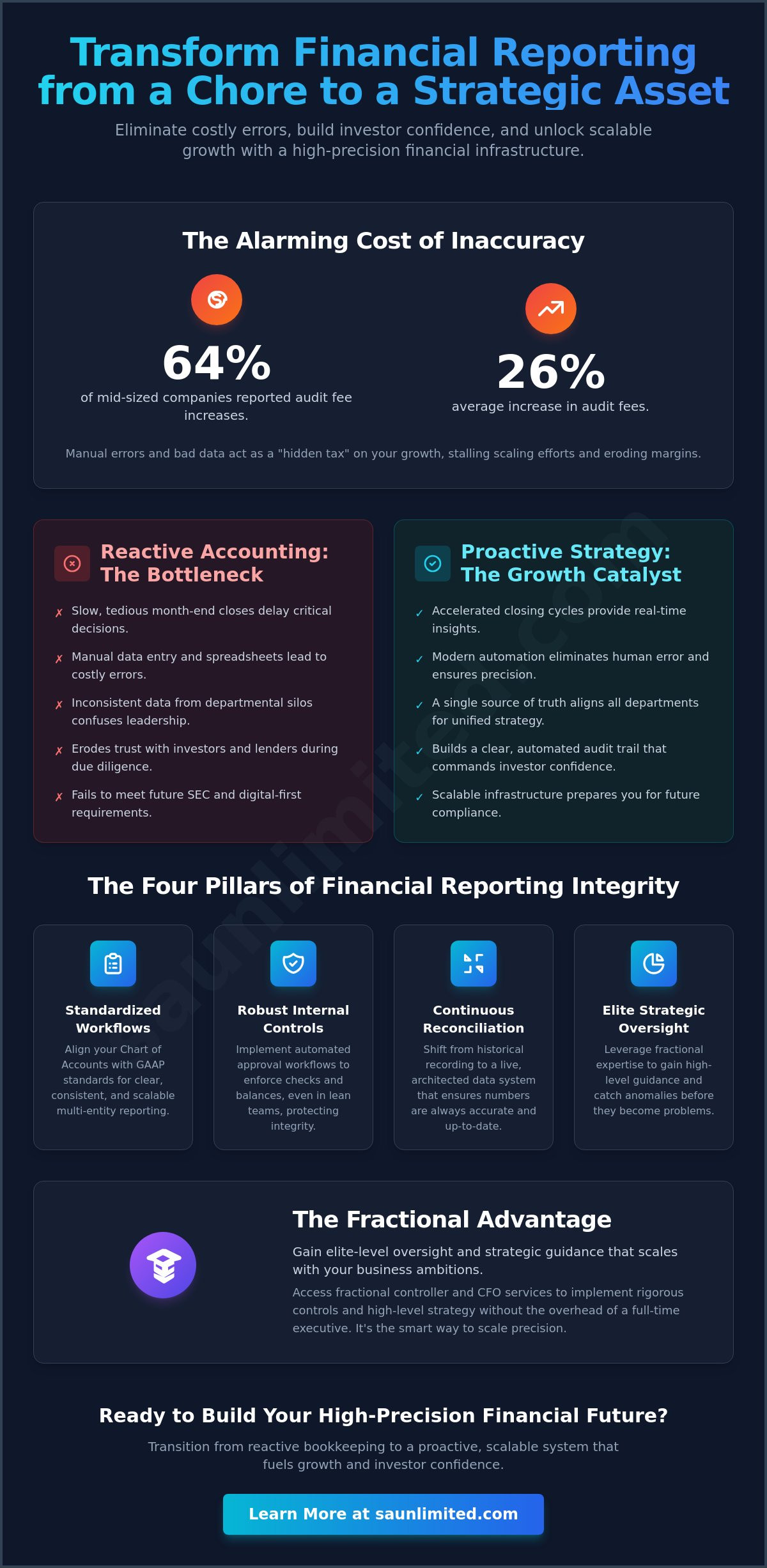
Did you know that 64% of mid-sized quoted companies recently reported an average audit fee increase of 26%? When your scaling efforts are met with rising costs and manual data errors, it’s a clear sign that you need solutions beyond Quickbooks that can keep pace with your ambition. You’ve likely felt the frustration of a slow month-end close or the anxiety of presenting inconsistent departmental data to your board. Improving financial reporting accuracy isn’t just about cleaning up spreadsheets; it’s about building a professional, high-precision infrastructure that commands investor confidence and protects your margins.
You already know that reactive accounting is a bottleneck to growth, and you’re ready for a solution that scales as fast as your revenue. This guide will show you how to transform your reporting from a tedious chore into a strategic asset that fuels expansion. We’ll explore the path to shortening your closing cycles, eliminating human error through modern automation, and implementing a robust reporting framework that prepares you for 2026 SEC deadlines and the digital-first requirements of the CFRS web platform.
Key Takeaways
- Identify the four structural pillars required to build a reporting system that aligns real-time data with GAAP standards.
- Explore why improving financial reporting accuracy acts as a growth catalyst by eliminating the “hidden tax” that’s caused by manual errors and bad data.
- Transition from manual spreadsheets to a scalable infrastructure by leveraging the high-precision capabilities of Sage Intacct.
- Execute a clear implementation roadmap that cleanses historical data and standardizes inputs for maximum reporting precision.
- Leverage fractional CFO expertise to gain elite-level oversight and strategic guidance that scales with your business ambitions.
The High Cost of Inaccuracy: Why Precision is Your Growth Catalyst
Accuracy is the heartbeat of a scaling mid-cap firm. It’s defined by the seamless alignment of your real-time operational data with rigorous GAAP standards. When you’re committed to improving financial reporting accuracy, you’re doing more than just balancing books. You’re eliminating the “hidden tax” of bad data. This tax manifests as missed market opportunities and stalled scaling efforts because you simply can’t move as fast as the competition when your numbers are in question. High-growth environments require a level of precision that basic bookkeeping can’t provide.
Inaccurate financial statements do more than just confuse your internal team; they actively erode the trust you’ve built with lenders and equity partners. If a bank can’t trust your debt-to-equity ratios, they won’t extend the credit lines you need for expansion. Precision is the direct bridge to EBITDA optimization. Without clean data, you can’t identify the operational leaks that are draining your bottom line or the product lines that are actually dragging down your profitability.
The Impact on Capital Raising and Valuation
Due diligence is a brutal process for companies without a clear, automated audit trail. If you can’t prove where a number came from, investors will discount your valuation or walk away entirely. High-precision financials don’t just secure the deal; they can significantly increase your company’s valuation during a strategic exit. Reporting integrity is a non-negotiable prerequisite for any Series B or later funding round. Investors aren’t just buying your product; they’re buying the reliability and transparency of your financial machine.
Operational Friction Caused by Data Silos
Strategic paralysis is the natural result of conflicting data. If your sales team reports one revenue figure based on bookings and finance reports another based on GAAP recognition, your leadership team is stuck in a loop of “which number is right?” instead of “how do we grow?” This friction is compounded by delayed month-end closes. If you don’t see your final numbers until the 20th of the following month, your mid-month decisions are based on obsolete history. Establishing a single source of truth is the only way to ensure every department is pulling in the same direction. It’s the difference between a business that reacts to the market and one that leads it with confidence.
The Four Pillars of Financial Reporting Integrity
Operational excellence requires a shift from recording history to architecting data. While basic bookkeeping tracks where money went, improving financial reporting accuracy focuses on where the business is going. This transition relies on four structural pillars: standardized workflows, robust internal controls, continuous reconciliation, and elite strategic oversight. Without these foundations, your financial data remains a liability rather than a growth engine.
Standardizing the Chart of Accounts
A messy Chart of Accounts (COA) is the primary enemy of precision. If your accounts are cluttered with redundant categories or inconsistent nomenclature, your reports will lack the clarity needed for multi-entity scaling. You must align your COA with industry benchmarks to ensure your records adhere to Generally Accepted Accounting Principles (GAAP). This standardization is the baseline for any credible organization. It allows for seamless data aggregation across departments, ensuring that every stakeholder is looking at the same financial reality. Consistent nomenclature isn’t just about organization; it’s about creating a scalable language for your entire enterprise.
Implementing Internal Controls in Lean Teams
Lean teams often struggle with the segregation of duties, yet this is critical for improving financial reporting accuracy. You don’t need a massive full-time headcount to protect your integrity. Modern accounting relies on automated approval workflows that enforce checks and balances without slowing down operations. By utilizing fractional controller services, you can bridge the gap between daily bookkeeping and high-level strategy. These experts provide the necessary oversight to catch anomalies before they reach your board reports. Partnering with a strategic financial advisor allows you to implement these rigorous controls without the overhead of a full-time executive suite.
Moving beyond batch processing is the next evolution in reporting integrity. Waiting until the end of the month to reconcile accounts is a recipe for obsolete data and hidden errors. Continuous reconciliation ensures that your books are “audit-ready” every single day. This proactive approach identifies discrepancies in real time, allowing for immediate correction. It transforms the month-end close from a frantic sprint into a routine validation of already-verified data.
Finally, true reporting integrity requires the high-level perspective found in fractional cfo services. A seasoned CFO doesn’t just look at the numbers; they interpret the story behind them. They provide the strategic oversight needed to ensure your reporting infrastructure supports your long-term capital raising and expansion goals. This level of expertise ensures that your financial machine is built for the complexities of mid-cap scaling.
Moving from Reactive to Proactive: The ERP Advantage
Scaling companies often hit a wall where manual processes simply break. If you’re still relying on a labyrinth of linked spreadsheets, you’re living in an “Excel Nightmare” that actively prevents improving financial reporting accuracy. These reactive systems force your team to look backward. By the time you spot a trend, the opportunity to act has already passed. Integrated cloud financial systems like Sage Intacct represent the gold standard for mid-cap precision. They replace rigid, linear account structures with dimensional accounting. This allows you to tag transactions with context, such as department, project, or location, without creating a bloated, unusable Chart of Accounts.
The Financial Accounting Standards Board (FASB) emphasizes that financial information is only useful if it is timely and faithfully represented. Static monthly PDFs fail this test. Proactive leaders demand real-time dashboards that provide an immediate pulse on the business. This visibility ensures that when you walk into a board meeting, you aren’t defending your data. You’re leveraging it to drive strategy. It’s about moving from a state of constant questioning to a state of absolute confidence in your numbers.
Why Spreadsheets Fail Ambitious Companies
The risk of a “broken formula” is a constant threat to your credibility. A single incorrect cell reference can tank an entire board deck, leading to disastrous strategic choices. Spreadsheets also lack a verifiable audit trail. This makes it impossible to see who changed what and when. This lack of version control is a major red flag during due diligence. Finance leaders report that teams in manual environments often spend over half their work week just on data consolidation. That’s time stolen from high-value analysis and strategic planning.
The Power of Automated Multi-Entity Consolidation
As you expand, complexity grows exponentially. Manual consolidation often leads to reporting double-counts and errors in intercompany eliminations. Automated ERP systems handle these eliminations instantly. They ensure your consolidated view is always accurate and up to date. For international operations, real-time currency conversions eliminate the headache of manual exchange rate adjustments. Architecting these sophisticated flows requires specialized expertise. Engaging a Sage consultant ensures your system is built to handle the specific nuances of your industry and growth trajectory.
Implementation Roadmap: Achieving 99.9% Reporting Accuracy
Precision isn’t a happy accident. It’s a deliberate architecture. Improving financial reporting accuracy requires more than a software upgrade; it demands a cultural shift toward discipline and technical rigor. While your competitors are still wrestling with manual reconciliations, you’ll be making moves based on yesterday’s actuals. This roadmap provides the tactical steps needed to build a high-precision financial machine that scales with your ambition.
- Step 1: Conduct a Comprehensive Financial Process Audit. You can’t fix what you haven’t mapped. Identify every manual touchpoint, data silo, and spreadsheet dependency currently slowing you down.
- Step 2: Cleanse Historical Data and Standardize Inputs. Garbage in, garbage out. Before migrating to advanced systems, you must scrub your historical records and enforce strict data entry standards across all departments.
- Step 3: Deploy Cloud Financials with Custom Reporting Dimensions. Leverage Sage Intacct to replace a flat Chart of Accounts with rich, multi-dimensional data tagging. This ensures every transaction carries the context needed for granular analysis.
- Step 4: Establish a Monthly Closing Checklist with Hard Deadlines. Discipline is the backbone of accuracy. Create a clear sequence of events with assigned owners and non-negotiable cutoff dates.
- Step 5: Layer in Strategic Review. Finalize your infrastructure by integrating an outsourced CFO to provide the high-level oversight and “sanity check” that automated systems alone cannot offer.
The 5-Day Month-End Close Challenge
Speed is a byproduct of accuracy. When your close takes 15 days, errors hide in the noise of old data. Break your close into daily actionable milestones to gain momentum. Day one should focus on bank reconciliations and cash positioning. By day three, your AP and AR sub-ledgers should be locked. Use automation to handle repetitive month-end journal entries, such as prepaid expenses and depreciation. This eliminates the human error inherent in manual calculations and frees your team for high-value variance analysis. If you’re ready to compress your close cycle and reclaim your time, consult with our strategic advisors to build your custom automation plan.
Designing Custom Dashboards for Stakeholders
One size never fits all in financial reporting. Your CEO needs to see cash runway and burn rates at a glance. Your Board of Directors requires high-level EBITDA trends and debt covenant compliance. Department heads need real-time budget vs. actuals to manage their spending effectively. Designing custom dashboards ensures every stakeholder has a “single source of truth” tailored to their specific needs. By using automated feed integrations, you remove the risk of manual manipulation. This transparency builds immediate trust and ensures that every strategic conversation is rooted in verified, real-time data.
The Fractional Advantage: Scaling Precision Without the Overhead
Mid-cap companies frequently hit what we call the “In-House Ceiling.” Your accounting team might be excellent at recording transactions, but they often lack the high-level perspective required for complex scaling. This is where the fractional model changes the game. By integrating fractional CFO services, you gain elite-level oversight without the massive overhead of a full-time executive suite. This strategic layer is essential for improving financial reporting accuracy, as it moves your organization beyond simple data entry and into the realm of rigorous data validation and strategic interpretation.
The true power lies in the synergy between cutting-edge technology and seasoned expertise. While Sage Intacct provides the modern infrastructure, your fractional advisor provides the architectural vision. They ensure your systems are configured to capture the data that actually matters for capital raising and operational expansion. SA Unlimited acts as your dedicated partner, combining Sage Intacct consulting with proactive advisory to ensure your financial future is built on a foundation of absolute precision. We don’t just identify obstacles; we architect the solutions to overcome them.
Expert Oversight vs. Entry-Level Bookkeeping
Clean books are just the baseline; they aren’t the strategic goal. Many organizations mistake “no errors in the ledger” for reporting excellence. However, improving financial reporting accuracy requires identifying the subtle anomalies that automated software might miss. A fractional CFO brings a seasoned eye to your financials, spotting trends in cash burn or margin compression before they become crises. This level of oversight extends to proactive tax planning and cash flow forecasting. It ensures you aren’t just reporting on the past, but actively engineering your future profitability and investor confidence.
Building a Scalable Financial Infrastructure
The jump from $10M to $100M in revenue requires a complete overhaul of your financial mindset. What worked for a small business will break under the weight of mid-cap complexity. You need a scalable infrastructure that grows with you. SA Unlimited tiers its fractional services to match your current stage while preparing you for the next level of expansion. Whether you need fractional controller services to tighten internal controls or capital raising support for your next round, we provide the high-quality talent required to succeed. Don’t let your back office be the bottleneck to your ambition. Contact SA Unlimited to start your financial transformation today.
Master Your Financial Narrative for the Next Level of Growth
Scaling a mid-cap organization requires a decisive move from defensive accounting to offensive strategy. You’ve seen how the “Excel Nightmare” drains internal resources and how structural pillars like standardized data and internal controls provide the foundation for rapid expansion. By improving financial reporting accuracy, you turn a mandatory compliance burden into a high-octane growth catalyst that attracts capital and maximizes your valuation. Whether you’re navigating complex international consolidations or preparing for a Series B round, your financial reporting must be beyond reproach.
SA Unlimited is here to help you bridge the gap between your current operations and your ultimate ambition. As Sage Intacct implementation experts and strategic advisors to the CEO, we provide the modern infrastructure and elite-level oversight your business requires. Our tiered pricing models are specifically engineered to grow with emerging and mid-cap companies, ensuring you have the right talent at every milestone. Ready to architect a high-precision financial engine? Schedule your SA Unlimited consultation.
Your data holds the roadmap to your future success. With the right systems and partners in place, you’ll lead your industry with absolute confidence and clarity.
Frequently Asked Questions
How can I improve financial reporting accuracy quickly?
Immediate improvements start with standardizing your data entry processes and enforcing strict month-end cutoffs. You should conduct a rapid process audit to identify where manual workarounds are creating bottlenecks. By cleaning up your Chart of Accounts and ensuring bank reconciliations happen daily rather than monthly, you’ll see an instant reduction in common entry errors and data discrepancies.
What are the most common causes of financial reporting errors?
Manual data entry and disconnected software systems are the primary drivers of inaccuracy in mid-cap firms. When your sales data doesn’t talk to your accounting software, your team is forced to use spreadsheets that are prone to broken formulas and version control issues. These “Excel Nightmares” often hide significant errors that only surface during a formal audit or due diligence process.
How does an ERP system like Sage Intacct improve accuracy?
Sage Intacct utilizes multi-dimensional accounting to tag every transaction with specific context like location, project, or department. This replaces a rigid, linear Chart of Accounts and eliminates the need for manual data manipulation in external spreadsheets. By automating complex tasks like intercompany eliminations and currency conversions, the system ensures your consolidated financials are audit-ready and based on real-time data.
Is a Fractional CFO better than a full-time Controller for accuracy?
They serve different but complementary roles in improving financial reporting accuracy for scaling firms. A Controller manages the tactical day-to-day accounting, while a Fractional CFO provides the high-level strategic oversight needed to identify anomalies and interpret financial trends. This expert layer ensures your reporting infrastructure supports long-term goals like capital raising and EBITDA optimization without the cost of a full-time executive.
How often should financial reports be reviewed for errors?
You should move toward a model of continuous review rather than waiting for the month-end close. While formal board decks are produced monthly, real-time dashboards allow leadership to spot anomalies weekly or even daily. This proactive approach ensures that errors are corrected immediately, preventing them from compounding and distorting your final month-end statements or strategic decision-making.
What is the role of internal controls in financial reporting?
Internal controls act as a structural safety net that prevents both fraud and accidental misstatements. By implementing automated approval workflows and clear segregation of duties, you ensure that no single individual has total control over a financial transaction. These controls are essential for maintaining the integrity of your data and building trust with external stakeholders, lenders, and investors.
Can automated data entry really eliminate all reporting errors?
Automation significantly reduces human error by removing manual touchpoints, but it doesn’t eliminate the need for professional oversight. Technology handles the high-volume processing, while a strategic advisor focuses on improving financial reporting accuracy through variance analysis and sanity checks. You need a combination of modern infrastructure and seasoned expertise to ensure your numbers tell a true and reliable story.
What should be included in a month-end closing checklist?
A robust checklist must include bank reconciliations, sub-ledger closings for AP and AR, payroll accruals, and intercompany eliminations. Each task needs a specific owner and a non-negotiable deadline to ensure the close stays on track. Including a final review step for budget-versus-actual variances helps catch any remaining outliers before the reports are finalized for the CEO or Board.