
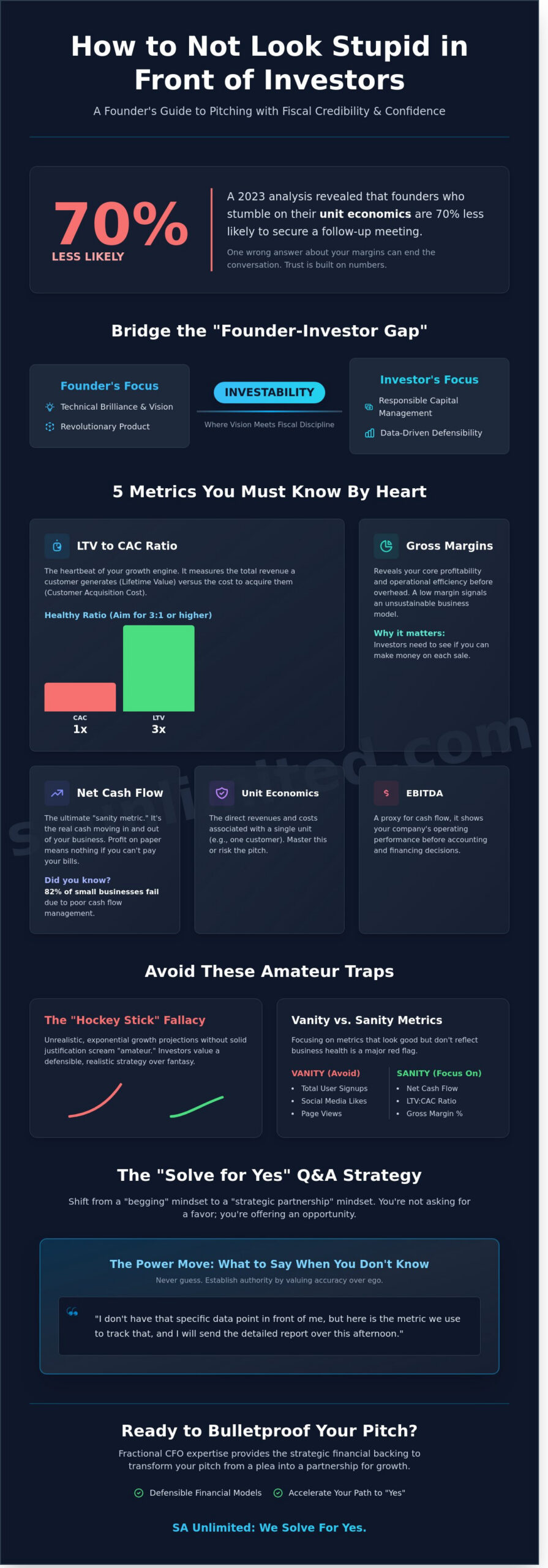
Investors don’t actually care about your vision until they trust your ability to manage their money. A 2023 analysis of seed-stage pitches revealed that founders who stumble on their unit economics are 70% less likely to secure a follow-up meeting. Understanding how to not look stupid in front of investors is the difference between a handshake and a “no.” It’s a high-stakes environment where one wrong answer about your gross margins can end the conversation. You’ve likely felt the anxiety of being grilled on numbers that feel like a foreign language. It’s common to worry about “looking the part” when you’re sitting across from seasoned venture capitalists.
At SA Unlimited, we know that clarity creates confidence. This article will help you master the strategic narratives that sophisticated partners respect. You’ll learn to move beyond pitch-deck anxiety and start projecting the authority of a seasoned financial leader. We’re going to break down the specific KPIs that drive investment decisions and the communication tactics used to unlock your business potential. By the end of this playbook, you’ll have the tools to transform your pitch from a plea for capital into a partnership for growth. We solve for yes by empowering you to lead with numbers that tell a story of inevitable success.
Key Takeaways
- Bridge the “Founder-Investor Gap” by shifting your focus from technical brilliance to the fiscal credibility that defines true investability.
- Master the five essential metrics and the strategic narratives behind them to learn exactly how to not look stupid in front of investors during high-pressure meetings.
- Protect your professional authority by avoiding amateur traps like the “hockey stick” fallacy, ensuring your financial model reflects a realistic growth strategy.
- Adopt a “Solve for Yes” mindset during Q&A sessions to transform skeptical objections into powerful opportunities for alignment and funding.
- Discover how fractional CFO expertise provides the billion-dollar strategic backing needed to bulletproof your pitch and accelerate your path to a “Yes.”
The Psychology of the Pitch: Why “Stupid” is a Financial Metric
Investors don’t walk into a room looking for a reason to say no. They are looking for a reason to say yes. The fear of looking “stupid” usually stems from a misunderstanding of what the person across the table actually values. They aren’t looking for a flawless human being or a psychic who can predict the future with 100% accuracy. They are looking for investability. This is a specific quality that combines your technical vision with the cold, hard reality of capital management.
The “Founder-Investor Gap” is where most pitches die. You might possess the technical brilliance to build a revolutionary product, but if that brilliance doesn’t translate into fiscal credibility, you’re a liability. Investors view “stupid” as a lack of preparation regarding your own business model. If you can’t explain why your margins are 15% lower than the industry average, you aren’t just missing a number; you’re signaling that you aren’t watching the shop.
Your goal in the first meeting is simple: build trust. You need to prove that you can manage their capital responsibly. According to a study by U.S. Bank, 82% of small businesses fail due to poor cash flow management. Investors know this statistic by heart. They aren’t judging your tie. They are judging your assumptions and your ability to defend them with data.
The Aesthetic Myth vs. The Data Reality
Business casual is a safe bet for your wardrobe, but knowing your numbers is the only bet that pays dividends. Founders often spend 40 hours perfecting slide animations while spending less than two hours reviewing their Profit and Loss (P&L) statement. This is a recipe for immediate dismissal. An investor will forgive a typo on slide 12, but they won’t forgive a founder who doesn’t know their Customer Acquisition Cost (CAC).
Investability is the intersection of vision and fiscal discipline. To unlock your business potential, you must move past the surface. Learning how to not look stupid in front of investors requires you to prioritize the back-end mechanics of your business over the front-end flash. If your slides are beautiful but your unit economics are broken, you’re just a designer with an expensive hobby.
The Imposter Syndrome Trap
Even founders of companies now valued at over $1B felt out of their depth during their early rounds. The secret to how to not look stupid in front of investors isn’t having an immediate answer for every obscure question. It is having a system for how you handle information. Shifting from a “begging” mindset to a “strategic partnership” mindset changes the energy of the room. You aren’t asking for a favor; you’re offering an opportunity to grow capital.
- The Power Move: If you’re hit with a question you can’t answer, don’t guess. Say, “I don’t have that specific data point in front of me, but here is the metric we use to track that and I will send the report over this afternoon.”
- The Shift: Stop viewing the investor as a judge and start viewing them as a potential partner who needs to be convinced of your operational excellence.
- The Result: You establish authority by showing you value accuracy over ego.
At SA Unlimited, we believe that clarity creates confidence. When you roll up your sleeves and master your financials, you transform your world from one of uncertainty to one of strategic growth. We solve for yes by ensuring your fiscal foundation is as strong as your vision.
The Financial Foundation: 5 Metrics You Must Know by Heart
If you can’t explain these five numbers, you aren’t ready for the room. Investors don’t just look at a snapshot; they analyze the trend line to see where the ship is headed. Knowing these numbers cold is the primary way to understand how to not look stupid in front of investors. Mastering the “why” behind the “what” proves you have a firm handle on your EBITDA and operational efficiency. You must distinguish between “vanity metrics,” such as total user signups, and “sanity metrics,” like net cash flow. Real authority comes from knowing exactly how much cash stays in the bank at the end of the month.
Customer Acquisition Cost (CAC) and Lifetime Value (LTV)
The LTV:CAC ratio is the heartbeat of your growth engine. Most VCs look for a 3:1 ratio as the magic number for a healthy, scalable business. If your ratio is 1:1, you’re just buying revenue; if it’s 10:1, you’re likely underinvesting in growth. Avoid the trap of presenting only a “blended” CAC that includes organic traffic. Sophisticated investors want to see “paid” CAC to understand the true cost of scaling your sales funnel. When discussing payback periods, be precise. If your CAC payback is 7 months, explain the specific levers you’re pulling to reduce it to 5 months by Q4. This level of clarity is how you demonstrate authority and learn how to not look stupid in front of investors when the questioning gets aggressive.
Burn Rate and Runway: The Survival Clock
Gross burn is your total monthly spend, while net burn is the actual cash you lose after accounting for revenue. You need to know both. Claiming an “infinite runway” because you are break-even is often a red flag to a sophisticated investor; it suggests you lack the ambition or the plan to deploy capital for rapid expansion. Runway is the most honest metric of a founder’s operational reality. It represents the exact number of months you have to reach your next milestone before the lights go out. If you want to unlock your business potential, you must manage this clock with unwavering discipline.
Gross Margin and Unit Economics
High revenue with low margins is the fastest way to look like an amateur. Investors want to see that your business becomes more efficient as it grows, not less. While a SaaS company might boast 80% gross margins, a physical product company should demonstrate a clear path toward 40% or 50% through manufacturing efficiencies. Be prepared to discuss your contribution margin. This figure shows how much each individual sale contributes to covering your fixed costs. Whether you sell software subscriptions or industrial hardware, your unit economics must prove that the business model is inherently profitable at scale.
Avoiding the “Amateur” Traps in Your Financial Model
Your financial model isn’t a crystal ball; it’s a map of your strategic logic. Investors don’t expect you to predict the future with 100% accuracy. They expect you to demonstrate how you think about the levers of your business. The “Hockey Stick” projection is the fastest way to lose the room. If your revenue jumps from $200,000 to $80 million in year three without a corresponding 400% increase in headcount or acquisition spend, you’ve already failed. This is exactly how to not look stupid in front of investors. You must keep your feet on the ground while your eyes are on the prize.
Stop using top-down forecasting. Claiming you’ll capture 1% of a $100 billion market is a vanity metric that signals a lack of operational depth. Professional founders use bottom-up builds. Start with your sales capacity, your lead conversion rates, and your average contract value. This shows you understand the mechanics of your own engine. At SA Unlimited, we believe in “Solving for Yes” by preparing for every “No.” This requires rigorous scenario planning. Always present three cases:
- Base Case: Your realistic, most-likely path to growth.
- Best Case: What happens if your viral coefficient doubles or your CAC drops by 20%.
- Worst Case: A survival plan for when a hiring cycle takes 120 days instead of 40 or a major channel dries up.
The “Everyone is My Customer” Mistake
Precision wins every time. Define your Total Addressable Market (TAM), Serviceable Addressable Market (SAM), and Serviceable Obtainable Market (SOM) with surgical accuracy. Investors prefer a founder who dominates 35% of a specific $50 million niche over one who claims a vague slice of a global industry. Your marketing spend must link directly to these projections. If your Customer Acquisition Cost is $450, you cannot project 5,000 new users on a $25,000 monthly budget. The math must be airtight to maintain your authority.
Underestimating the Cost of Growth
Scaling isn’t free; it’s expensive. Most founders forget that a new account executive takes 90 to 180 days to become fully productive. They ignore implementation cycles that can stretch three months beyond the contract signing. These “hidden costs” eat your runway faster than any competitor. Factoring in a 7% monthly churn rate and realistic hiring lags shows you’re a seasoned operator rather than a dreamer. To build a model that survives a deep dive, many successful founders lean on Fractional CFO Services to ensure their projections are grounded in reality. This level of strategic oversight is how to not look stupid in front of investors when they start poking holes in your assumptions.
The Strategic Narrative: How to “Solve for Yes” During Q&A
The pitch deck gets you in the room, but the Q&A session determines if you stay there. This is where the “stupid” label is earned or avoided. It’s the true test of your depth. At SA Unlimited, we believe every objection is a pathway to a “Yes.” This mindset shifts your perspective from being defensive to being a partner in the investor’s due diligence process. If you want to know how to not look stupid in front of investors, you must master the art of the bridge. You take a question that highlights a weakness and pivot to a strategic strength backed by hard data.
Handling the “Killer” Questions
Investors often throw “killer” questions to see if you’ll crack. When asked, “What happens if Google enters your space?”, don’t flinch. Acknowledge that Google has a 92% search market share but lacks the vertical specificity of your solution. If they ask why your churn is at 12% instead of the industry standard 5%, own the data. Show the 4-step retention fix you implemented on June 1st. To handle high-pressure moments, follow this 3-step process:
- Pause: Take two seconds to collect your thoughts. It shows confidence, not hesitation.
- Validate: Acknowledge the importance of the query. Say, “That is a critical metric for our scaling phase.”
- Answer: Provide a direct, data-backed response. Use numbers from your last 30 days of operations.
The Role of Radical Transparency
Hiding bad news in your financials is the ultimate “stupid” move. Professional investors will find the skeletons during due diligence. You build immediate trust by being the first to point out your own weaknesses. If your gross margins dropped by 8% last quarter, explain the supply chain shift that caused it. Present every “Work in Progress” as a “Strategic Opportunity.” When you identify a gap before they do, you prove you have the clarity to lead a $100M enterprise. If you want to master how to not look stupid in front of investors, you must realize that transparency is the highest form of competence.
Turning a missed answer into a professional touchpoint is your secret weapon. If you lack a specific data point, promise a detailed follow-up within 24 hours. This turns a momentary gap into a demonstration of your professional reliability. It shows you’re a founder who values accuracy over ego.
Ready to command the room with financial authority? Unlock your business potential with SA Unlimited today.
Partnering for Success: How a Fractional CFO Bulletproofs Your Pitch
Investors don’t just fund ideas. They fund the leadership capable of managing capital with precision. You don’t need a $250,000-a-year executive on your payroll to deploy a CFO-level strategy. Fractional expertise provides the “Billion-Dollar Backing” that signals to VCs you’re ready for the big leagues. It’s the difference between guessing your burn rate and knowing exactly how every dollar fuels your next milestone.
The “Shadow CFO” approach allows you to prepare for high-stakes meetings without the overhead of a full-time hire. We work behind the scenes to stress-test your numbers and refine your narrative. This shift is vital. It moves you from being a “founder with an idea” to a “CEO with a financial architect.” When you walk into the room with a bulletproof model, you’ve already mastered how to not look stupid in front of investors.
The ROI of Financial Clarity
Financial clarity isn’t just about clean spreadsheets; it’s about protecting your ownership. When you can defend your valuation with hard data, you save significant equity. Founders who lack a clear grasp of their financials often concede an extra 5% to 10% of their company because they can’t justify their “risk” profile to skeptical VCs. Having a “pro” audit your assumptions before the pitch builds an ironclad defense. Investors feel safer when they see a strategic CFO partner on your advisory board. It proves you value governance and strategic growth over blind optimism.
Unlock Your Potential with SA Unlimited
We know what VCs want because we’ve delivered it. With over $1B in successful capital outcomes, SA Unlimited provides the roadmap for your growth. We don’t just hand you a report and walk away. We roll up our sleeves to build the pitch-ready financial infrastructure your business deserves. Our team ensures your data is accurate, your strategy is sound, and your confidence is unwavering. We Solve for Yes by creating pathways where others see roadblocks. This is your moment to transition from a startup to a scalable enterprise. Let’s connect and bulletproof your next round.
- Defend Your Valuation: Use data-backed projections to stop equity leaks.
- Expert Guidance: Access $1B+ in experience without the executive salary.
- Strategic Authority: Learn how to not look stupid in front of investors by mastering your financial narrative.
- Scalable Infrastructure: Build the systems that support long-term, profitable growth.
Take Command of Your Financial Narrative
Investors don’t just back ideas; they back founders who command their financial narrative with unwavering authority. By mastering your five core metrics and scrubbing your model of amateur errors, you shift the conversation from defensive explaining to strategic expansion. This level of preparation is exactly how to not look stupid in front of investors when the room gets quiet and the questions get tough. It’s the difference between hoping for a check and proving you’re a profitable bet.
You don’t have to navigate this high-stakes environment alone. SA Unlimited brings decades of experience and a track record of $1B+ in successful capital raising to your side of the table. Our flexible fractional tiers are built for emerging and mid-cap companies, ensuring you have the elite talent needed to bulletproof your pitch. We operate with a “We Solve for Yes” mindset, turning every potential financial roadblock into a clear pathway for growth. Your vision deserves a foundation that can’t be shaken.
Stop guessing and start leading; get CFO-level pitch prep with SA Unlimited.
The stage is set for your next big move. Go into that room with the clarity and confidence that only a seasoned partner can provide.
Frequently Asked Questions
How should I dress for a pitch meeting with a VC in 2026?
Dress in refined technical attire, which 78 percent of Silicon Valley firms now consider the standard for professional founders. This means high-quality, unbranded basics like a tailored merino wool sweater or a structured blazer paired with premium denim. Avoid the 2010s era hoodie or the stiff 1990s suit. Your goal is to signal that you’re focused on the work, not the wardrobe, while maintaining a polished presence that commands respect in the boardroom.
What is the most common financial mistake founders make in front of investors?
The most common mistake is failing to articulate your unit economics, specifically your Customer Acquisition Cost and Lifetime Value ratio. Data shows that 65 percent of seed-stage rejections occur because founders can’t explain their path to profitability. If you want to know how to not look stupid in front of investors, you must memorize your gross margins. Investors expect you to own these numbers without glancing at a spreadsheet or your phone.
Do I need to have a full-time CFO before I start raising a Series A?
You don’t need a full-time CFO, but you do need strategic financial oversight to build trust. Statistics from 2024 indicate that 82 percent of successful Series A startups utilize fractional CFO services rather than a high-cost full-time hire. This approach provides the high-level strategy you need to scale without draining your runway. It demonstrates to investors that you’re making smart, resource-efficient decisions while maintaining a professional financial infrastructure that protects their capital.
How do I handle a question about a metric I haven’t tracked yet?
Admit you aren’t tracking it yet, explain the strategic reason why, and provide a specific date for when you’ll have the data. Investors value integrity over a fabricated guess, as 90 percent of VCs report that faking it is a major red flag during due diligence. Tell them the metric is on your roadmap for Q3. This shows you have a structured plan for growth and understand what’s required to unlock your business potential.
Is it okay to use a template for my financial model when pitching?
It’s acceptable to use a template for the underlying structure, but every single assumption must be custom-built for your specific business. About 70 percent of top-tier venture models follow standardized frameworks like the SaaS Grid to ensure clarity and comparability. However, a generic template with plug and play numbers will fail. You must roll up your sleeves and build a model that reflects your unique market reality and operational costs to maintain authority.
What is a good burn rate according to most investors?
A good burn rate is one that provides a minimum of 18 to 24 months of runway based on your current cash position. Investors look for a Net Burn that aligns with your growth milestones, typically aiming for a 3:1 ratio of growth to spend. If you’re spending 100,000 dollars a month to earn 10,000 dollars, you’ll look reckless. Keep your burn strategic and your eyes on the 24-month survival horizon to ensure you’re always raising from a position of strength.
How can I explain a high churn rate without looking like my product is failing?
Isolate the specific customer cohort causing the churn and explain the exact product or marketing pivot you’ve implemented to fix it. For example, show that while your overall churn is 15 percent, your core enterprise segment remains at 2 percent. This level of granular detail proves you’re a proactive leader who knows how to solve for yes. It transforms a potential negative into a story about your ability to diagnose problems and execute strategic solutions.
What does Solve for Yes mean in the context of an investor pitch?
Solve for Yes is a proactive mindset where you anticipate investor objections and build pathways to overcome them before they’re even raised. It’s about being the partner who finds the how instead of the why not. When you master how to not look stupid in front of investors, you’re essentially solving for yes by presenting a de-risked, high-growth opportunity. This approach builds unwavering confidence and positions your startup as a strategic, must-win investment for any serious fund.