

Your accounting system shouldn’t be a graveyard of past transactions. It should be a high-performance engine that powers your next big move. If you’re tired of delayed month-end closings and inconsistent reporting that leaves you guessing, you aren’t alone. Many leaders find that as they scale, their financial infrastructure starts to crack under the pressure. You might be asking, what does a fractional controller do to fix this without the overhead of a full-time executive hire?
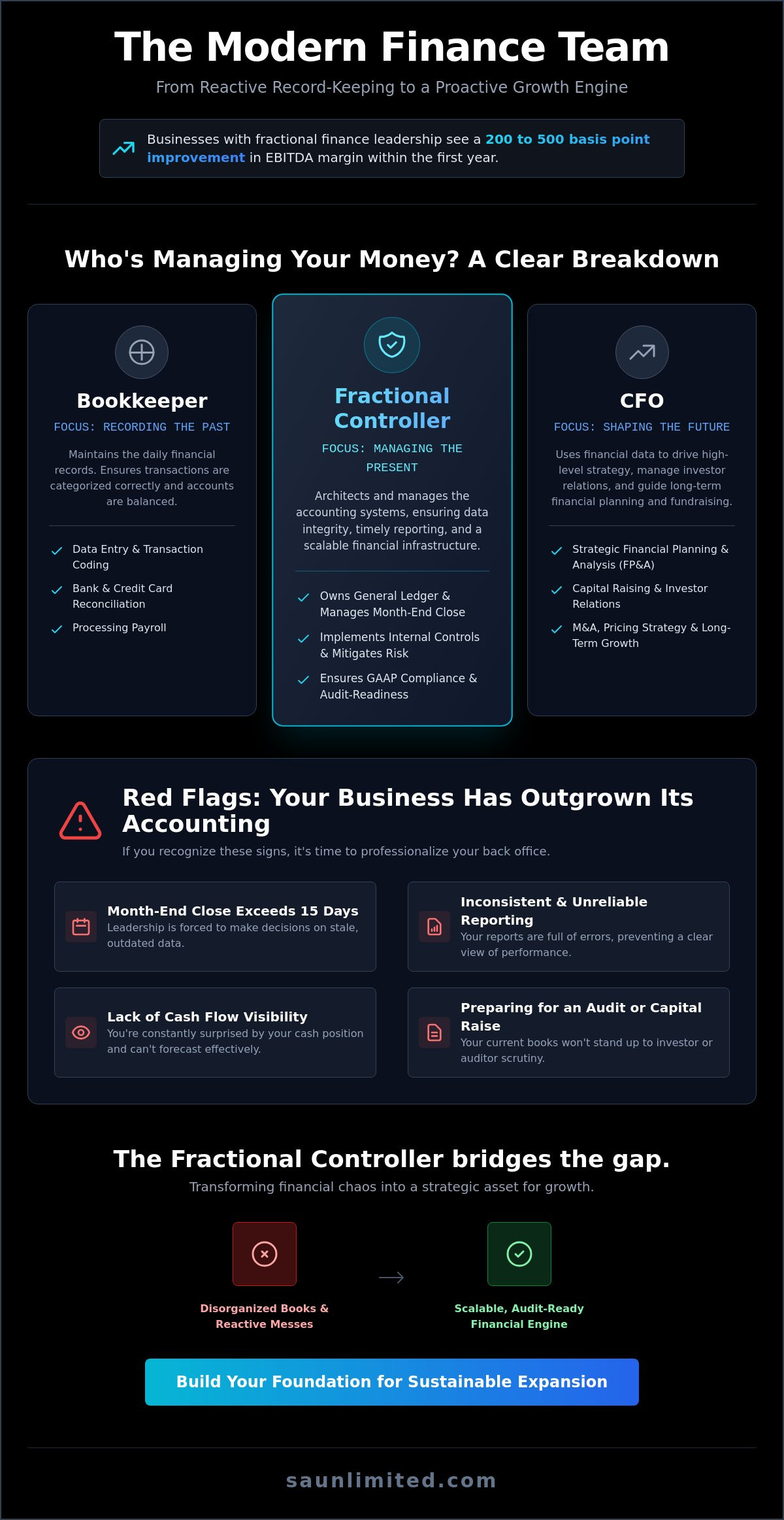
A fractional controller serves as the strategic architect of your back office, transforming disorganized books into a scalable, audit-ready financial engine. They bridge the gap between basic bookkeeping and the high-level strategy your leadership team demands. Industry data indicates that businesses utilizing fractional finance leadership often see a 200 to 500 basis point improvement in their EBITDA margin within the first year. This article will break down how these experts implement internal controls and deliver the timely, accurate data you need to drive growth and satisfy investors. Discover how to stop reacting to financial messes and start building a proactive foundation for sustainable expansion.
In this article, you will learn:
- Understand exactly what does a fractional controller do to move your business beyond simple record-keeping and into high-performance financial management.
- Discover how a controller builds a scalable engine by owning the general ledger and implementing robust internal controls to protect your assets.
- Distinguish between the roles of bookkeepers, controllers, and CFOs to ensure you have the right talent driving your data integrity and long-term strategy.
- Identify the critical warning signs that your business has outgrown its current setup, such as month-end closings that consistently exceed 15 days.
- Learn how integrating professional accounting with high-level consulting creates an audit-ready infrastructure prepared for your next capital raise or successful exit.
Defining the Fractional Controller: More Than Just Oversight
A fractional controller isn’t a glorified bookkeeper or a part-time supervisor. They are high-level accounting professionals hired on a contractual basis to build the systems your company needs to survive rapid growth. When asking what does a fractional controller do, the answer lies in the shift from reactive to proactive management. They don’t just record what happened last month. They design the controls and reporting structures that ensure your data is accurate, audit-ready, and strategically useful. This role provides the elite expertise required to manage complex financial ecosystems without the six-figure salary burden of a full-time executive.
Think of the controller as the essential bridge in your organization. They sit between the transactional data handled by your accounting staff and the high-level strategy provided by CFO consulting. Historically, this role has been synonymous with the Comptroller, an executive responsible for overseeing the quality of all accounting and financial reporting. By bringing this level of rigor to your business on a fractional basis, you gain an architect who turns messy spreadsheets into a professionalized back office. You stop guessing about your cash position and start relying on a single source of truth.
The Core Evolution of the Role in 2026
Digital transformation has completely redefined the controller’s daily workflow. The days of waiting 30 days for a retrospective report are over. Modern controllers leverage advanced automation and cloud-based systems like Sage Intacct to provide real-time financial visibility. This allows leadership to make decisions based on what is happening now, not what happened six weeks ago. The 2026 controller is a systems-first financial leader who prioritizes scalable architecture over manual data entry. They ensure your tech stack talks to your general ledger, eliminating the human errors that lead to audit failures.
Why ‘Fractional’ is the Preferred Model for Mid-Cap Firms
For mid-cap firms, the ROI of a fractional leader far outweighs hiring a full-time mid-level manager. A fractional controller brings “cross-pollination” to your business. Because they work with multiple companies across various industries, they bring battle-tested best practices that a single-company employee simply wouldn’t have. This model also offers unparalleled flexibility. You can scale their hours up during a heavy audit or a capital raise and scale them back during quieter seasons. You pay for high-impact results and strategic infrastructure, not for someone to sit at a desk forty hours a week. It is a lean, powerful way to access top-tier talent that drives expansion.
The Core Responsibilities: Building a Scalable Financial Engine
If you’re wondering what does a fractional controller do on a day-to-day basis, think of them as the guardian of your financial integrity. They own the general ledger. They ensure every transaction is coded correctly and every account is reconciled. This isn’t just about balancing books; it’s about creating a single source of truth that the CEO and investors can trust implicitly. By overseeing the Role and Responsibilities of a Financial Controller, these experts professionalize your back office, ensuring that your financial data is accurate, consistent, and ready for high-level analysis.
One of the most visible impacts of a fractional controller is the transformation of the month-end close process. In many growing businesses, closing the books can drag on for weeks, leaving leadership with stale data. A skilled controller implements rigorous workflows to ensure the close is completed quickly and accurately, often targeting a window of ten days or less. They also manage the critical functions of accounts payable (AP), accounts receivable (AR), and payroll systems. This oversight ensures that vendors are paid on time, cash is collected efficiently, and employees are compensated accurately, all while maintaining strict compliance with GAAP standards.
Internal Controls and Risk Mitigation
A fractional controller protects your company’s assets by building a robust framework of internal controls. Even for small, growing teams, they establish a “segregation of duties” to prevent fraud and minimize human error. They don’t just identify risks; they solve them. This includes rigorous verification of assets and ensuring that all tax compliance and regulatory filings are handled proactively. By creating these guardrails, they prepare your business for external audits long before an auditor ever knocks on your door. If you want to ensure your infrastructure is truly audit-ready, our fractional accounting services provide the seasoned oversight needed to mitigate risk at every level.
Optimizing the Modern Tech Stack (Sage Intacct)
The modern controller is the primary owner of your Enterprise Resource Planning (ERP) system. They move your business beyond the limitations of basic software and eliminate “manual spreadsheet hell.” By leveraging Sage Intacct, a fractional controller can build custom reporting dashboards and automate repetitive tasks. This technological shift allows for real-time visibility into your cash flow and departmental spending. They turn your accounting software from a simple digital ledger into a powerful, automated engine that fuels informed decision-making and supports rapid organizational scaling.
Controller vs. CFO vs. Bookkeeper: Knowing the Difference
Many business owners make the mistake of treating finance as a single, monolithic department. They hire a bookkeeper and expect them to provide executive-level insights, or they hire a CFO and wonder why that high-priced strategist is stuck fixing errors in the general ledger. To scale effectively, you must understand the Hierarchy of Finance. If the bookkeeper is the bricklayer and the CFO is the city planner, the controller is the foreman and systems architect. When people ask what does a fractional controller do, they’re really asking how to bridge the gap between daily transactions and long-term vision.
The distinction between these roles comes down to data integrity versus data entry. A controller’s primary mission is to ensure the quality and accuracy of the financial reporting process. This involves more than just oversight; it requires a deep understanding of treasury and accounting quality. As noted in the professional definition of a Controller (General), this role is responsible for the technical accuracy of all financial statements and the implementation of the internal controls that protect company assets. They don’t just record the numbers; they validate the systems that produce them.
The Bookkeeper: The Foundation of Transactions
Bookkeeping is transactional by nature. It’s about recording bills, processing invoices, and matching bank statements. While essential, a bookkeeper isn’t trained to build complex financial systems or manage the “what does a fractional controller do” level of technical compliance. Asking a bookkeeper to perform controller-level duties is a significant risk. Without a seasoned professional designing the workflows, you’ll likely face inconsistent reporting and a lack of audit-ready data. Bookkeepers follow processes; controllers build them.
The CFO: The Architect of Strategy
A CFO’s value lies in high-level capital allocation, M&A strategy, and investor relations. However, a CFO is only as good as the data they receive. If the controller hasn’t professionalized the back office, the CFO will spend 80% of their time cleaning up messy books instead of driving growth. The synergy between these roles is what creates a truly scalable organization. For a deeper look at how high-level strategy integrates with these systems, explore our Fractional CFO Services Guide. By separating these functions, you ensure each professional is operating at their highest level of impact.
Signs Your Business Has Outgrown Its Current Accounting Setup
Growth is a double-edged sword. As your revenue climbs, the simple accounting processes that served you at $1 million in revenue will inevitably fail at $10 million. If your month-end close is consistently taking longer than 15 days after the month ends, you’re operating on stale data. By the time you see the reports, the window for strategic adjustment has already closed. This is a primary indicator that your back office lacks the structural integrity to support your current scale. When CEOs find themselves spending more than 5 hours a week answering accounting questions or untangling payroll errors, they’ve stopped being visionaries and started being expensive clerks.
Inaccurate financial reports are another glaring red flag. If your statements require frequent “corrections” or “reclassifications” after they’ve been issued, your investors and lenders will lose confidence. Understanding what does a fractional controller do helps you recognize that these errors aren’t just mistakes; they’re symptoms of a system that has reached its breaking point. You need a professional who can transition your business from “good enough” bookkeeping to institutional-grade financial reporting that stands up to scrutiny.
Audit Readiness and Compliance Pressures
A clean audit is nearly impossible without controller-level oversight. Auditors look for documented internal controls and a clear audit trail; these are things that basic bookkeeping services rarely prioritize. The hidden costs of non-compliance, from regulatory fines to delayed capital rounds, can be devastating to a growing firm. A fractional controller acts as your primary point of contact for external auditors, shielding your internal team from the stress of the process. They ensure every transaction is documented and every policy is followed, creating a culture of accountability that makes your business attractive to Series B investors and potential acquirers.
Scaling Pains: When Volume Exceeds Capacity
Manual accounting processes have a hard limit. As transaction volume increases, the risk of human error skyrockets. A fractional controller identifies this “break point” before it causes a total system failure. They facilitate the critical transition from cash-basis to accrual-basis accounting, providing a more accurate picture of your company’s long-term health. In the 2026 remote-first environment, this professional also manages the digital workflows that allow your finance team to operate seamlessly across time zones. They prepare your infrastructure for 2x or 5x revenue growth by implementing automated systems that don’t require adding massive headcount. If you’re ready to professionalize your back office and stop the manual grind, explore our fractional controller services to build a foundation for scale.
The SA Unlimited Approach: Proactive Financial Partnership
At SA Unlimited, we reject the notion that accounting is a passive back-office utility. It’s a strategic weapon. Our “Unlimited” philosophy is built on a simple premise: we don’t just find problems; we solve them. When you ask what does a fractional controller do within our ecosystem, the answer is that they act as a proactive force for clarity and precision. They don’t hand you a list of discrepancies and walk away. They roll up their sleeves, fix the underlying system failures, and ensure those errors never return. This results-oriented approach moves your business from simply surviving its financials to weaponizing them for aggressive growth.
We believe that high-level strategy is only as strong as the data supporting it. That’s why we seamlessly integrate our fractional accounting services with elite CFO consulting. This partnership ensures that the “how” of your accounting matches the “where” of your long-term vision. By utilizing our deep expertise in Sage Intacct, we create a level of financial transparency that mid-cap firms rarely achieve on their own. We replace manual guesswork with automated, real-time dashboards that give you the confidence to make bold moves in a competitive market.
Tailored Tiers for Every Stage of Growth
Every business follows a unique trajectory, so we provide flexible operational tiers to match your specific needs. Whether you require our Hourly support for targeted projects, our Review tier for high-level oversight, or our Unlimited model for total financial ownership, we match our talent to your industry. Our onboarding process is designed for speed and impact. We take clients from messy, disorganized books to a streamlined, professionalized dashboard in just 90 days. We don’t believe in long, drawn-out transitions; we believe in immediate execution and measurable results.
Ready to Scale? Your Next Strategic Move
Waiting for a “full-time need” before hiring top-tier financial leadership is a costly mistake. Research indicates that 38% of US small and medium-sized businesses with revenues under $25 million already utilize fractional finance leadership to stay competitive. The impact is quantifiable. Businesses that engage a fractional leader typically see a 200 to 500 basis point improvement in their EBITDA margin within the first year. Additionally, these engagements often cost 40% to 70% less than a full-time executive hire, allowing you to reinvest that capital into your core operations. Don’t let a weak financial infrastructure cap your potential. It’s time to build a scalable, audit-ready engine that drives your valuation higher. Book a consultation with SA Unlimited today and take control of your financial future.
Architect Your Financial Success
Your business deserves a financial infrastructure that matches your ambition. We’ve explored the critical distinctions between transactional bookkeeping and executive oversight, and we’ve identified the red flags that signal your current systems are reaching their limit. So, what does a fractional controller do to solve these pains? They act as the strategic architect who builds audit-ready engines and ensures your data integrity is beyond reproach. They don’t just manage your current state; they prepare you for your future valuation.
At SA Unlimited, we don’t just identify gaps. We close them. Our expertise in Sage Intacct implementation and our tiered pricing models allow you to access elite talent at a scale that fits your current growth stage. We provide a proactive, results-oriented partnership that turns your back office into a catalyst for expansion. Stop letting disorganized books cap your potential and start leveraging financial transparency as a competitive advantage.
The path to your next capital raise or successful exit begins with a foundation you can trust. It’s time to stop reacting to the past and start building for the future. Let’s scale your business together.
Frequently Asked Questions
What is the difference between a fractional controller and a part-time bookkeeper?
A part-time bookkeeper focuses on recording transactions, while a fractional controller focuses on the integrity of the entire financial system. While the bookkeeper handles data entry, the controller ensures that the data is accurate, follows GAAP, and is protected by internal controls. This role provides the strategic oversight required to move from basic record-keeping to professional financial reporting.
How many hours a week does a fractional controller typically work?
Most fractional controllers work between 5 and 15 hours per week, depending on the complexity of your operations. This flexibility allows you to scale their involvement during high-intensity periods, such as a month-end close or an audit, and reduce hours during quieter months. It’s a cost-effective way to access executive talent without the burden of a full-time executive salary.
Can a fractional controller help my business prepare for an audit?
Yes, a fractional controller is the primary architect of an audit-ready back office. They implement the internal controls and segregation of duties that auditors require to verify the accuracy of your financial statements. By acting as the main point of contact for external auditors, they shield your internal team from the stress and technical demands of the audit process.
Is a fractional controller responsible for tax preparation?
Yes, we include tax planning and preparation as part of our comprehensive service offerings. While many leaders ask what does a fractional controller do, they often forget the importance of integrating tax strategy with daily accounting. We ensure that your financial data is structured correctly throughout the year to maximize tax efficiency and ensure timely, accurate filings.
What software does a fractional controller usually use?
While many small businesses start on QuickBooks, a fractional controller usually transitions growing firms to more robust ERP systems like Sage Intacct. These platforms offer the advanced automation and custom reporting needed for real-time financial visibility. We specialize in Sage Intacct consulting to help you eliminate manual spreadsheet errors and build a scalable tech stack that supports rapid expansion.
At what revenue level should a company hire a fractional controller?
Most companies begin looking for a fractional controller when they hit the $5 million to $10 million revenue mark. At this stage, the complexity of managing payroll, compliance, and multi-departmental spending often exceeds the capabilities of a bookkeeper. If your month-end close is taking longer than 15 days, it is a clear sign that your business needs professional controller-level oversight.
Does a fractional controller manage my existing accounting staff?
Yes, a fractional controller typically manages your existing accounting staff, including accounts payable, accounts receivable, and payroll clerks. They provide the technical guidance and quality control necessary to ensure your team is operating at peak efficiency. This oversight ensures that every transaction is coded correctly and that your internal staff follows the rigorous workflows required for data integrity.
How does a fractional controller coordinate with a fractional CFO?
The fractional controller provides the accurate, timely data that the fractional CFO uses to drive long-term strategy. When evaluating what does a fractional controller do, it is helpful to see them as the data provider and the CFO as the data user. While the controller focuses on the integrity of the general ledger, the CFO focuses on capital raising, forecasting, and M&A strategy.