

Is your business running on a patchwork of disconnected spreadsheets and software? If you’re struggling to get a clear, real-time picture of performance and feel your current systems are holding back growth, you’ve likely heard the acronym ‘ERP’ tossed around as the ultimate solution. But for ambitious leaders, knowing what erp stands for is just the starting point. The real question is what it can do for you. This isn’t just another piece of technology; it’s a strategic command center for your entire operation.
In this plain-English guide, we cut through the technical jargon to empower you with strategic clarity. We’ll go beyond the acronym to reveal what Enterprise Resource Planning truly is, how it works, and why it’s the key to unlocking scalable, profitable growth. You will leave with the confidence to determine if and when an ERP is the right move for your company and the authority to lead that conversation. It’s time to build the foundation for your future success.
Key Takeaways
- While ERP stands for Enterprise Resource Planning, its true meaning for leaders is creating a single source of truth to drive strategic decisions with confidence.
- An ERP system is not just an IT project; it’s a strategic investment that delivers the data clarity required to unlock profitable, scalable growth.
- Understand how a centralized ERP platform demolishes data silos, empowering your entire team to operate with unified, real-time information.
- Pinpoint the exact operational pain points that signal your business has outgrown its current systems and is ready for the power of an integrated solution.
ERP Stands for Enterprise Resource Planning: What That Actually Means
So, what does erp stands for? The textbook answer is Enterprise Resource Planning, a term for the integrated management of core business processes. But for a leader, that definition barely scratches the surface. It’s a definition that describes the tool, not the transformation.
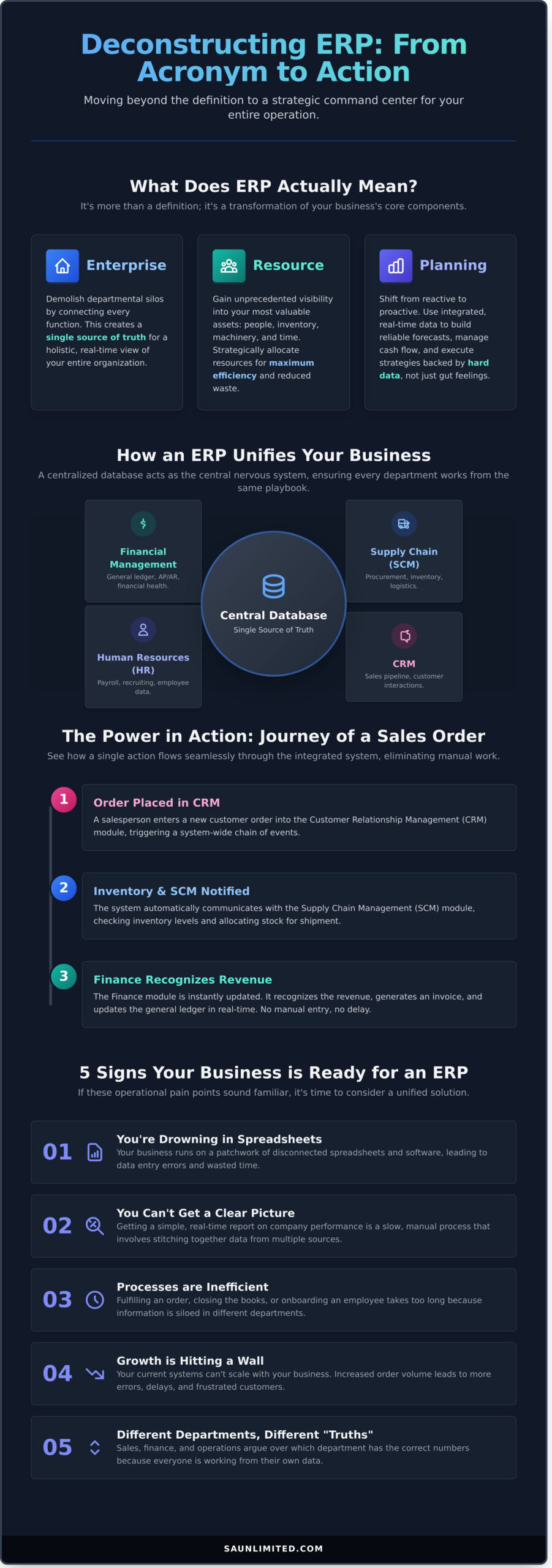
Think of an ERP not as software, but as the central nervous system of your entire operation. It’s the strategic platform that unifies every critical function-from finance and HR to supply chain and sales-into a single, intelligent system. This integration marks a fundamental shift in how you lead: moving from simply recording business history to actively planning its future with confidence and clarity.
Enterprise: A Holistic View of Your Business
An ERP system is engineered to demolish the departmental silos that create friction and blind spots. It connects every function, creating a seamless flow of information from the executive suite to the warehouse floor. The result is a single source of truth that empowers every decision-maker with a complete, real-time view of the entire organization. No more conflicting reports or data discrepancies-just one powerful version of reality.
Resource: Managing Your Most Valuable Assets
When we talk about resources, we mean far more than just capital. Your most valuable assets are your people, your inventory, your machinery, and your time. An ERP provides unprecedented visibility into the status and utilization of every single asset. This clarity allows you to move beyond guesswork and strategically allocate resources for maximum efficiency, reduced waste, and ultimately, a more profitable and resilient enterprise.
Planning: From Reactive to Proactive Strategy
This is where an ERP truly unlocks your strategic potential. Instead of reacting to market shifts, you can anticipate them. With integrated, real-time data, you can build reliable sales forecasts, manage cash flow with precision, and optimize production schedules. An ERP transforms your leadership from relying on gut-feel decisions to executing proactive strategies backed by hard data. It empowers you to identify challenges and seize opportunities before your competitors even see them coming.
How an ERP System Works: Unifying Data and Processes
To truly grasp the strategic value of an ERP, you must look beyond the acronym. While ERP stands for Enterprise Resource Planning, its real power lies in how it creates a single, unified nervous system for your entire organization. It’s not just another piece of software; it’s a foundational shift from operational chaos to strategic clarity.
At its core, an ERP system is built on a centralized database. This single architecture eliminates the dangerous data silos and redundant spreadsheets that plague growing companies. Every piece of information is entered once and is then instantly accessible and consistent across all departments, empowering your teams to act with confidence.
The Core Concept: A Single Source of Truth
Imagine a world without debates over which department has the “right” numbers. That is the world an ERP creates. When your sales team closes a deal, the inventory module instantly knows what to ship, and the finance module immediately recognizes the revenue. This isn’t a manual process of reconciliation; it’s an automated, real-time reflection of your business reality-a single source of truth that drives decisive action.
Common ERP Modules and What They Do
An ERP system is composed of interconnected modules, each designed to manage a specific business function. Think of them as specialized applications that all speak the same language because they share the same central database. Key modules include:
- Financial Management: The heart of the system. This module manages the general ledger, accounts payable (AP), accounts receivable (AR), and financial reporting, giving you a real-time view of your company’s financial health.
- Supply Chain Management (SCM): Your command center for physical operations. It handles everything from procurement and supplier management to inventory control, warehousing, and logistics.
- Human Resources (HR): Manages your most critical asset-your people. This module streamlines payroll, benefits administration, recruiting, onboarding, and employee data management.
- Customer Relationship Management (CRM): The engine for growth. It manages your sales pipeline, tracks customer interactions, and supports marketing efforts to build and maintain profitable relationships.
A Practical Example: The Journey of a Sales Order
The true power of this integration is best seen in action. Follow a single customer order as it flows seamlessly through the ERP:
- A salesperson enters a new order into the CRM module.
- The system automatically communicates with the SCM module to verify inventory levels and reserve the product. If stock is low, it can trigger a procurement request.
- Once the order is fulfilled, the Finance module automatically generates an invoice and records the transaction in the general ledger.
This frictionless flow-from sales to fulfillment to finance-is what a modern ERP delivers. It replaces manual handoffs with automated precision, unlocking the efficiency and visibility your business needs to scale profitably.
The Strategic Benefits of ERP: Why It Matters for Growth
Let’s be clear: Implementing an ERP is not an IT project. It’s a strategic business initiative designed to fuel your growth. Too many leaders get lost in the technical details, forgetting what an erp stands for at its core-a unified engine for enterprise-wide clarity and control. A modern ERP moves you from reactive problem-solving based on siloed, outdated spreadsheets to proactive, data-driven leadership. It provides the single source of truth you need to make bold, confident moves that directly impact your bottom line.
Superior Data Visibility and Decision-Making
An ERP system demolishes data silos, consolidating information from finance, sales, operations, and HR into one accessible hub. This isn’t just about collecting data; it’s about transforming it into strategic intelligence. Your leadership team is empowered with:
- Real-time dashboards: Instantly visualize key performance indicators (KPIs) and operational health without waiting for month-end reports.
- Granular profitability insights: Confidently identify your most profitable products, customers, and sales channels to focus resources where they matter most.
- Accurate forecasting: Leverage historical data and current trends to build more reliable financial and operational forecasts.
Increased Operational Efficiency
Imagine eliminating the hours your team wastes on manual data entry, reconciling reports, and chasing down information. An ERP automates and streamlines core business processes, enforcing best practices across the organization. This operational discipline frees your top talent from repetitive, low-value tasks like invoicing and order processing, unleashing their time to focus on strategic initiatives, innovation, and high-touch customer service.
A Foundation for Scalability
Growth exposes weakness. The disparate systems and manual workarounds that function for a small company will inevitably break under the pressure of increased transaction volume and complexity. An ERP is the architectural foundation that supports your ambition. It’s designed to scale with you, ensuring that standardized processes make it simple to onboard new team members, open new locations, and expand into new markets without the chaos. This is what a true partnership with technology looks like-a system that delivers on what erp stands for: a unified plan for all your enterprise resources, ready for whatever comes next.
As you expand into new markets, managing multilingual documentation for compliance, operations, and marketing becomes critical. For businesses navigating this complexity, it’s wise to explore Document Translation services to ensure clarity and consistency across all languages.
Types of ERP Systems: Cloud vs. On-Premise
Once you understand what ERP stands for and its potential, your next strategic decision is deployment. This choice between hosting the system on your own servers (on-premise) or accessing it via the internet (cloud) will fundamentally shape your costs, agility, and long-term growth trajectory. It’s a critical fork in the road that determines who manages the technology versus who uses it to drive profitable results.
For today’s leaders, the debate has largely been settled. The agility and scalability of cloud solutions empower businesses to move faster and adapt to market changes with confidence.
On-Premise ERP: The Traditional Approach
An on-premise ERP is installed directly onto your company’s local servers and computers. This model requires a significant upfront capital investment in software licenses, server hardware, and the infrastructure to support it. Your internal IT team bears the full responsibility for system maintenance, security patches, and all future upgrades-a resource-intensive commitment that can divert focus from core business innovation.
Cloud ERP (SaaS): The Modern Standard
Cloud ERP, delivered as a Software-as-a-Service (SaaS) model, has become the definitive choice for agile, growth-focused businesses. Instead of a large upfront purchase, you pay a predictable subscription fee. The provider manages all the technical heavy lifting:
- Lower Total Cost of Ownership: Eliminates the need for expensive hardware and dedicated IT maintenance staff.
- Automatic Updates: You always have the latest features and security protocols without manual intervention.
- Unmatched Accessibility: Securely access real-time data from anywhere, empowering a flexible and decisive leadership team.
To fully leverage these cloud benefits, partnering with a firm that provides tailored IT and telecommunications solutions is key. A specialist like SolaaS LTD can ensure the underlying infrastructure is robust enough to support a powerful ERP system, guaranteeing both flexibility and scalability.
This modern approach provides the financial clarity needed to make bold moves. This agility is why we empower our partners with cutting-edge cloud solutions at SA Unlimited-to unlock your business potential without the burden of IT management.
Hybrid ERP: A Mix of Both Worlds
A hybrid model combines on-premise and cloud solutions, often used as a strategic stepping stone for established companies transitioning legacy systems. This allows you to retain certain on-premise applications for specific operational needs (like manufacturing floor systems) while leveraging the cloud for finance and HR. While it offers flexibility, a hybrid strategy can introduce complexity in data integration and management that must be carefully governed.
5 Signs Your Business Is Ready for an ERP
Making the leap to a unified system is a significant strategic move. While knowing what ERP stands for-Enterprise Resource Planning-is the first step, recognizing the precise moment your business needs one is what unlocks its transformative power. If your team is battling operational friction and your current tools are creating more problems than they solve, you’ve likely reached a critical inflection point. These common pain points are clear signals that you’ve outgrown your disparate systems and are ready for a more powerful, integrated solution.
You’re Drowning in Spreadsheets
Are your most critical business functions-from financial reporting to inventory tracking-running on a patchwork of manual spreadsheets? This is a classic sign of inefficiency. When your team spends more time reconciling conflicting data and correcting manual entry errors than performing high-value analysis, you are losing a competitive edge. This reliance on spreadsheets creates a nightmare of version control and puts your company’s data integrity at risk, directly impacting your ability to make confident decisions.
You Can’t Get Answers Quickly
In today’s market, speed and clarity are paramount. If you can’t get a clear, real-time view of your company’s performance, you’re operating in the dark. The warning signs include:
- It takes days or even weeks to generate basic financial or operational reports.
- Different departments operate with their own “version of the truth,” leading to confusion and mistrust.
- You lack a consolidated, immediate view of cash flow, sales pipelines, and inventory levels.
An ERP system dismantles these data silos, providing a single source of truth that empowers decisive leadership.
Your Processes Are Holding You Back
Growth exposes the weaknesses in fragmented processes. Painfully slow month-end closes, inventory levels that are disconnected from sales data, and purchasing that can’t keep up with demand are not just frustrations-they are direct barriers to profitability. Your ambition to scale is being actively throttled by software that was never designed to support it. True enterprise resource planning aligns these functions, creating a seamless operational flow that fuels growth instead of fighting it.
If these challenges sound painfully familiar, it’s not a sign of failure; it’s a signal for evolution. Recognizing these limitations is the first step toward building a more resilient, efficient, and profitable future. Feeling these pains? A strategic partner can help you find the solution.
Beyond the Acronym: Unlocking Your Growth Potential
Now you know that erp stands for Enterprise Resource Planning-but more importantly, you understand it represents a strategic transformation for your entire organization. It’s the central nervous system that unifies your data, streamlines complex operations, and provides the real-time financial clarity needed to make bold, confident decisions. Recognizing the signs that you’ve outgrown your current systems is the critical first step toward building a powerful, integrated engine for sustainable growth.
Choosing the right ERP system is a pivotal decision, and you don’t have to make it alone. At SA Unlimited, we do more than implement software; we architect financial clarity. With decades of strategic financial expertise, our specialists in Sage Intacct implementation are dedicated to helping companies like yours scale with confidence. We solve for yes, creating the pathways for your ambition.
Ready to unlock your business potential? Let’s discuss the right financial systems for your growth. Your next chapter is waiting.
Frequently Asked Questions About ERP Systems
What is the main difference between ERP and accounting software like QuickBooks?
Think of it as the difference between a specialized tool and a complete command center. Accounting software like QuickBooks is a powerful tool for one job: managing your books. An ERP system is a strategic platform that integrates all core business functions-finance, HR, manufacturing, supply chain, and more-into a single source of truth. It moves you from just tracking finances to actively orchestrating your entire operation for maximum profitability and strategic growth.
What is the difference between ERP and CRM?
The core difference is focus: front-office versus back-office. A Customer Relationship Management (CRM) system is laser-focused on managing your external customer journey-sales, marketing, and service interactions. An ERP, however, is the operational backbone of your business, managing internal resources like inventory, financials, and human resources. While top-tier ERPs often include CRM modules, their primary purpose is to optimize internal efficiency and unlock enterprise-wide clarity.
How much does an ERP system typically cost?
ERP pricing is an investment in growth, not an expense, and it scales with your ambition. Costs vary based on business size, complexity, and deployment (cloud vs. on-premise). A small business might invest $10,000 to $50,000 annually for a cloud solution. A mid-sized enterprise could see costs from $150,000 to $750,000 for implementation and licensing. The key is to measure this investment against the immense ROI from enhanced efficiency and strategic clarity.
How long does it take to implement an ERP system?
A strategic implementation is a marathon, not a sprint, designed for long-term results. The timeline depends on your company’s scale and complexity. A straightforward cloud ERP for a smaller business might take 3-6 months to go live. For a large, multi-departmental enterprise, implementation can range from 8 to 18 months or more. This deliberate process ensures the system is perfectly aligned with your strategic goals, creating a powerful engine for sustained growth from day one.
Can a small business use an ERP?
Absolutely. The modern ERP is built for growth at any scale. Gone are the days when ERPs were only for global giants. Cloud-based solutions now offer scalable, affordable options specifically for small and mid-sized businesses seeking a competitive edge. An ERP provides the integrated data needed to make bold moves. After all, ERP stands for Enterprise Resource Planning-and managing your resources effectively is critical, whether you have 10 employees or 10,000.
Is Sage Intacct considered an ERP system?
Sage Intacct is a top-tier financial management system that functions as the core of a modern ERP strategy. While it doesn’t have native modules for manufacturing or supply chain like a traditional system, it excels at providing deep financial clarity. It’s designed to integrate seamlessly with other best-in-class applications (like CRM or HR), creating a powerful, customized ERP ecosystem. This approach proves that what ERP stands for is evolving beyond a single, monolithic system.