
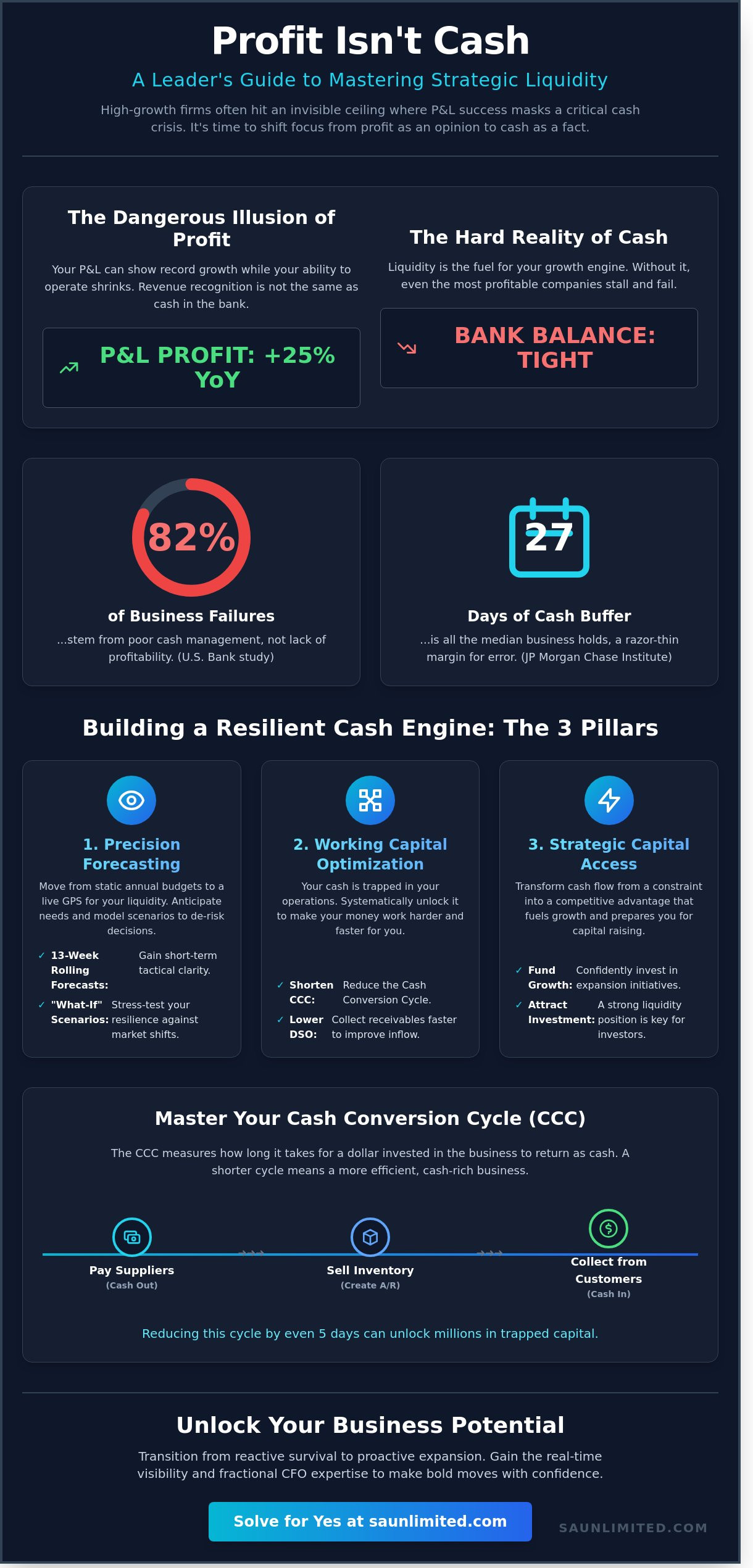
Your P&L statement says you’re winning, but your bank balance says you’re stuck. It’s a frustrating reality for mid-cap leaders where revenue grows by 25% year-over-year, yet the actual liquidity feels tighter than ever. If you’re searching for how to improve cash flow management, you’re likely tired of manual forecasting that takes 10 hours a week only to be outdated by Tuesday. When the JP Morgan Chase Institute reports that the median business holds only 27 days of cash buffer, it’s clear that growth without a plan is just a faster way to run out of fuel. We agree that you shouldn’t have to choose between scaling and stability.
This guide will show you how to master the strategic levers of liquidity to transform your cash flow from a constraint into a competitive advantage. At SA Unlimited, we solve for yes by providing the clarity you need to move from reactive survival to proactive expansion. We’ll help you build predictable cycles and gain real-time visibility that empowers you to make bold moves with confidence. We’re rolling up our sleeves to help you unlock your business potential through 13-week rolling forecasts and optimized working capital strategies.
Key Takeaways
- Understand why accounting profit often masks critical liquidity gaps and how to break through the “invisible ceiling” that frequently stalls high-growth companies.
- Discover how to improve cash flow management by optimizing your Cash Conversion Cycle to bridge the gap between operational spending and revenue collection.
- Learn how to transition from reactive accounting to real-time visibility using automated, multi-entity reporting tools designed to scale with your enterprise.
- Unlock your business potential by leveraging fractional CFO expertise to build a resilient financial engine and prepare your organization for capital raising.
- Identify the three strategic pillars of liquidity that transform cash from a growth constraint into a powerful competitive advantage for your mid-cap firm.
The Invisible Ceiling: Why Profit Doesn’t Equal Cash Flow in 2026
Your P&L statement shows a record year, yet your bank balance tells a different story. This is the invisible ceiling. In 2026, mid-cap firms are discovering that accounting profit is a vanity metric; liquidity is the only reality that keeps the lights on. A 2024 study by U.S. Bank found that 82% of business failures stem from poor cash management. For a high-growth firm, the danger is amplified. Rapid scaling often requires upfront investment in inventory, talent, and infrastructure long before the first invoice is paid. This gap creates a “Growth-Induced Cash Deficiency” that can sink even the most profitable enterprises. Moving from reactive firefighting to proactive strategic planning is the only way to unlock your business potential.
Understanding how to improve cash flow management begins with a shift in mindset. You can’t manage what you don’t measure with precision. At SA Unlimited, we believe you must Know Your Numbers to make bold moves. If you’re chasing revenue without a clear view of your liquidity, you’re driving a car at 100 mph without a fuel gauge. Strategic leaders prioritize a deep understanding of cash flow to ensure their growth is sustainable, not just visible.
The Profit vs. Cash Paradox
Your P&L statement can be dangerously misleading during rapid scaling. Revenue recognition rules often allow you to record a sale as soon as the contract is signed, but that doesn’t put money in your vault. If your AR cycle is 45 days and your payroll is due every 14, you have a structural deficit. This is why many CEOs focus on EBITDA as a proxy for health. While EBITDA provides a snapshot of operational efficiency, it doesn’t account for the capital expenditures or the working capital swings that drain your actual liquidity. Profit is an opinion; cash is a fact.
Common Cash Flow Killers in Mid-Cap Firms
The most common trap is “overtrading.” This happens when a firm takes on more work than its current cash reserves can support. Aggressive expansion without a 20% cash reserve buffer is a recipe for a crunch. Inefficient accounts receivable processes are another silent killer. When your AR team lacks a rigorous follow-up system, your lifeblood stays trapped in your customers’ bank accounts. To solve for yes, you must have a clear understanding of your burn rate. This means knowing exactly how many months you can survive if new sales stopped tomorrow. We roll up our sleeves to help you identify these leaks, ensuring you have the clarity and confidence to scale without fear. Mastering how to improve cash flow management isn’t just about survival; it’s about creating the pathways for your next billion-dollar milestone.
Building a Resilient Cash Flow Engine: The 3 Pillars of Strategic Liquidity
Mid-cap growth requires a decisive shift from reactive survival to proactive strategy. You need a framework that prioritizes absolute visibility and control over every dollar. This isn’t about reviewing last month’s bank statement; it’s about controlling the future. High-level financial advisory ensures your margins don’t just look good on paper; they must materialize as liquid cash. At this stage of growth, your executive team must align around cash-centric KPIs to ensure everyone is pulling in the same direction. Focus on metrics that matter, such as:
- Days Sales Outstanding (DSO): Reducing this by even 5 days can unlock millions in trapped capital.
- Operating Cash Flow (OCF): The lifeblood of your internal reinvestment strategy.
- Cash Conversion Cycle (CCC): A shorter cycle means your money works harder for you.
Pillar 1: Precision Forecasting and Modeling
A budget is a static map created once a year. A dynamic cash flow forecast is a live GPS. It’s the primary tool for how to improve cash flow management. Mid-cap leaders must utilize 13-week rolling forecasts to anticipate ripples before they become waves. Scenario planning allows you to model “what if” situations, such as a 15% spike in raw material costs or a 20% delay in a major contract. A Fractional CFO builds these sophisticated models to ensure your growth trajectory stays funded and your investors stay confident. This level of precision transforms uncertainty into a calculated roadmap.
Pillar 2: Optimized Working Capital Management
Efficiency lives in the gap between your payables and receivables. You must accelerate inflows without alienating your client base. This might involve offering 2% discounts for early payments or transitioning to milestone-based billing for long-term projects. On the flip side, manage outflows by negotiating 45 or 60-day terms with vendors to favor your cycle. Integrating actionable strategies from financial experts helps you tighten inventory levels and reduce Work in Progress (WIP) lag. Every day shaved off your cash conversion cycle is capital you don’t have to borrow from the bank.
Pillar 3: Strategic Capital Allocation
Operational vs. Strategic Levers: Optimizing Your Cash Conversion Cycle
Efficiency isn’t just about cutting costs; it’s about velocity. For mid-cap firms, the Cash Conversion Cycle (CCC) acts as a high-stakes speedometer for your liquidity. The Cash Conversion Cycle is the number of days it takes for a company to convert its investments in inventory and other resources into cash flows from sales. If your CCC is 45 days while your top competitor operates at 30, you’re essentially handing them a 15-day head start on every dollar. Shortening this gap requires a mix of tactical precision and bold, strategic shifts. Strategic pricing adjustments are often the fastest way to move the needle. Data shows that a 1% improvement in pricing can boost operating profit by up to 11% for many enterprises. This creates an immediate cash cushion without increasing sales volume.
Benchmarks are your North Star. Industry leaders often achieve a negative CCC, meaning they get paid by customers before they ever have to pay their suppliers. While that’s the gold standard, your goal is consistent, measurable reduction. To understand how to improve cash flow management, you must analyze where your capital stalls. Is it sitting in a warehouse? Is it trapped in an unpaid invoice? We help you identify these friction points to ensure your capital is always working, never waiting.
Accelerating the Inflow: AR Best Practices
Managing the Outflow: AP and Supplier Strategy
Strategic outflow management isn’t about hoarding cash; it’s about intentional deployment. Tier your vendors based on strategic importance. Critical suppliers should be paid on time to protect your supply chain, but secondary vendors may accept extended terms in exchange for guaranteed long-term volume. At SA Unlimited, we apply a “Solve for Yes” mentality to every negotiation. This means finding creative pathways where both parties win. Don’t just ask for more time. Offer a larger share of your wallet for better terms. You should also weigh bulk discounts against cash on hand. If your cost of capital is 8% and a supplier offers a 3% discount for bulk buying, keeping the cash might be the smarter play. This level of strategic thinking is how you unlock your business potential and scale with unwavering commitment.
The Digital Advantage: Leveraging Sage Intacct for Real-Time Cash Visibility
Scaling a mid-cap company requires more than just grit; it requires a tech stack that keeps pace with your ambition. Most growth-stage founders start with QuickBooks, but that system often hits a wall when you add your third or fourth entity. Manual workarounds create data silos. These silos lead to blind spots. If you want to master how to improve cash flow management at scale, you must move beyond entry-level software and embrace a single source of truth.
Sage Intacct provides the architectural foundation for this transition. By integrating your ERP directly with your banking institutions and CRM, you eliminate the lag time between a sale and its impact on your liquidity. This real-time synchronization allows leadership to make bold moves with absolute confidence. You no longer have to guess if you can afford a new acquisition or a massive capital expenditure. You know your numbers, and you know them now.
Beyond Spreadsheets: The Case for Sage Intacct
Manual AR and AP workflows are the silent killers of liquidity. When your team relies on disconnected spreadsheets, manual errors are inevitable, and human error in finance is expensive. Sage Intacct automates these complex workflows, ensuring that invoices go out on time and bills are paid strategically to maximize float. Custom dashboards allow you to track liquidity across multiple departments or subsidiaries in a single view. Professional Sage Intacct consulting ensures your system is architected for this level of visibility, turning your accounting software into a strategic asset.
AI and Automation in Cash Management
The future of finance is proactive, not reactive. Modern automation uses predictive analytics to spot potential cash shortfalls months before they happen. By automating cash application, you increase data accuracy and speed up the cycle of capital. Sage Intacct allows CFOs to reduce monthly close times by up to 50%, freeing up time for strategic cash analysis. Instead of spending two weeks every month just looking at the past, your finance team can focus on the future. We solve for yes by providing the clarity you need to unlock your business potential.
Ready to transform your financial operations and gain total clarity over your numbers? Let’s connect and build your roadmap to growth.
Scaling with Confidence: Why Fractional CFO Leadership is the Ultimate Strategy
Mid-cap growth requires more than just keeping the books balanced. It demands a high-level financial architect who understands exactly how to improve cash flow management while navigating complex market shifts. A fractional CFO provides the ROI of a seasoned executive without the overhead of a $300,000 annual salary. This strategic partnership moves your business beyond survival mode. We roll up our sleeves to transform your finance department from a passive cost center into a proactive growth driver. By identifying capital leaks and optimizing your cash conversion cycle, we empower you to make bold moves with certainty. Our team brings decades of experience and a history of managing $1B+ in success metrics to your corner.
The Strategic Architect for Growth
CFO consulting provides the essential blueprint for sustainable scaling. We help you transition from founder-led finance to executive leadership, ensuring your systems can handle 5x or 10x volume increases without breaking. Our team builds the financial narrative that wins over investors and lenders. We’ve seen how a clear, data-backed story can be the difference between a rejected loan and a $20 million credit facility. We solve for yes by creating pathways where others only see obstacles. Whether you’re eyeing a strategic acquisition or a new product launch, we provide the rigorous analysis required to move forward. Knowing your numbers means you never walk into a boardroom unprepared.
Unlock Your Business Potential
Professional cash management has a direct impact on company valuation. When you prepare for due diligence or exit planning, clean financials and optimized cash flow can significantly increase your EBITDA multiples. We focus on the details that matter to buyers, from debt-to-equity ratios to predictable recurring revenue models. Our experience ensures your business is always exit-ready, even if you don’t plan to sell for years. Don’t let financial fog hold you back from your next big opportunity. It’s time to gain total clarity on how to improve cash flow management for long-term success. We’re here to help you make the leap from where you are to where you want to be. Ready to know your numbers and solve for yes? Connect with SA Unlimited today.
Master Your Strategic Growth Engine
Success in 2026 requires more than a healthy P&L; it demands a resilient cash engine. You’ve seen that profit doesn’t guarantee liquidity and that optimizing your cash conversion cycle is the vital difference between stalling and scaling. By integrating Sage Intacct for real-time visibility and leveraging fractional leadership, you move from reactive accounting to proactive strategy. Understanding how to improve cash flow management isn’t just a financial exercise. It’s about building the foundation to seize market opportunities the moment they appear.
At SA Unlimited, we bring decades of high-level strategic financial experience to your executive team. We’ve guided clients through over $1B in successful transactions and growth metrics, proving that the right partner changes everything. As Expert Sage Intacct Implementation Partners, we don’t just provide data; we provide the clarity you need to lead. We solve for yes.
Empower your business to make bold moves. Schedule your strategic consultation with SA Unlimited.
Your next big move is waiting. Let’s unlock your business potential together.
Frequently Asked Questions
What is the most effective way to improve cash flow quickly?
Accelerating accounts receivable through early payment discounts, such as 2/10 net 30, is the most effective way to improve cash flow quickly. This strategy can reduce your Days Sales Outstanding by 15% within a single quarter. At SA Unlimited, we solve for yes by showing you how to improve cash flow management through aggressive collection optimization. Rapidly converting invoices into liquid assets provides the fuel for your next strategic move.
How does a fractional CFO differ from a traditional accountant in managing cash flow?
A fractional CFO provides forward-looking strategy and capital structure optimization, while a traditional accountant focuses on historical compliance and tax filings. While an accountant records what happened, a fractional CFO builds 13-week rolling forecasts to predict what will happen. This proactive approach allows mid-cap leaders to navigate growth with clarity. We roll up our sleeves to unlock your business potential through sophisticated financial modeling and strategic partnership.
Can Sage Intacct actually improve my cash conversion cycle?
Sage Intacct improves the cash conversion cycle by automating complex workflows and providing real-time visibility into aging reports. A 2023 Forrester Total Economic Impact study found that Sage Intacct users can achieve a 20% improvement in accounts receivable efficiency. This cutting-edge technology eliminates manual data entry errors. It empowers your team to identify bottlenecks and make data-driven decisions that strengthen your how to improve cash flow management initiatives.
What are the early warning signs of a cash flow crisis?
A consistent decline in the quick ratio below 1.0 and a widening gap between revenue growth and cash collections are primary warning signs. If your accounts payable aging exceeds 45 days, you’re likely facing a liquidity crunch. Don’t wait for a crisis to act. Monitoring these metrics weekly gives you the confidence to pivot before a shortfall impacts your operations or your ability to fund strategic growth initiatives.
Is it better to cut expenses or increase sales to improve cash flow?
Increasing sales with high margins is superior for long-term growth, but cutting non-essential overhead provides the fastest liquidity injection. A 5% reduction in operating expenses often yields more immediate cash than a 10% increase in sales due to the delay in collection cycles. We help you find the balance. Our goal is to ensure you’re profitable and liquid, creating pathways for sustainable expansion without sacrificing quality.
How much cash reserve should a mid-cap company maintain?
Mid-cap companies should maintain a cash reserve equal to 3 to 6 months of operating expenses to ensure stability during market volatility. According to a 2022 JPMorgan Chase study, the average mid-sized business holds 27 days of cash buffer, which is often insufficient for rapid growth phases. Establishing a robust reserve empowers you to make bold moves. It provides the unwavering commitment required to execute your long-term vision.
What role does EBITDA play in cash flow management?
EBITDA serves as a proxy for operational profitability, but it must be adjusted for changes in working capital to reflect actual cash flow. While EBITDA shows your earning power, it doesn’t account for the $500,000 you might have tied up in inventory or unpaid invoices. Understanding this distinction is vital for mid-cap growth. We provide the clarity needed to bridge the gap between paper profits and your actual bank balances.
How can I prepare my cash flow statement for a capital raise?
Prepare your cash flow statement by ensuring three years of audited historical data and a detailed 24-month forward-looking projection. Investors look for a positive trend in Cash Flow from Operations to validate your business model’s scalability. This transparency builds immediate trust with lenders and equity partners. Knowing your numbers is the first step to securing the capital required to transform your world and scale your enterprise.