

Imagine sitting in a high-stakes investor call when a simple question about your debt-to-equity ratio triggers a cold sweat. You’ve built a successful enterprise, yet you’re certain this is the moment they’ll realize you don’t have a formal finance degree. This specific brand of anxiety is known as imposter syndrome managing company finances. It affects roughly 70 percent of high-achieving entrepreneurs according to research published in the International Journal of Behavioral Science. You aren’t alone in feeling like a fraud while staring at a balance sheet.
It’s natural to rely on gut feel when you’re moving at the speed of business, but guessing isn’t a long-term strategy for growth. At SA Unlimited, we believe you deserve to lead with unwavering commitment rather than hesitation. This guide will teach you how to dismantle financial self-doubt by shifting from intuition to data-backed clarity. We’ll show you how to build a reliable system that empowers you to make bold moves and focus on your vision. We solve for yes by turning complex spreadsheets into your most powerful strategic tool for long-term success.
Key Takeaways
- Identify why the transition from Founder to CEO often triggers self-doubt and learn to reframe financial complexity as a technical challenge rather than a personal failing.
- Shift from gut-feel leadership to unwavering confidence by implementing systems that provide real-time visibility and data-backed clarity.
- Discover practical strategies to dismantle imposter syndrome managing company finances by mastering the art of asking high-level strategic questions.
- Learn why partnering with a fractional CFO is a hallmark of bold leadership that bridges the gap between your vision and financial execution.
- Unlock your business potential by moving beyond “messy data” and utilizing expert insights to make proactive, growth-oriented decisions.
What is Financial Imposter Syndrome and Why Does it Target Leaders?
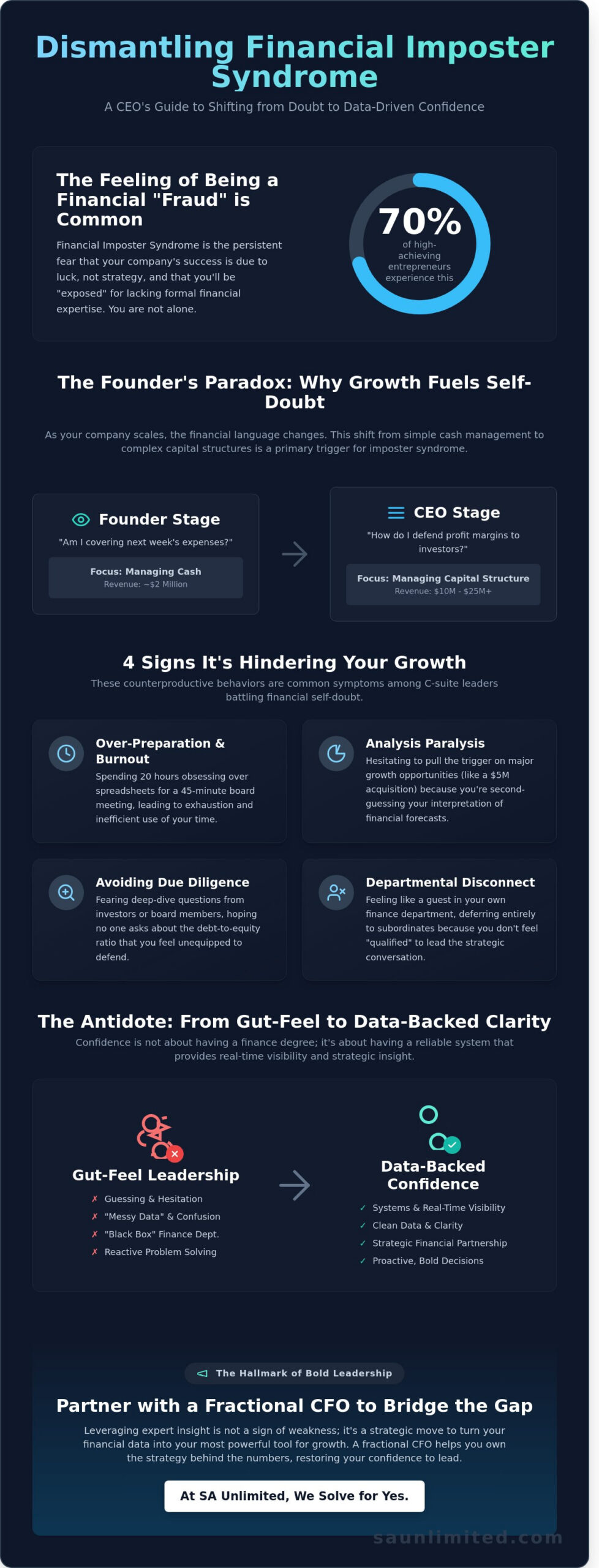
Financial imposter syndrome is a persistent, internal experience of intellectual phoniness, specifically regarding your ability to oversee a company’s wealth. It’s the nagging fear that your firm’s success is the result of market luck rather than your strategic direction. You worry that a single pointed question from a board member about your capital structure will expose a perceived lack of technical expertise. This psychological pattern, often researched in broader contexts of What is Imposter Syndrome, affects approximately 70% of high achievers at some stage in their careers. For a CEO, this manifests as a paralyzing belief that they’re merely “playing the part” of a financial expert.
The transition from a hands-on Founder to the CEO of a mid-cap firm often triggers these feelings. When your revenue climbs from $2 million to $25 million, the stakes change. You’re no longer just checking bank balances to ensure you can cover next week’s expenses. You’re managing high-stakes capital, optimizing payroll for a staff of 150, and defending your profit margins to sophisticated investors. Without a formal finance degree, the weight of these responsibilities creates a significant psychological toll. It’s vital to distinguish between healthy caution, which keeps you sharp, and the debilitating self-doubt of imposter syndrome managing company finances. One leads to due diligence; the other prevents the bold moves required to reach $100 million in growth.
The Founder’s Paradox: Success as a Catalyst for Doubt
Scaling past the $10 million revenue mark introduces structural complexities that basic bookkeeping cannot handle. You’ve moved from “managing cash” to “managing a capital structure,” and this shift produces intense anxiety. Even the most successful leaders feel like outsiders when looking at a complex ebitda report. You see the numbers, but you fear you don’t truly understand the strategic narrative they tell. Success becomes the catalyst for doubt because the higher you climb, the more you feel you have to lose if your perceived “lack of knowledge” is discovered.
Common Symptoms in the C-Suite
In the executive suite, these symptoms often lead to counterproductive behaviors that hinder growth. You might find yourself over-preparing for a 45-minute board meeting by spending 20 hours obsessing over spreadsheets, which leads directly to burnout. Other common signs include:
- Avoiding Due Diligence: You might hesitate during investor questions, fearing that a deep dive into your debt-to-equity ratio will “unmask” you.
- Departmental Disconnect: You feel like a guest in your own finance department, deferring entirely to subordinates because you don’t feel “qualified” to lead the conversation.
- Analysis Paralysis: Hesitating to pull the trigger on a $5 million acquisition because you’re second-guessing your interpretation of the cash flow forecast.
At SA Unlimited, we know that clarity is the antidote to this doubt. We roll up our sleeves to ensure you don’t just see the numbers, but you own the strategy behind them. When you know your numbers, you unlock your business potential and lead with unwavering confidence.
Why Financial Complexity Triggers the ‘Fraud’ Narrative
You’ve built a powerhouse team and a product that scales. Yet, opening a complex cash flow forecast makes you feel like an interloper. This disconnect between operational brilliance and financial technicality often triggers the ‘fraud’ narrative for high-achieving leaders. It isn’t a lack of intelligence or capability. It is simply a shift in the language of business that you haven’t been trained to speak yet.
Messy data acts as high-octane fuel for this internal fire. When your accounts receivable don’t align with your CRM or your monthly burn rate feels like a rough guess, the internal dialogue turns toxic. You start believing you don’t know what you’re doing because you can’t see the full picture. This leads to the “black box” finance department. In this scenario, the CEO only sees the final output. You don’t see the underlying logic or the assumptions. Without that transparency, you’re a passenger in your own company. That lack of control breeds deep-seated doubt.
There is a definitive point where “QuickBooks and a prayer” stops working. For most emerging companies, this occurs when revenue scales between $2 million and $7 million. Suddenly, you have more than 20 employees, complex payroll taxes, and investors demanding rigorous quarterly updates. The DIY approach that got you through the startup phase won’t get you to the next level. At this stage, the stakes are too high for reactive accounting, and the pressure of imposter syndrome managing company finances can become a daily weight.
Moving Beyond Basic Bookkeeping
Bookkeeping is about the past; it’s a historical record of what happened. Strategic financial planning is about the future and creating pathways for growth. You don’t need a CPA license or formal accounting training to lead a profitable, sustainable company. Leadership is about interpreting data, not just generating it. Our team helps you unlock your business potential by shifting your focus from the “how” of the data to the “so what” of the strategy.
High-Stakes Pressure and Regulatory Anxiety
The fear of a tax error or a non-compliance filing can be paralyzing for a founder. You worry that a single oversight will be labeled as “leadership incompetence” by your board or the IRS. External pressure from banks and investors only amplifies this self-doubt. They expect 100% accuracy and forward-looking clarity. When you feel you can’t provide it, the internal narrative of being a “fraud” takes root. We replace that anxiety with a proactive, solution-oriented framework that has already supported over $1B in successful transactions.
Dismantling Doubt with Data: Moving from Gut Feel to Clarity
Dismantling doubt starts with a fundamental shift in perspective. You don’t need an advanced degree in corporate finance to lead effectively. You need a system that tells the truth. When you’re struggling with imposter syndrome managing company finances, the loudest voice in the room is often your own uncertainty. Real-time visibility silences that voice. It eliminates the guessing game that keeps leaders awake at night. Instead of wondering if the current cash flow can support a 20 percent increase in headcount, you look at a dashboard and know. Professional-grade tools provide the validation required to turn a hunch into a strategic move. By shifting your focus from historical data (what happened) to predictive forecasting (what will happen), you reclaim your authority. You stop looking in the rearview mirror and start steering the vehicle.
The Role of Modern ERPs like Sage Intacct
A robust sage int implementation creates the single source of truth that every confident leader relies on. It isn’t just about accounting; it’s about clarity. Automating complex reporting removes the human error that often fuels self-doubt. When the numbers are generated through a rigorous, automated workflow, your confidence in them scales. Companies that automate their financial consolidation often see a 40 percent reduction in close time, giving leaders more space to think strategically. Custom dashboards allow you to ignore the noise and focus on the specific KPIs that drive your unique growth goals. This level of precision is how you unlock your business potential. We solve for yes by ensuring the technology works for your ambition, not against it.
Transforming Messy Numbers into Strategic Assets
Clean data is the ultimate antidote to imposter syndrome. Many leaders feel like frauds because their chart of accounts is a tangled web that fails to reflect their business reality. Cleaning this structure allows you to see the true story of your operations. Using data to prove your gut feelings were correct all along is a powerful way to build self-trust. Research from the American Psychological Association suggests that finding Practical Strategies to Manage these feelings often involves focusing on tangible evidence rather than internal narratives. When your intuition about a market shift is backed by a 12 percent uptick in specific lead metrics, you aren’t guessing anymore. You’re leading with conviction. High-level financial clarity transforms messy numbers into your most valuable strategic assets, allowing you to make bold moves with unwavering commitment.
5 Practical Strategies to Manage Financial Imposter Syndrome
Stop viewing financial anxiety as a personal failing. It’s a technical gap. Treat it like any other operational bottleneck you’ve solved. You don’t need to be a CPA to lead a profitable company. Overcoming imposter syndrome managing company finances starts with shifting your perspective from fear to strategy. Clarity is your greatest asset.
- Acknowledge the gap. Accept that you don’t know everything. Treat financial illiteracy as a software bug that needs a patch, not a character flaw.
- Normalize “not knowing.” Your job isn’t to calculate the depreciation; it’s to understand how that depreciation affects your tax liability. Ask high-level questions.
- Build a “Financial Wins” ledger. Document every successful capital raise, every profitable quarter, and every cost-saving measure you’ve greenlit. Evidence silences doubt.
- Focus on the 80/20 rule. Learn the 20% of metrics that drive 80% of your business value. Master your gross margin and your burn rate before worrying about granular line items.
- Bring in an objective expert. Hire a third party to audit your systems and your mindset. An outside perspective provides the validation you can’t give yourself.
Ask the Right Questions, Not All the Questions
Stop asking “How did we calculate this?” and start asking “So what?” If your team presents a 4% dip in margins, don’t get lost in the math. Ask how this affects your ability to hire in Q3. This shift moves you from a defensive posture to a leadership role. Empower your finance team to explain numbers in plain English. If they can’t explain it simply, they don’t understand it well enough. Your role is to drive the “why” behind the “what.”
The Power of Incremental Education
You won’t master finance overnight. Start with one statement. Own the P&L this month. Master the Balance Sheet next month. Finally, conquer the Cash Flow statement. This staged approach builds genuine confidence. Many executives use a cfo consulting partner as a personal tutor. This partnership allows you to learn complex transactions in a private, high-stakes environment where you can ask “dumb” questions without judgment. We solve for yes by turning your confusion into a competitive advantage.
At SA Unlimited, we believe your potential is limitless once you know your numbers. Don’t let imposter syndrome managing company finances hold your growth hostage. It’s time to unlock your business potential with a partner who understands the weight of leadership.
Solving for Yes: How a Fractional CFO Restores Leadership Confidence
Real leadership isn’t about knowing every technical line item in a complex ledger. It’s about knowing when to bring in a specialist to ensure those line items lead to sustainable growth. If you feel imposter syndrome managing company finances, you’ve reached a common inflection point. Many founders hit a ceiling where their creative vision outpaces their financial technicality. Admitting you need a strategic partner isn’t a sign of weakness; it’s a calculated power move that defines high-level leadership.
Strategic Partnership: Admitting You Need a Pro is a Power Move
The world’s most successful CEOs don’t try to be the smartest person in the room. They hire the smartest people to sit at the table. Bringing in an outsourced cfo is a strategic decision that signals you’re ready for mid-cap growth and beyond. This partner provides an unbiased, external perspective that calms internal doubt. They replace the “what ifs” with data-backed certainty. Statistics from industry reports indicate that companies with professional financial oversight are 2.5 times more likely to outperform their peers in long-term profitability. You gain a partner who rolls up their sleeves to create pathways where others only see obstacles.
Unlock Your Business Potential with Expert Oversight
Utilizing fractional cfo services allows you to bridge the gap between your founder vision and actual financial execution. This relationship creates a “Confidence Proxy.” You leverage the CFO’s authority and decades of experience in the boardroom while you lead the company’s culture and innovation. This shift is vital. You must transition from “doing the work” of a mid-level manager to “reviewing the strategy” of a true executive. It frees up your bandwidth to focus on the bold moves that originally built the brand.
When you have a seasoned expert handling the numbers, your management style changes. You move from defensive management, which is rooted in a fear of making mistakes, to offensive growth. This is where you start planning three to five years ahead with clarity. We’ve seen this transformation lead to billion-dollar success metrics for those who choose to partner with top-tier talent.
- Stop Guessing: Use real-time data to validate your gut instincts.
- Lead with Authority: Walk into every investor meeting with a “Confidence Proxy” by your side.
- Focus on Innovation: Reclaim 15 to 20 hours a month previously spent on financial troubleshooting.
You don’t have to carry the weight of imposter syndrome managing company finances any longer. At SA Unlimited, “We Solve for Yes” by turning financial complexity into strategic clarity. We empower you to make bold moves with unwavering commitment. Unlock your business potential and take the next step toward a profitable future. Let’s connect.
Own Your Seat at the Financial Table
Leadership isn’t about having every answer. It’s about knowing where to find them. You’ve learned that data dismantles the fraud narrative and that strategic clarity comes from robust systems, not just instincts. Overcoming imposter syndrome managing company finances requires replacing isolation with a partnership that turns complexity into a roadmap for growth. At SA Unlimited, we’ve spent decades providing that visibility. We’ve managed over $1B in successful transactions and specialized in Sage Intacct to help mid-cap leaders scale with precision.
We roll up our sleeves to ensure your financial infrastructure is a launchpad, not a liability. When you replace doubt with a seasoned team, you unlock your business potential and move with an unwavering commitment to your vision. We solve for yes so you can focus on the bold moves that define your legacy. Your expertise built this company. Our expertise will help you lead it with total authority.
Ready to turn financial doubt into an unwavering competitive advantage? Let’s connect.
The future of your enterprise is waiting for your most confident self. You’ve got this.
Frequently Asked Questions
What is the primary cause of imposter syndrome in business owners?
The primary cause of imposter syndrome in business owners is the psychological gap between their specialized industry expertise and the complex requirements of financial leadership. A 2023 study by the International Journal of Behavioral Science found that 70% of high achievers experience these feelings. You built your company on a vision, not a ledger. When the numbers get complex, that knowledge gap feels like a personal failure rather than a common growth stage.
Can imposter syndrome actually help me manage my company finances better?
Imposter syndrome can drive superior financial management by forcing a higher standard of due diligence and accuracy. This healthy skepticism leads 42% of founders to double-check projections and seek expert validation before making major capital commitments. It transforms doubt into a catalyst for strategic clarity. Instead of guessing, you lean into the data to prove your strategy, which ultimately protects your bottom line and ensures long term stability.
How do I know if my financial anxiety is a personal issue or a system issue?
You can identify a system issue if your financial data takes more than 10 days to close at the end of the month or if your reports contain more than 5% manual entry errors. Personal anxiety is often vague, but system issues are quantifiable. If your software doesn’t sync with your bank, or if your bookkeeping is 3 weeks behind, your stress is a logical reaction to a broken process. We solve for yes by fixing the system first.
Is it normal for a CEO not to understand every detail of the balance sheet?
It’s entirely normal for a CEO to focus on high level strategy rather than the 50+ line items on a standard balance sheet. Your role is to understand the “why” behind the numbers, not to perform the reconciliation yourself. Most successful leaders focus on 5 key drivers that impact 80% of their company’s value. You don’t need to be a CPA to lead a global enterprise; you need to be a strategist who knows which levers to pull.
How can a fractional CFO help me overcome the fear of being ‘found out’?
A fractional CFO eliminates the fear of being found out by providing an authoritative layer of expertise that validates your decisions. They roll up their sleeves to ensure your reporting is 100% accurate, giving you the confidence to lead. By having a seasoned partner handle the technical heavy lifting, you overcome imposter syndrome managing company finances. You stop worrying about the “gotcha” moments and start focusing on growth and expansion.
What financial metrics should I master first to build my confidence?
Master your Cash Runway, Burn Rate, and Customer Acquisition Cost (CAC) to build immediate financial confidence. These three metrics provide a clear window into your company’s survival and growth potential. Tracking these monthly allows you to make bold moves based on hard evidence. Once you own these numbers, the rest of the balance sheet becomes much less intimidating. You’ll move from reactive stress to proactive, strategic leadership.
How do I talk to my board about my financial concerns without looking weak?
Talk to your board by framing financial concerns as strategic inquiries into risk mitigation and optimization. Use data-driven questions like, “How do we improve our current 15% margin to reach the 22% industry benchmark?” This shifts the conversation from your perceived lack of knowledge to your unwavering commitment to excellence. Board members value transparency when it’s paired with a solution-oriented mindset. It shows you’re a leader who prioritizes results over ego.
Does every founder experience imposter syndrome during a capital raise?
Data suggests that 85% of founders experience heightened imposter syndrome during a capital raise due to the intense scrutiny of professional investors. This pressure is a natural byproduct of the high stakes environment where every decimal point is questioned. Overcoming imposter syndrome managing company finances during this phase requires a “We Solve for Yes” attitude. Having a robust financial model in place ensures you walk into every pitch with total authority and strategic clarity.