

Adding more people to a slow month-end close isn’t a scaling strategy; it’s an expensive way to mask operational friction. Most leaders believe that a larger team equals better data, yet they still find themselves squinting at manual spreadsheet errors while the board waits for answers. If you’ve outgrown QuickBooks and lost sight of your real-time cash position, you don’t need more resumes. You need a modern finance team structure for growth that prioritizes lean architecture over heavy headcount.
It’s frustrating to feel like your finance function is a reactive cost center rather than a strategic partner. You deserve a department that anticipates obstacles instead of just reporting on them after they’ve happened. This blueprint shows you how to master a three-tiered system of automated technology, standardized processes, and fractional leadership to gain investor-ready reporting without the overhead of full-time executive hires. We will explore how to leverage Sage Intacct’s cloud power and fractional CFO expertise to transform your department into a high-velocity engine. It’s time to stop chasing data and start driving the business forward with total financial visibility.
Key Takeaways
- Build a system that absorbs increased transaction volume without proportional cost increases by implementing a scalable three-tiered architecture.
- Learn how a modern finance team structure for growth utilizes Sage Intacct as a digital nervous system to move beyond basic accounting software.
- Transition from historical reporting to predictive strategy by distinguishing between the “Accounting Loop” and the forward-looking “Finance Loop.”
- Secure elite executive guidance and capital raising support through fractional CFO services that provide top-tier talent without the full-time price tag.
- Transform your finance department from a back-office cost center into a proactive strategic partner that drives long-term business expansion.
The Architecture of a Scalable Finance Function
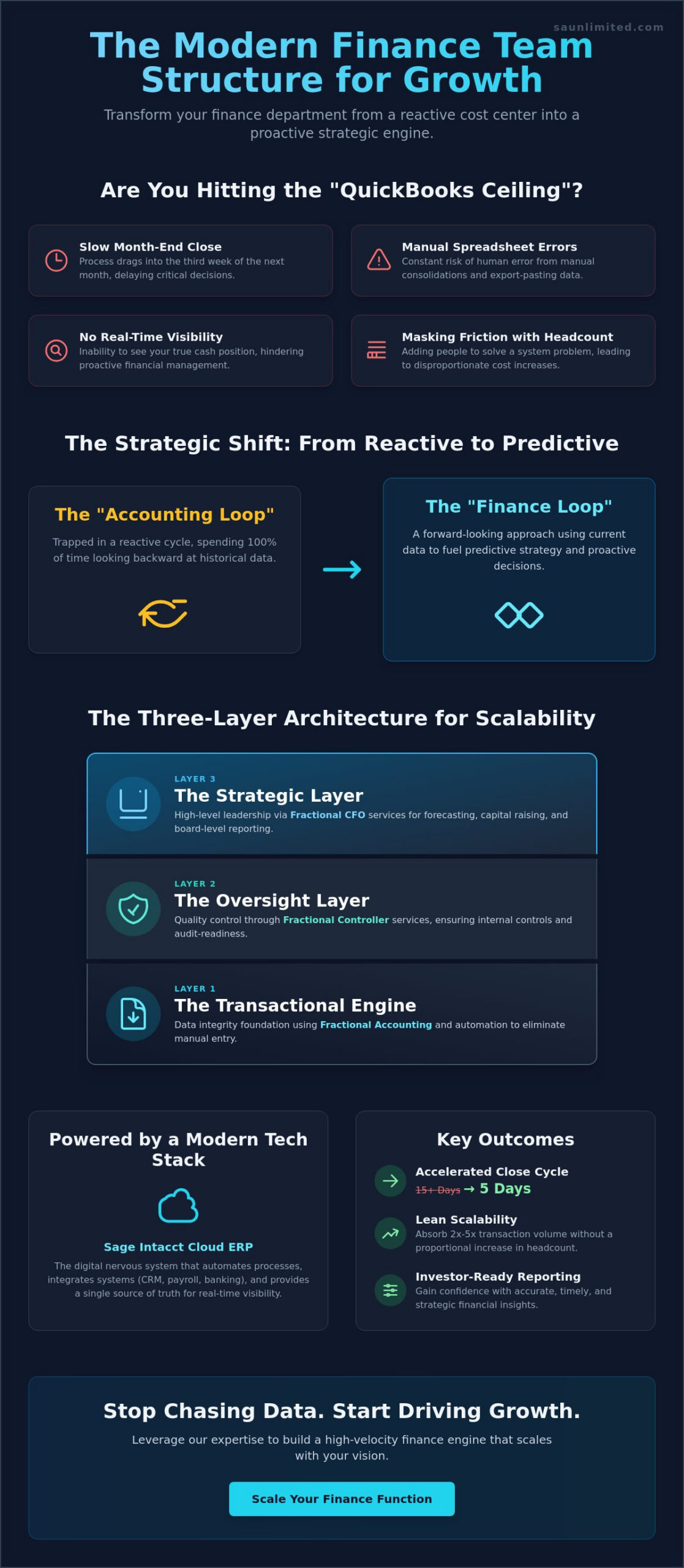
Scalability in a finance department isn’t about adding more desks or increasing your payroll budget. It’s about building a resilient system that handles a 2x or 5x increase in transaction volume without a proportional increase in headcount. Most companies fail because they stay trapped in the “Accounting Loop,” a reactive state where the team spends 100% of its time looking backward at historical data. To drive expansion, you must pivot to the “Finance Loop.” This forward-looking approach uses current data to fuel predictive strategy and proactive capital allocation.
This transition is often the deciding factor between a business that dominates its market and one that collapses under its own operational weight. Applying foundational principles of corporate finance requires a framework that supports both daily accuracy and long-term value creation. A modern finance team structure for growth ensures your department acts as a strategic catalyst, providing the clarity needed to make high-stakes decisions with confidence.
Identifying the ‘QuickBooks Ceiling’
You’ll know you’ve hit the “QuickBooks Ceiling” when your month-end close drags into the third week of the following month. Common red flags include manual consolidations across multiple entities, a constant lag in reporting, and an inability to see your real-time cash position. These manual workarounds don’t just slow you down; they lead to significant EBITDA leakage. When your team is buried in spreadsheets, they can’t spot the inefficiencies draining your bottom line. Moving to solutions beyond QuickBooks is a mandatory step for mid-cap growth in 2026, allowing you to automate the mundane and focus on the meaningful.
The Three-Layer Governance Model
To maintain control during rapid expansion, your finance team structure for growth should follow a clear three-layer governance model. This architecture ensures that every level of the organization has the specific support it needs to thrive.
- Layer 1: The Transactional Engine. This foundation prioritizes data integrity. It leverages fractional accounting services and automation to ensure every transaction is recorded accurately and instantly, eliminating the need for manual data entry.
- Layer 2: The Oversight Layer. This tier focuses on quality control. Fractional controller services provide the internal controls and audit-readiness required to protect the company’s assets and ensure reporting accuracy.
- Layer 3: The Strategic Layer. This is where high-level leadership lives. Utilizing fractional CFO services allows you to access tier-1 expertise for forecasting, capital raising support, and board-level reporting without the expense of a full-time executive.
Modernizing the Tech Stack: From Spreadsheets to Sage Intacct
Software isn’t just a passive ledger. It’s the central nervous system of your entire business. If your team spends more time export-pasting data between spreadsheets than they do analyzing performance, your tech stack is actively hindering your expansion. A robust finance team structure for growth requires a shift from entry-level accounting tools to mid-market ERP solutions. This transition provides the single source of truth necessary for global operations and real-time visibility. When you leverage Sage Intacct consulting, you transform a back-office cost center into a strategic data powerhouse that fuels your vision.
The Power of Cloud-Based ERP Automation
Speed is a massive competitive advantage in 2026. Automating the “close” process allows your team to move from a sluggish 15-day cycle to a crisp 5-day close. This rapid turnaround accelerates decision cycles for the CEO and board, providing insights while they’re still actionable. By integrating your CRM, payroll, and bank feeds directly into the primary ledger, you eliminate the need to hire more accounting staff just to handle increased transaction volume. While 79% of FP&A teams are now using AI for operational tasks, a modern stack allows you to apply that power to high-level strategy instead of data entry. It’s about building a lean, high-output department.
Standardizing Data for Multi-Entity Growth
Scalability demands a Chart of Accounts (COA) designed for the future, not just today. You need a structure that handles new locations, product lines, or subsidiaries without a manual overhaul. Sage Intacct uses dimensions to slice data by department or project, keeping your COA clean while providing granular visibility. This architecture enables real-time consolidation across multiple business units without the risk of manual export errors. You get the transparency investors demand and the clarity you need to lead. If you’re ready to move beyond basic tools, you can explore our strategic advisory services to see how we bridge the gap between software and scale.
Effective data standardization ensures that as your company expands, your reporting remains consistent. This consistency is vital for capital raising and long-term planning. A well-implemented ERP doesn’t just record what happened; it prepares you for what’s next. By moving away from manual workarounds, you protect your EBITDA and create a foundation that supports aggressive, sustainable growth.
Moving from Reactive Reporting to Predictive Strategy
Accounting tells you where you’ve been. Strategic finance tells you where you’re going. While your foundational layers ensure data integrity, the real value of a modern finance team structure for growth lies in its ability to predict the future. Investors don’t just buy your history; they buy your future cash flows. Transitioning from reactive reporting to predictive strategy requires a shift in mindset from the back office to the boardroom. Your finance function must evolve into a Financial Planning and Analysis (FP&A) powerhouse that provides the roadmap for capital allocation and market expansion.
This evolution is particularly critical when you’re seeking capital or preparing for an exit. Active EBITDA management becomes your primary lever for valuation growth. It’s not just about tracking expenses; it’s about identifying which investments yield the highest return and which operational inefficiencies are dragging down your multiple. By building a culture of data-driven accountability, you empower your entire executive leadership team to make decisions based on hard evidence rather than gut feeling.
Building Dynamic Forecasting Models
Static annual budgets are obsolete the moment they’re finished. To scale effectively, you need dynamic models that breathe with your business. Start by identifying your primary growth drivers; these usually include customer acquisition cost (CAC), churn rates, and unit economics. Once these are defined, create a rolling 12-month forecast that updates automatically as actuals flow in from your ERP. Finally, perform rigorous scenario planning. You must stress-test your cash runway against market shifts, such as a 20% drop in sales or a sudden increase in supply chain costs, to ensure you’re never caught off guard.
KPI Dashboards for Executive Decision-Making
A finance team structure for growth is only effective if the data it produces is digestible. You need “North Star” metrics tailored to your specific industry and growth stage. Instead of burying the CEO in 50-page reports, provide real-time dashboards that visualize cash runway and burn rate instantly. These tools are essential during board meetings, allowing you to lead data-backed sessions that focus on strategy rather than debating the accuracy of the numbers. When the leadership team can see the impact of their decisions in real-time, the entire organization moves faster and with more precision.
Implementing the Fractional CFO Model for Rapid Growth
Hiring a full-time CFO too early is a common mistake that drains vital capital and stalls momentum for emerging companies. A traditional executive salary, often exceeding $250,000 plus equity and benefits, is a heavy burden for a business that needs that cash for R&D or market expansion. The fractional advantage allows you to bypass this overhead while still accessing Tier-1 talent and decades of high-level experience. This lean approach to your finance team structure for growth ensures you have the strategic weight you need without the “headcount friction” that slows down agile organizations.
A fractional leader doesn’t just manage the books; they act as a proactive strategic advisor to the CEO. By leveraging fractional CFO services, you gain an external perspective that is often missing in internal-only teams. They help you navigate the “Finance Loop” we discussed earlier, turning data into a roadmap for bold moves and sustainable expansion. It’s about moving beyond the ledger to find the opportunities that others miss.
When to Hire Fractional vs. Full-Time
Knowing when to bridge the gap between a Controller and a CFO is essential. You don’t need a full-time executive until your operational complexity demands 40 hours a week of high-level architectural planning. Consider these triggers for an outsourced CFO:
- Revenue Milestones: When you hit the mid-cap growth phase and your financial complexity outpaces your current staff’s expertise.
- Controller Ceiling: Your current team is excellent at reporting “what happened” but struggles to provide a clear answer to “what will happen next.”
- Strategic Triggers: You are planning a merger, international expansion, or a significant shift in your product line that requires sophisticated capital allocation.
Preparing for Capital Raising and Due Diligence
A scalable finance team structure for growth is your greatest asset during a fundraise. Most deals fail or stall because the company’s financial records can’t withstand the scrutiny of due diligence. A fractional CFO ensures your department is audit-ready long before you sit down with investors. This preparation can shorten the due diligence window from several months to just a few weeks, giving you a massive advantage in a fast-moving market.
Beyond compliance, the CFO’s role is to master the art of financial storytelling. They build the narrative that connects your unit economics to your long-term vision, making your business irresistible to lenders and investors alike. If you’re ready to build an investor-ready department, partner with us to architect your strategic roadmap. We provide the high-level leadership required to ensure your vision is backed by undeniable data and a clear path to profitability.
Partnering with SA Unlimited to Scale Your Vision
Building a resilient finance team structure for growth requires more than just hiring talented individuals. It demands a sophisticated blend of high-performance technology and elite strategic leadership. At SA Unlimited, we don’t just provide services; we architect the financial engine that powers your expansion. By integrating Sage Intacct mastery with fractional executive advisory, we transform your finance department into a high-value asset. This isn’t a back-office expense. It’s a strategic investment that increases your company’s future valuation and prepares you for a lucrative exit potential.
Most firms offer either software implementation or executive coaching, but they rarely bridge the gap between the two. We provide the infrastructure and the expertise simultaneously, ensuring your data is accurate and your strategy is actionable. This holistic approach allows emerging leaders to scale with confidence, knowing their financial foundation is built to withstand the pressures of rapid growth.
Tailored Fractional CFO Tiers
Our fractional CFO services are designed to meet you exactly where you are on your journey. We offer flexible support levels, from project-based on-demand assistance to our Unlimited strategic partnerships. This model gives you access to a deep bench of financial talent across various specialties, including tax planning and M&A support. Our proactive approach identifies cash flow gaps and operational obstacles before they become crises. We don’t just report on the numbers; we help you navigate the complexities of capital allocation and market expansion with the precision of a seasoned partner.
Expert Sage Intacct Implementation
Technology is only as powerful as the workflows behind it. Our Sage Intacct consulting team follows a proven process to set up customized reporting and automated workflows tailored specifically to your growth trajectory. We go beyond the initial setup by training your internal team to leverage the platform for maximum ROI and data clarity. As your business evolves, we provide ongoing optimization to ensure your tech stack grows alongside your revenue. This ensures your finance team structure for growth remains lean, automated, and capable of handling increased complexity without adding unnecessary headcount.
Scaling your business should be a journey of strategic wins, not a struggle against operational chaos. Choosing SA Unlimited means choosing a partnership that opens new opportunities for capital raising and market dominance. Don’t let a legacy back-office structure hold back your vision. Let’s build the architecture you need to lead your industry. It’s time to stop managing your finance function and start leading your business with total financial visibility.
Architect Your Strategic Advantage for 2026
Your company’s potential shouldn’t be limited by a back-office that can’t keep pace. Transitioning from reactive bookkeeping to a forward-looking “Finance Loop” allows you to anticipate market shifts instead of just reporting on them. By replacing manual spreadsheets with automated ERP power and securing elite fractional leadership, you eliminate the friction that stalls most scaling businesses. A modern finance team structure for growth is the foundation for every bold move your company makes. It’s the difference between guessing your cash position and leading with total clarity.
SA Unlimited brings the specific expertise you need to bridge the gap between vision and execution. As Sage Intacct implementation experts with decades of mid-cap financial leadership, we provide the architecture, infrastructure, and proven capital raising support required for high-velocity expansion. We’ve helped countless leaders move beyond the “QuickBooks Ceiling” to achieve investor-ready reporting and strategic transparency. You don’t have to navigate this transition alone or risk your EBITDA on manual workarounds.
Ready to scale without the chaos? Book your strategy session with SA Unlimited today.
The opportunities ahead are significant. It’s time to build the finance function your vision deserves and secure your seat at the head of the market.
Frequently Asked Questions
What are the first steps to building a scalable finance function?
The first step is auditing your existing data integrity and moving away from reactive bookkeeping. You must establish a three-layer governance model that prioritizes a transactional engine, an oversight layer, and strategic leadership. By automating data entry and standardizing your processes early, you create a foundation that can handle increased volume without the need to hire additional full-time staff for every new product line or location.
When should a company move from a bookkeeper to a fractional CFO?
You should make the transition when your business needs shift from simple historical recording to forward-looking strategic planning. If you are hitting revenue milestones that require sophisticated capital allocation or complex multi-entity reporting, a bookkeeper’s scope is no longer sufficient. A fractional CFO provides the executive-level forecasting and narrative building necessary to navigate the “Finance Loop” and drive long-term valuation growth.
How does Sage Intacct help with financial scalability for mid-cap firms?
Sage Intacct serves as a digital nervous system by providing real-time visibility and automated consolidations across multiple business units. Its use of dimensions allows you to slice financial data by project or department without cluttering your Chart of Accounts. This architecture ensures your finance team structure for growth remains lean and automated, providing the single source of truth that investors and board members demand during rapid expansion.
What is the difference between a Controller and a CFO in a scaling business?
A Controller focuses on internal accuracy and the “oversight layer,” ensuring that financial statements are audit-ready and compliant. In contrast, a CFO acts as a strategic advisor to the CEO, focusing on the “strategic layer.” While the Controller manages the quality of the data, the CFO uses that data to handle capital raising support, scenario planning, and high-level resource allocation to fuel the company’s vision.
How much does it cost to build a scalable finance department in 2026?
The total investment depends on your operational complexity and the specific tier of fractional support required to manage your growth. Building a scalable department involves costs for mid-market ERP subscriptions and tiered fractional services. By utilizing fractional accounting and controller services, you can scale your expenses proportionally with your revenue, avoiding the heavy burden of full-time executive salaries while still accessing top-tier financial talent.
Can a fractional CFO help with raising venture capital or debt?
Yes, a fractional CFO is a vital partner for capital raising support, often shortening the due diligence window from months to weeks. They lead the process of financial storytelling, building the models and stress-testing the cash runways that lenders and investors require. Having an executive-level leader manage these conversations ensures your department is audit-ready and that your financial narrative aligns perfectly with your growth objectives.
How do I know if my current finance processes are holding back my growth?
Your processes are likely a bottleneck if your month-end close takes longer than ten days or if you’re suffering from frequent manual spreadsheet errors. Other red flags include an inability to see your real-time cash position and “headcount friction,” where you feel forced to hire more people just to keep up with basic transaction volume. If your finance function feels like a back-office cost center, it’s holding you back.
What KPIs are most important for a growth-stage company to track in real-time?
Growth-stage companies must prioritize “North Star” metrics such as Customer Acquisition Cost (CAC), churn rates, and unit economics. Beyond these operational figures, you must maintain real-time visibility into your cash runway and burn rate to ensure sustainability. Tracking these KPIs through automated dashboards allows your finance team structure for growth to support data-driven accountability and rapid adjustments to your rolling 12-month forecast.