

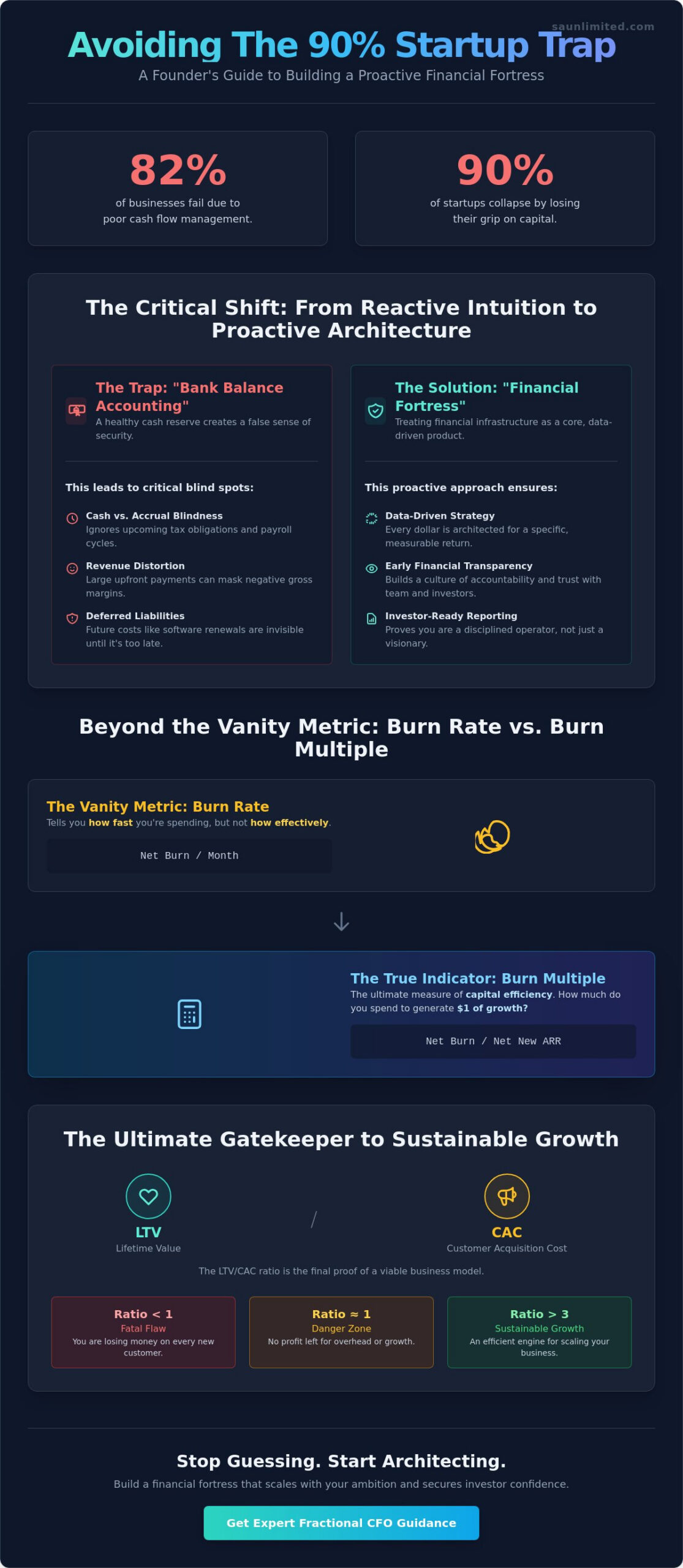
Did you know that 82% of businesses that fail do so because of poor cash flow management? Even in 2026, with advanced AI-powered modeling at our disposal, 90% of startups still collapse because they lose their grip on capital. It’s a sobering reality that many founders face: the “move fast and break things” era has been replaced by a “measure twice, cut once” economy that demands absolute financial discipline.
You probably know the feeling of outgrowing basic accounting software or the frustration of trying to explain a complex financial model to a skeptical investor. It’s common to feel like your financial infrastructure is held together by spreadsheets and hope. This guide focuses on avoiding common startup financial mistakes by moving beyond reactive bookkeeping into proactive strategic architecture. You’ll discover the critical pitfalls that sink most ventures and learn the specific strategies used by seasoned fractional CFOs to ensure long-term scalability. We’re going to provide a clear roadmap to financial stability and show you how to build an investor-ready system that grows as fast as your ambition.
Key Takeaways
- Learn how to transition from “Bank Balance Accounting” to a sophisticated model that reveals fatal flaws before they sink your venture.
- Master the shift from tracking simple Burn Rate to evaluating your Burn Multiple, the true indicator of capital efficiency in 2026.
- Discover the proactive framework for avoiding common startup financial mistakes that typically cripple 90% of early-stage companies.
- Identify the critical infrastructure gaps that occur when you outgrow basic software and learn how to build a scalable financial fortress.
- Explore why unit economics, specifically the LTV/CAC ratio, is the ultimate gatekeeper for sustainable growth and successful capital raising.
The Silent Killers: Why Financial Intuition Fails Startup Founders
Founders often pride themselves on their gut instincts. While intuition drives product innovation, it’s a dangerous compass for managing a balance sheet. Many entrepreneurs fall into the trap of “Bank Balance Accounting,” where a healthy cash reserve creates a false sense of security. This is one of the most significant hurdles in avoiding common startup financial mistakes. If you only look at the cash in your bank, you’re driving a car by looking in the rearview mirror. You aren’t seeing the upcoming liabilities, deferred revenue, or the true burn rate that determines your actual runway.
Deceptive bank balances lead to three specific blind spots:
- Cash vs. Accrual Blindness: Cash on hand doesn’t account for upcoming tax obligations or payroll cycles.
- Revenue Distortion: Large upfront payments can mask a negative gross margin that eventually drains the company.
- Deferred Liabilities: Future costs, like software renewals or equipment leases, aren’t visible on a simple banking app screen.
Early-stage success can be the ultimate mask for fatal flaws. High revenue growth often hides inefficient unit economics or unsustainable customer acquisition costs. In the 2026 market, investors have moved past “growth at all costs.” They want to see a Financial Fortress. This mindset treats your financial infrastructure as a core product, not an administrative burden. It requires a hard shift from founder intuition to a data-driven strategy where every dollar spent is architected for a specific, measurable return.
The Trap of Reactive Financial Management
Waiting for month-end reports is a recipe for disaster in a high-growth environment. By the time you see the numbers, the opportunity to pivot has already passed. Reactive management leads to “Infrastructure Debt,” where your systems can’t support your scale. Strategizing growth means forecasting three steps ahead. It’s about ensuring your cash planning accounts for the “surprise” expenses that inevitably surface as you move from Seed to Series A.
Establishing Financial Transparency Early
Transparency isn’t just about honesty; it’s about building a culture of accountability from day one. The CEO must set the financial tone by demanding clarity and precision in every department. When you prioritize transparency, you build immediate trust with your team and potential investors. In 2026, clear, investor-ready reporting is your greatest asset. It proves you aren’t just a visionary, but a disciplined operator capable of avoiding common startup financial mistakes that sink 90% of your competitors.
Cash Flow Mismanagement: Moving Beyond the ‘Burn Rate’ Obsession
Most founders fixate on their monthly burn rate as the ultimate health indicator. It isn’t. Burn rate is a vanity metric when viewed in isolation. To truly understand your trajectory, you must look at your Burn Multiple. This ratio, calculated by dividing your net burn by your net new ARR, reveals how much you’re spending to generate each dollar of growth. A high burn is acceptable if it fuels efficient expansion; it’s a death sentence if it doesn’t. Mastering this distinction is a cornerstone of avoiding common startup financial mistakes that lead to premature insolvency.
There’s also a dangerous gap between cash-on-hand and true liquidity. You might have $2 million in the bank, but if $1.5 million is already earmarked for upcoming tax deadlines and accounts payable, your operational “moat” is smaller than you think. Startups often bleed out through uncollected accounts receivable. When you allow payment terms to stretch without oversight, you’re essentially providing interest-free loans to your customers using your precious venture capital. Protecting your liquidity requires a proactive, aggressive stance on collections and a deep understanding of your cash conversion cycle.
Forecasting vs. Guessing: The 13-Week Model
Precision in 2026 requires moving beyond annual budgets to a rolling 13-week cash flow forecast. This short-term model provides a granular view of every dollar entering and exiting the business. By analyzing your cash flow statements through this lens, you can identify “leaky buckets” in your operational spend before they become systemic issues. This level of detail allows you to predict bottlenecks months in advance, giving you the lead time necessary to adjust spending or trigger a bridge round. Developing a strategic cash planning and forecasting framework ensures you never face a surprise liquidity crisis.
Optimizing the Cash Conversion Cycle
Efficiency isn’t just about spending less; it’s about moving money faster. You can accelerate receivables by offering small incentives for early payments or implementing automated billing systems. On the flip side, you should negotiate longer payment terms with vendors to keep cash in your accounts longer. This strategy preserves your cash moat without increasing your debt; to see how this works with branding and supply partners, you can learn more about The CEO Creative. If your business involves physical inventory, optimizing your turnover rate is vital. Every day a product sits in a warehouse is a day your capital is locked away from high-impact growth initiatives. By tightening these cycles, you create a more resilient, scalable financial infrastructure that supports avoiding common startup financial mistakes at every stage of growth.
Infrastructure Debt: The Cost of Scalability Gaps in Financial Systems
Most founders are familiar with technical debt, but few recognize the looming threat of infrastructure debt in their finance department. Infrastructure debt occurs when your accounting systems can’t keep up with your operational complexity. While QuickBooks is an excellent starting point, it eventually becomes a massive bottleneck that stifles growth. If your team spends more time fighting with spreadsheets than analyzing data, you’ve hit a ceiling. Recognizing these limitations early is a vital part of avoiding common startup financial mistakes that derail Series A and Series B transitions.
The signs of outgrowing basic software are often subtle at first. You might notice that closing the books takes two weeks instead of three days. Perhaps you’re relying on manual data entry to move information from your CRM into your ledger. These manual workarounds carry a heavy price. They introduce human error, create data silos, and hide the real-time visibility you need to make aggressive moves. Scaling requires a single source of truth where your financial systems integrate seamlessly with your sales and operations data. Moving toward solutions beyond QuickBooks isn’t just about better software; it’s about building a foundation that supports high-velocity decision-making.
The Case for Modern Cloud Financials
Visibility is the lifeblood of a scaling company. Modern platforms like Sage Intacct (Sage Int) provide the deep insights needed for mid-cap scaling. These systems automate complex tasks that usually require hours of manual labor, such as multi-entity consolidations and sophisticated revenue recognition. When you automate these processes, you free your leadership team to focus on strategy rather than clerical oversight. Real-time custom reporting allows you to see exactly where your capital is most effective, turning your finance department into a proactive growth engine.
Avoiding the ‘Frankenstein’ Tech Stack
In the rush to scale, many startups stitch together a “Frankenstein” tech stack of disconnected apps. This creates a nightmare of siloed data where your billing system doesn’t talk to your ledger. A truly scalable financial stack must support GAAP compliance and provide a clear audit trail from the beginning. Building this architecture requires more than just a software subscription; it needs a CFO consulting perspective to ensure every tool aligns with your long-term exit or expansion goals. By architecting your systems correctly today, you are avoiding common startup financial mistakes that would otherwise require a painful and expensive overhaul during your next major funding round.
Strategic Blind Spots: Unit Economics and Capital Raising Pitfalls
Growth isn’t always a sign of health. In the pursuit of rapid expansion, many founders fall into the “Growth at All Costs” trap. They prioritize top-line revenue while ignoring the crumbling foundation of their unit economics. Scaling a business that loses money on every customer is simply scaling a disaster. This strategic blind spot is a primary reason why 75% of venture-backed startups fail to return capital to their investors. Focus on avoiding common startup financial mistakes by ruthlessly auditing your margins before you hit the gas.
Investors in 2026 are looking for more than just a vision. They demand a deep understanding of your EBITDA and a clear path to profitability. Misrepresenting these figures or failing to prepare for rigorous due diligence will kill your round before it starts. Your pricing strategy must be architected around gross margin requirements, not just market competition. If your pricing doesn’t support your operational overhead, your growth is a ticking time bomb. You can’t fix a broken business model by adding more customers.
Mastering Your Unit Economics
Unit economics represents the direct profit or loss generated by a single customer over their entire relationship with your company. Sustainable growth requires a Customer Acquisition Cost (CAC) that is significantly lower than the Lifetime Value (LTV) of that customer. However, the ratio itself isn’t enough. Modern investors prioritize the “Payback Period,” which is the time it takes to recoup the cash spent to acquire a customer. If your payback period exceeds 12 months, you’re likely facing a liquidity crunch regardless of your LTV. Stop chasing vanity metrics and start measuring the velocity of your capital.
Investor-Ready Financial Modeling
Static budgets are useless in a fast-moving market. You need dynamic financial models that allow for scenario planning and real-time adjustments. When you enter a funding round, your “Data Room” must be a fortress of transparency. Investors want to see that your projections are based on historical data, not optimistic guesswork. This is where professional cfo services become indispensable. They bridge the gap between your high-level vision and the granular data investors demand. By presenting a professional, audit-ready model, you’re avoiding common startup financial mistakes that signal amateurism to high-value backers.
Ready to secure your next round with confidence? Partner with a strategic advisor to optimize your capital raising support today.
The Fractional CFO: Building a Proactive Financial Fortress for 2026
Scaling a startup is a high-stakes balancing act. You need executive-level financial oversight to navigate complex capital markets, yet your budget might not support a full-time C-suite salary. This is where the fractional cfo services model changes the game. By bringing in a seasoned expert on a part-time or project basis, you gain access to the same strategic brilliance used by Fortune 500 companies without the prohibitive overhead. This approach is the most effective way of avoiding common startup financial mistakes while maintaining the agility required in a fast-paced market.
A strategic partner does more than just balance the books; they transform your finance department from a back-office function into a powerful growth engine. In 2026, the fractional CFO market is projected to reach $6.4 billion, reflecting a massive shift toward specialized, on-demand expertise. When you partner with a fractional CFO, you’re getting a roadmap that usually unfolds in three critical phases. The first 30 days focus on a deep-dive diagnostic of your current systems. The next 30 days involve architecting a scalable infrastructure, often moving beyond QuickBooks to more robust cloud financials. By day 90, your CFO is providing the high-level forecasting and capital raising support needed to secure your next round of funding.
Strategic Partnership vs. Transactional Accounting
It’s vital to understand that a bookkeeper, a controller, and a CFO serve entirely different purposes. A bookkeeper records the past; a controller manages the present; a CFO architects the future. As a strategic advisor to the CEO, a fractional CFO helps you interpret data to make bold, confident moves. They don’t just report that you’re out of cash; they predict the shortfall six months in advance and provide the strategy to prevent it. Leveraging “Unlimited” partnership tiers ensures you have continuous growth support, allowing your leadership team to focus on innovation while your financial fortress remains impenetrable.
Next Steps: Securing Your Financial Future
If you’re feeling the weight of “Infrastructure Debt” or struggling to explain your financial model to investors, it’s time to bring in professional expertise. Waiting until a crisis hits is a mistake that costs more than any service fee. Start by conducting a comprehensive Financial Health Audit to identify immediate risks in your cash flow or tax planning. This proactive step is the first move in avoiding common startup financial mistakes and positioning your company for a successful exit or expansion. Don’t leave your scalability to chance. Partner with SA Unlimited to build your financial fortress.
Architect Your Financial Future
Transitioning from reactive bookkeeping to proactive financial architecture is the most critical shift a founder can make. You’ve learned that burn rate is a vanity metric without the context of a burn multiple and that outgrowing entry-level software is a sign of success, not a chore. By ruthlessly auditing your unit economics and establishing real-time visibility, you’re effectively avoiding common startup financial mistakes that sink the majority of new ventures. Your finance department should be a growth engine, not a bottleneck.
SA Unlimited provides the seasoned expertise required to build this foundation. We specialize in Sage Intacct implementations, high-stakes capital raising support, and precise cash flow forecasting. Our tiered pricing models are engineered to support both emerging startups and mid-cap firms with elite strategic guidance. Scale your startup with expert Fractional CFO services today.
Your ambition deserves a financial fortress that won’t crumble under the weight of your success. With the right architecture in place, you’re not just surviving; you’re positioned to lead your industry. Let’s start building.
Frequently Asked Questions
What is the most common financial mistake startups make early on?
The most frequent error is relying on “Bank Balance Accounting” to judge the health of the venture. Founders often confuse cash-on-hand with true liquidity, which leads to a failure in predicting upcoming liabilities or tax obligations. This reactive mindset is a primary hurdle in avoiding common startup financial mistakes and often results in a liquidity crisis just as the company begins to scale.
How do I know if my startup has outgrown QuickBooks?
You’ve outgrown QuickBooks when your team relies on manual spreadsheet workarounds to close the books or manage complex revenue recognition. If it takes longer than five days to generate accurate month-end reports, your software has become a bottleneck. High-growth firms need automated consolidations and real-time visibility that basic accounting tools simply can’t provide as complexity increases.
What is a ‘Burn Multiple’ and why does it matter to investors?
A Burn Multiple is the ratio of your net cash burn to your net new Annual Recurring Revenue (ARR). It measures how much capital you’re consuming to generate each dollar of growth. Investors prioritize this over raw burn rate because it reveals your operational efficiency. In the 2026 market, a low burn multiple is a key indicator of a sustainable, high-value business model.
Can a fractional CFO help with my Series A or B capital raising?
A fractional CFO is instrumental during Series A or B rounds by architecting your data room and building investor-ready financial models. They bridge the gap between your vision and the granular due diligence investors demand. By providing professional capital raising support, they ensure your metrics are transparent and your valuation is backed by defensible, audit-ready data.
How much should a startup spend on financial systems and accounting?
Startups should view financial systems as a strategic investment rather than a back-office expense. While costs vary based on organizational complexity, the focus should be on the ROI of automation and accuracy. Investing in robust systems early prevents expensive “Infrastructure Debt” and ensures you have the scalable foundation needed to support mid-cap growth without constant manual intervention.
What is the difference between a bookkeeper and a fractional CFO?
A bookkeeper focuses on recording historical transactions, while a fractional CFO acts as a strategic advisor to the CEO. Bookkeeping is about accuracy in the past; a CFO is about architecting the future. A CFO provides high-level cash planning and forecasting to ensure your strategic moves are backed by sufficient capital and aligned with long-term exit goals.
How do I calculate my startup’s runway accurately?
Accurate runway calculation requires dividing your total liquid cash by your average monthly net burn. However, a strategic calculation must also account for upcoming one-time expenses, seasonal fluctuations, and deferred liabilities. Using a rolling 13-week cash flow forecast provides the most granular and reliable view of your actual survival timeline compared to a simple static estimate.
Why is unit economics more important than total revenue for a startup?
Unit economics reveal whether your business model is actually profitable at the individual customer level. Total revenue can be a vanity metric if your Customer Acquisition Cost (CAC) exceeds the Lifetime Value (LTV). Mastering these ratios is essential for avoiding common startup financial mistakes because it proves your growth is sustainable rather than just a temporary result of aggressive spending.