

What if the most expensive part of your digital transformation isn’t the software license, but the cost of a financial architecture that fails to scale? For mid-cap leaders eyeing the $1B mark in 2026, the cost of sage intacct implementation typically ranges from $25,000 to $150,000, yet a poorly planned rollout can easily double that through hidden re-implementation fees. You likely feel the pressure of outgrowing entry-level software and fear that a lack of internal expertise will turn a strategic upgrade into a budget-draining headache.
At SA Unlimited, we solve for yes by building financial foundations that empower bold moves and profitable growth. This guide unlocks the exact 2026 cost drivers, from the $1.00 to $1.75 implementation-to-subscription ratio to the specific module add-ons that average $3,000 to $10,000 annually. You’ll gain a clear roadmap to ROI and the confidence to deploy a system that handles complex multi-entity scale without breaking your budget. We’re providing a full strategic breakdown, including the transition from entry-level $9,000 packages to enterprise-grade $75,000 configurations verified as of May 2026.
Key Takeaways
- Master the 2026 baseline for the cost of sage intacct implementation, which typically ranges from 100% to 150% of your first year subscription fee.
- Identify the four core drivers of project pricing, including how multi-entity complexity and data migration taxes impact your total strategic investment.
- Distinguish between a standard technical setup and a strategic financial architecture that empowers you to make bold moves and scale with clarity.
- Quantify the internal opportunity costs of your finance team’s time to ensure your transition doesn’t stall due to a lack of an executive champion.
- Learn how to bridge the gap between simply going live and achieving true ROI by aligning your system with a billion dollar growth blueprint.
The Strategic Reality of Sage Intacct Implementation Costs in 2026
Smart CFOs don’t view software as a line item expense; they see it as a growth lever. In the current market, the cost of sage intacct implementation is rarely about the software license itself. Instead, it’s an investment in a financial architecture that supports your next $100M in scale. As of May 2026, mid-cap companies must move beyond the “Go-Live” mentality and focus on building a system that is scale ready from day one. Choosing the cheapest implementation path often triggers a painful re-implementation cycle within 18 months because the initial setup lacked the strategic depth to handle complex consolidations or capital raising requirements.
At SA Unlimited, we solve for yes by treating your accounting system as a catalyst for EBITDA improvement. We don’t just map accounts; we create pathways for clarity and confidence. A standard setup might get your bills paid, but a strategic architecture ensures your data is clean enough to satisfy the most rigorous private equity due diligence. This foresight transforms a technical hurdle into a powerful asset for your business potential.
The Baseline: What to Expect for Mid-Cap Implementation
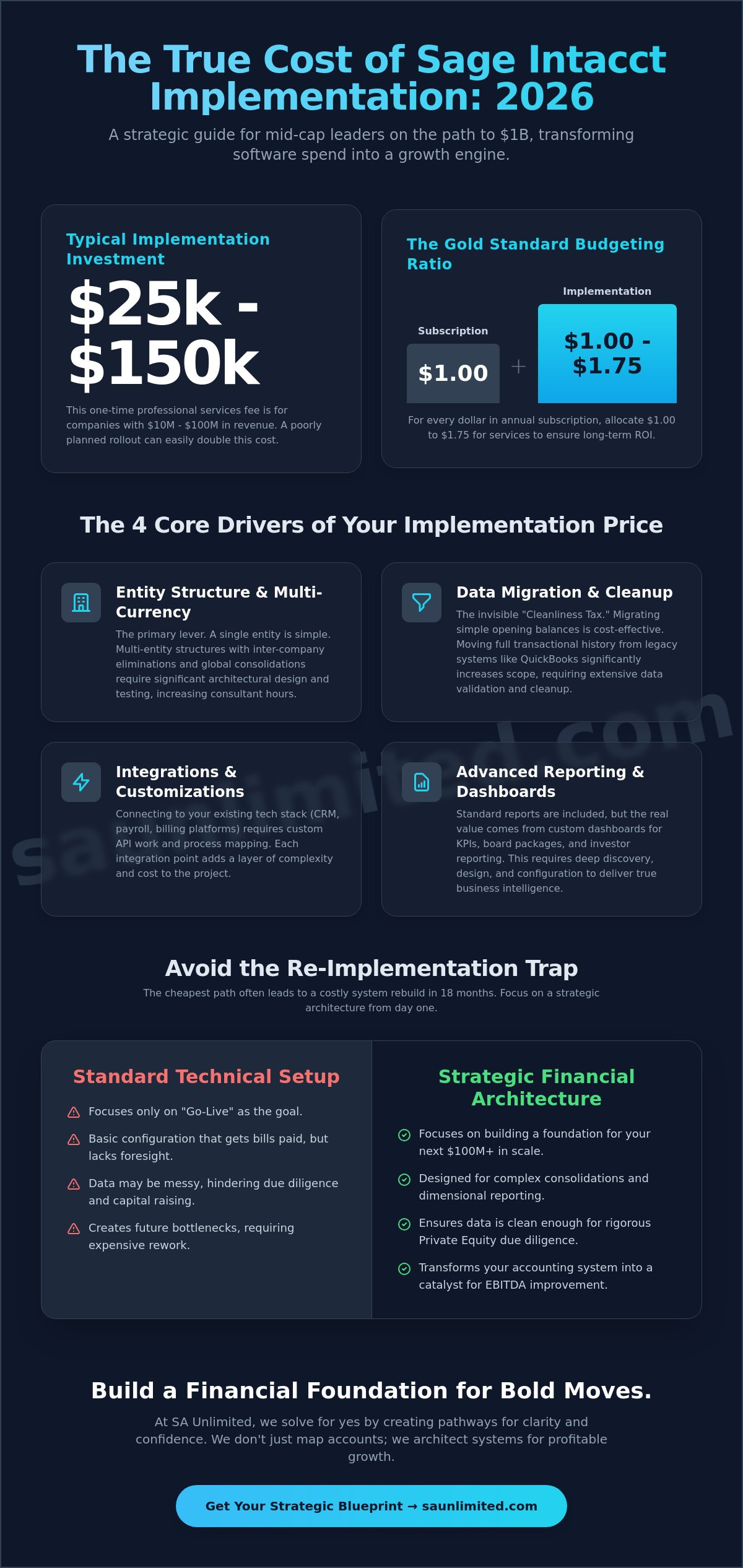
For companies generating between $10M and $100M in revenue, the professional services floor has shifted due to the rising demand for top notch financial talent. You should expect to invest between $25,000 and $150,000 for a professional implementation, depending on your entity structure and reporting needs. The Implementation Ratio serves as the gold standard for ERP budgeting, dictating that for every $1.00 spent on the annual subscription, you should allocate $1.00 to $1.75 for professional services to ensure the system is built for long term success.
Subscription vs. Professional Services: Defining the Split
Understanding the split between recurring and one-time costs is vital for accurate 2026 budgeting. While your annual subscription for Sage Intacct might start between $12,000 and $35,000 for core financials, the one-time implementation fee covers the heavy lifting of data migration, process design, and custom dashboarding. As you add advanced modules like Global Consolidations or specialized revenue recognition, the implementation effort increases because these features require sophisticated configuration to deliver their full ROI.
To maximize this investment, leaders should review our Sage Intacct (Sage Int): The Strategic Leader’s Guide to Cloud Financials for a deeper dive into how these modules align with your specific growth stage. By separating the perpetual value of the software from the one-time hurdle of the setup, you can budget with precision and ensure your team has the cutting edge technology they need to drive profitable growth.
The Four Core Drivers of Your Implementation Price Tag
Every mid-cap company has a unique financial fingerprint, which means the cost of sage intacct implementation is never a one-size-fits-all figure. While software vendors might provide a baseline, the true investment is determined by four strategic variables. These drivers dictate whether your system is a simple digital ledger or a powerful engine for profitable growth. We focus on these areas to ensure you don’t just go live, but actually unlock your business potential through superior architecture.
Entity Structure and Multi-Currency Requirements
The complexity of your corporate structure is the primary lever for consultant hours. Setting up a single entity is straightforward, but mid-cap leaders often require automated inter-company eliminations and global consolidations across multiple currencies. Each additional entity requires its own configuration, mapping, and testing. Dimensional accounting offers incredible clarity, yet designing these structures requires senior architectural time to ensure you aren’t over-engineering. At SA Unlimited, we streamline this process to reduce long-term administrative overhead, ensuring your team spends less time on manual entries and more time on strategy.
Data Migration and Cleanup: The Invisible Cost Driver
Many businesses ignore the “Cleanliness Tax” associated with moving data from legacy systems like QuickBooks. Migrating simple opening balances is cost-effective, but moving full transactional history increases the scope significantly. Data cleanup is the leading cause of implementation budget overruns. If your historical data is messy, consultants must spend dozens of hours mapping and reconciling before the first import. We often recommend a staged migration strategy to control initial costs, focusing on the most critical data first to ensure a clean break from the past.
The Integration Ecosystem
Your ERP shouldn’t be an island. Budgeting for the cost of sage intacct implementation must include the technical debt of connecting tools like Salesforce, Bill.com, and Expensify. While Sage Intacct offers a robust API, some integrations require middleware like Workato or custom scripting to function perfectly. A Fractional CFO Services: The Ultimate Guide to Scaling Your Business partner is essential here. They vet which connections actually drive ROI and which are just expensive “nice-to-haves” that complicate your tech stack.
If you want to avoid the pitfalls of a technical-only setup, our team can help you design a roadmap that prioritizes high-impact automation. We solve for yes by balancing your desire for a fully integrated suite with the practical reality of your budget and timeline. This strategic approach ensures your system supports $1B+ in scale without unnecessary friction.
Partner Selection: The VAR Model vs. The Fractional CFO Approach
Choosing the right partner is the most critical variable in the cost of sage intacct implementation. Most mid-cap leaders default to a Value-Added Reseller (VAR) because they specialize in the technical plumbing of the software. A software vendor’s primary metric for success is “Go-Live,” which often means the system is functional but not necessarily strategic. In contrast, a CFO partner focuses on being “Scale-Ready.” They look beyond the software’s buttons and menus to ensure the system supports your long term financial goals and capital requirements.
The hidden cost of a technical-only implementation is significant. You might end up with a system that processes transactions perfectly but produces reports that don’t help you make bold moves. A strategic architect ensures your chart of accounts is designed for a $1B+ valuation from the start. They build the dimensions and reporting structures that private equity firms and investors demand during due diligence. While generic consultants might offer lower hourly rates, their lack of financial depth often leads to expensive gaps in your data visibility that require manual workarounds.
The ROI of Strategic Architecture
Properly structured systems reduce the need for additional full-time accounting headcount as you grow. By automating complex workflows and consolidations, you empower your existing team to do more with less. Having a partner who understands both the software and your P&L creates an immediate return on investment. This dual expertise is the core of CFO Consulting: The Strategic Blueprint for Scaling Your Business in 2026, where technical mastery meets high level financial strategy to unlock your business potential.
Avoiding the Re-Implementation Trap
Transactional implementations often lead to a “re-implementation trap” within 18 to 24 months. Signs of a failing setup include heavy reliance on spreadsheets for reporting or a chart of accounts that feels cluttered and restrictive. The 2026 cost of fixing a broken ERP system can easily exceed the original project budget. SA Unlimited’s “Solve for Yes” mindset prevents this technical debt. We ensure your foundation is solid from day one, saving you from the frustration and expense of starting over when your business model evolves or you enter new markets.
Managing the “Internal Cost” of Sage Intacct Implementation
Your invoice from a software partner is only half the story. The cost of sage intacct implementation also includes the massive diversion of your internal talent. Mid-cap companies often underestimate the “Shadow Cost” of pulling a Controller or CFO away from their strategic duties for 15 to 20 hours a week over a six-month period. When your top financial minds are buried in data mapping and user acceptance testing, they aren’t focusing on EBITDA growth or capital efficiency. This opportunity cost can be more expensive than the consulting fees themselves.
Implementation success hinges on having an internal Executive Champion. Without a leader who owns the vision, projects frequently stall or suffer from low adoption. To mitigate this burden, many smart organizations leverage Fractional Controller services. This allows your internal team to maintain focus on daily operations while a dedicated expert handles the implementation heavy lifting. We solve for yes by providing the extra capacity needed to ensure your transition is seamless and your core business remains profitable during the shift.
Internal Resource Allocation Strategy
Preparing your team for the implementation sprint requires a tactical approach. Use this 5-step checklist to protect your resources:
- Audit current workloads to identify which tasks can be automated or paused.
- Appoint a dedicated Project Lead who has the authority to make configuration decisions.
- Backfill transactional accounting roles to free up your Controller for strategic design.
- Set clear “Blackout Dates” where no new projects are started during the migration.
- Schedule weekly “Symmetry Sessions” to align technical progress with business goals.
Quantifying the diverted time of a $150,000 per year Controller reveals that a typical rollout consumes roughly $35,000 in internal salary alone. Backfilling these roles isn’t just a convenience; it’s a smart financial move that prevents burnout and keeps your scaling efforts on track. By protecting your team’s time, you ensure the system is built with the precision required to unlock your business potential.
Post-Go-Live Support and Phase 2 Planning
Budgeting shouldn’t stop at the “Go-Live” date. True ROI comes from a “Phase 2” plan that includes advanced custom dashboards and deep-dive training for your staff. System stagnation is a real risk. If your team doesn’t fully adopt the new tools, you’ve essentially paid for a high performance engine that stays in the garage. Ongoing optimization ensures your software evolves with your business. This long term vision is why many leaders choose Outsourced CFO Services: The Strategic Architect for Mid-Cap Growth in 2026 to maintain a cutting edge financial stack.
If your internal team is already at capacity, don’t let a major upgrade derail your momentum. You can connect with our experts today to learn how we offload the implementation burden while building a roadmap for $1B+ in scale.
Solving for Yes: The SA Unlimited Sage Intacct Implementation Advantage
At SA Unlimited, we realize that the cost of sage intacct implementation is an investment in your company’s future enterprise value. We don’t just sell software services. We provide a strategic partnership that blends high level Fractional CFO expertise with technical Sage Intacct mastery. While a standard vendor might leave you with a functional ledger, we build a strategic financial engine designed to fuel your growth. Our “Billion Dollar Blueprint” is specifically engineered for mid-cap leaders who refuse to settle for mediocrity and want to scale with unwavering commitment.
We provide transparent pricing and tiered support models that align with your specific growth trajectory. Whether you are transitioning from QuickBooks or optimizing an existing setup, our team ensures your financial stack is a source of clarity, not confusion. We solve for yes by removing the technical obstacles that prevent you from making bold moves. Our goal is to empower your team with cutting edge technology and the strategic insights needed to drive profitable outcomes in a competitive 2026 market.
Our Proven Implementation Methodology
We follow a rigorous 3-pillar approach to ensure your system is built for the long haul. This methodology moves beyond simple configuration to create a foundation for billion dollar success:
- Discovery: We roll up our sleeves to audit your current processes and identify the pathways to your business potential.
- Design: Our architects build a dimensional structure that ensures you are knowing your numbers from day one.
- Deploy: We execute a seamless transition that prioritizes data integrity and high system adoption across your entire organization.
Our results speak for themselves. We’ve leveraged this methodology to support clients through $1B+ capital raises and have transformed complex, multi-month audits into streamlined, stress-free processes. By focusing on strategic architecture rather than just technical go-live dates, we ensure your implementation is a one-time investment that pays dividends for years.
Unlock Your Potential: Your Next Steps
Transforming your financial world starts with a strategic implementation assessment. In your first discovery call, our consultants won’t just talk about software modules. We’ll discuss your roadmap to ROI and how to align your tech stack with your 2026 growth targets. We’ll explore how to eliminate technical debt and build a system that supports your ambitions. Don’t let a standard, transactional setup limit your vision for the future.
Transform your financials and Solve for Yes—Let’s connect today.
Secure Your Scale-Ready Financial Future
Transitioning to an enterprise-grade system is a high-stakes move for any mid-cap leader. You now have the roadmap to navigate the cost of sage intacct implementation by balancing software fees with the strategic architecture required for $1B+ in scale. By accounting for internal opportunity costs and avoiding the technical-only trap, you protect your EBITDA and ensure your data satisfies the most rigorous investor due diligence. It’s about building a system that works for you, not the other way around.
SA Unlimited brings a Red Dot level of precision to your financial architecture. With over $1B in successful client transactions and capital raises, our Fractional CFO-led approach ensures your software matches your specific growth strategy. We roll up our sleeves to solve for yes, creating clear pathways for your team to make bold moves with confidence. Your business potential is limitless when your technology and strategy are in perfect alignment.
Unlock Your Business Potential—Get a Strategic Sage Intacct Quote
Frequently Asked Questions
What is the average cost of a Sage Intacct implementation for a mid-sized company?
The average cost of sage intacct implementation for a mid-sized company typically ranges from $25,000 to $150,000 as of May 2026. This professional services fee usually mirrors your first year subscription costs at a ratio of 1.0 to 1.75. Complexity drivers include the number of entities, the volume of historical data migrated, and the depth of custom reporting required for your specific industry.
How long does a typical Sage Intacct implementation take in 2026?
A typical implementation in 2026 takes between three and six months to reach full go-live status. Smaller organizations with standard requirements might finish in 90 days, while global enterprises with multi-currency needs often require the full 180 day window. This timeline includes discovery, configuration, data migration, and comprehensive user testing to ensure the system is scale ready.
Can I implement Sage Intacct myself to save on costs?
Implementing Sage Intacct yourself is not recommended due to the sophisticated architectural requirements of the software. Sage requires certified partners to lead the rollout to prevent configuration errors that lead to expensive re-implementations later. Attempting a DIY approach often results in “Data Debt” and broken workflows that cost more to fix than the initial consulting investment.
What are the most common hidden costs in an ERP implementation?
The most common hidden costs involve data cleanup and the internal opportunity cost of your finance team’s time. Companies often pay a “Cleanliness Tax” when migrating messy historical records from legacy systems. Additionally, you should budget for third party integration fees for tools like Salesforce or Bill.com, which may require custom API work or middleware subscriptions.
Does the cost of implementation include staff training?
Standard implementation packages usually include initial admin and end user training, but deep dive sessions are often extra. You should budget for ongoing education as you add new modules or hire new staff to ensure high system adoption. We recommend a “Phase 2” training budget to help your team master advanced dashboards and dimensional reporting after the initial go-live.
How do I choose between a Sage Intacct VAR and a Fractional CFO partner?
A VAR focuses on the technical plumbing to get the software running, while a Fractional CFO partner ensures the system matches your long term financial strategy. Choosing a CFO led partner means your chart of accounts is built for $1B+ scale and investor due diligence. This strategic oversight prevents the technical debt that often occurs with software only vendors.
What happens if our implementation goes over budget?
Budget overruns usually happen when the project scope creeps or data migration proves more complex than anticipated. To prevent this, we use a rigorous discovery process to lock in requirements before configuration begins. If a project exceeds the initial estimate, it’s often due to adding “nice to have” features that weren’t in the original strategic blueprint.
Is there an annual cost for Sage Intacct support after implementation?
Your annual Sage Intacct subscription includes hosting, maintenance, and four major updates per year, but ongoing consulting is a separate cost. While software updates are automatic, you may require periodic strategic reviews to optimize new features. Most mid-cap companies retain a consulting partner for a few hours a month to ensure their financial engine remains at peak performance.