

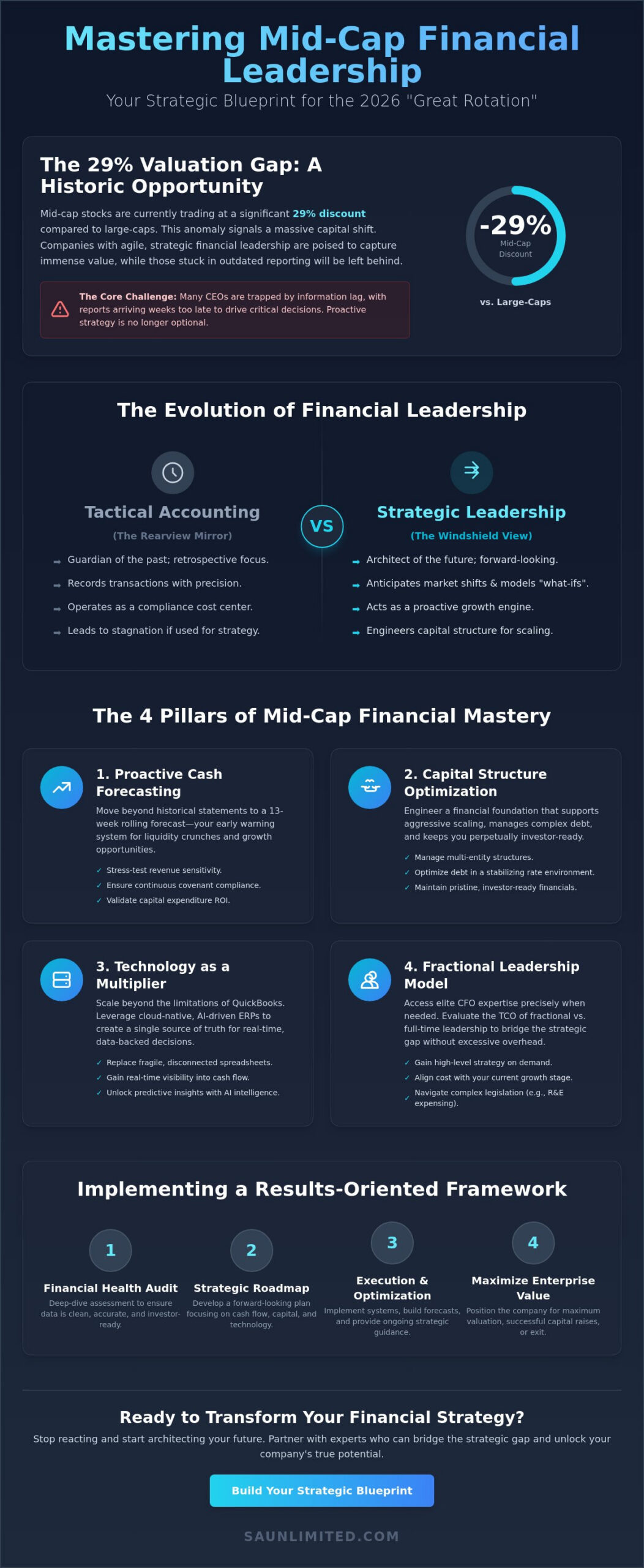
Mid-cap stocks are currently trading at a 29% discount compared to large-caps, a staggering deviation from historical norms that marks 2026 as the year of the “Great Rotation.” While the market opportunity is massive, many CEOs remain trapped by information lag and reports that arrive weeks too late to drive decisions. You know that scaling requires more than just keeping the books; it demands a proactive partner who can navigate the complexities of the One Big Beautiful Bill Act and permanent R&E expensing with precision.
This article delivers the strategic blueprint you need to master financial leadership for mid-cap companies. We’ll show you how to transition from tactical accounting to high-level strategy that fuels growth and maximizes enterprise value. You’ll learn how to leverage AI-driven ERP intelligence and fractional CFO expertise to gain real-time visibility into your cash flow. We’ll also cover how to ensure your financials are always investor-ready, giving you the confidence to raise capital and manage complex debt in a stabilizing interest rate environment.
Key Takeaways
- Bridge the “strategic gap” by evolving your finance department from a compliance cost center into a proactive growth engine.
- Master the four pillars of financial leadership for mid-cap companies, focusing on predictive cash flow forecasting and capital structure optimization.
- Learn why scaling beyond QuickBooks is essential for mid-cap growth and how cloud-native ERPs create a foundation for real-time decision-making.
- Evaluate the total cost of ownership between fractional and full-time leadership to identify the precise moment your business requires a higher tier of expertise.
- Implement a results-oriented framework that starts with a deep-dive financial health audit to ensure your data is investor-ready.
The Evolution of Financial Leadership for Mid-Cap Companies
Financial leadership for mid-cap companies has moved far beyond the boundaries of basic bookkeeping. It’s no longer enough to simply close the books on time or ensure tax compliance. In the high-stakes environment of 2026, true leadership means transforming raw data into a competitive advantage. Mid-market firms often hit a “strategic gap” when they scale past the $10 million revenue mark. They have enough data to be dangerous, but they lack the high-level insight to use it effectively. This gap is where growth stalls and enterprise value begins to erode. Modern success requires a pivot from historical reporting to forward-looking advisory that anticipates market shifts before they hit the balance sheet.
The 2026 economic landscape adds a layer of urgency to this transition. With mid-cap stocks trading at a 29% discount to large-caps, there’s a massive “Great Rotation” of capital occurring. Companies that lack sophisticated financial leadership will miss this window. You need a framework that doesn’t just record the past but actively models the future, especially as the One Big Beautiful Bill Act introduces permanent 100% bonus depreciation and complex R&E expensing rules. Static reporting is a liability in a year defined by domestic fiscal stimulus and stabilizing interest rates.
Tactical Accounting vs. Strategic Leadership
A common mistake is confusing tactical accounting with strategic direction. Your Controller is the guardian of the past; they ensure every transaction is recorded with surgical precision. While this is vital, it’s inherently retrospective. The Role of a Chief Financial Officer, however, is to serve as the architect of the future. They don’t just tell you where the money went; they tell you where it should go next. Relying on tactical staff for strategy leads to stagnation. They aren’t equipped to model the “what-ifs” of a volatile market or engineer a capital structure that supports aggressive scaling. You need a partner who looks through the windshield, not just the rearview mirror.
Why the Mid-Cap Stage Requires a Different Playbook
Scaling to $10 million and beyond introduces complexities that a standard small business playbook can’t handle. You’re likely managing multi-entity structures, diverse revenue streams, and sophisticated ebitda management requirements. This is the breaking point where manual spreadsheets fail. When your data lives in disconnected tabs, you lose the ability to forecast accurately. Modern financial leadership for mid-cap companies replaces these fragile systems with integrated intelligence. It’s about moving from “gut feel” decisions to data-backed certainty. If your current setup can’t provide real-time visibility into your cash flow or investor-ready financials, it’s time to upgrade your leadership caliber before the market leaves you behind.
The 4 Pillars of Strategic Mid-Cap Financial Management
Capturing the 29% valuation gap mentioned earlier requires more than just market timing. It requires an internal engine capable of high-speed maneuvers. True financial leadership for mid-cap companies rests on four non-negotiable pillars. These aren’t just accounting functions. They are the strategic levers that determine whether your company expands or implodes under the weight of its own success. While macro trends offer a Strategic Blueprint for 2026, your internal execution determines if you actually capture that value.
Pillar 1: Proactive Cash Planning and Forecasting
Most controllers provide a cash flow statement, which is a post-mortem of what already happened. A strategic leader provides a 13-week rolling forecast. This is your early warning system. It identifies liquidity crunches before they happen, giving you time to pivot. High-growth firms often leverage fractional cfo services to build these models without the overhead of a full-time executive hire. To stress-test your model, you must evaluate:
- Revenue Sensitivity: What happens to your burn rate if a primary contract is delayed by 60 days?
- Covenant Compliance: Does your current debt structure survive a 15% increase in COGS or labor costs?
- Capital Expenditure ROI: Can your cash reserves handle the 100% bonus depreciation property acquisitions enabled by the OBBBA?
Pillar 2: Capital Raising and Investor Readiness
Investor readiness is a permanent state. You don’t start cleaning up the books when you need capital; you maintain them so you’re always ready for a term sheet. Strategic cfo services play a critical role here. They handle the heavy lifting of due diligence and negotiate the fine print of senior and junior debt. This level of oversight ensures that capital isn’t just raised, but raised on terms that protect your equity and support long-term reinvestment.
Infrastructure is the multiplier. You cannot support 5x growth on a foundation built for a lifestyle business. This means moving beyond manual entry into automated, scalable systems that provide the CEO with actionable insights. Leadership isn’t handing the CEO a 50-page data dump; it’s providing three clear options based on predictive modeling. When financial leadership for mid-cap companies is executed correctly, the finance department stops being a cost center and starts being a catalyst for value creation. If you’re ready to move beyond basic reporting, consider how strategic financial guidance can transform your operation.
Technology as the Multiplier: ERP Intelligence in 2026
By the time a company crosses the $10 million revenue threshold, QuickBooks is no longer a tool; it’s a bottleneck. It lacks the multi-entity consolidation and granular visibility required for sophisticated financial leadership for mid-cap companies. In 2026, the gap between “keeping the books” and “driving the business” is bridged by technology that moves beyond simple record-keeping. You need a system of intelligence that leverages AI for predictive analytics and anomaly detection. These aren’t futuristic concepts anymore. They’re embedded directly into modern workflows to suggest pricing adjustments or flag production inefficiencies before they impact the bottom line.
Cloud-native, composable ERP platforms have replaced monolithic, on-premise software. This shift allows you to integrate best-of-breed applications tailored to your specific industry. Automated reporting is the ultimate multiplier here. It frees your leadership team from the drudgery of manual data entry, allowing them to focus on high-impact strategic advisory. When your financial data flows in real-time, your CFO can spend their energy on capital structure and expansion strategy instead of hunting for errors in a spreadsheet. It’s about providing solutions beyond Quickbooks that scale with your ambition.
The Sage Intacct Advantage for Mid-Market Firms
For mid-cap firms targeting aggressive growth, sage int has become the gold standard. Unlike entry-level software, it offers multi-dimensional reporting that lets you slice data by location, project, or department instantly. This level of transparency is vital for board meetings and investor due diligence. Custom dashboards provide “one version of the truth,” ensuring every stakeholder is looking at the same real-time KPIs. Through expert Sage Intacct consulting, you can build a financial engine that consolidates multi-entity financials in minutes rather than days.
Optimization: Beyond the Initial Implementation
Implementation is just the starting line. True optimization requires ongoing training and system refinement to align with your evolving industry KPIs. As market conditions shift, your reporting needs to stay agile. This transition from manual entry to automated intelligence isn’t a one-time event; it’s a continuous process of refining your tech stack to ensure data integrity. By leveraging fractional accounting services and specialized consultants, you ensure your ERP remains a strategic asset that supports your long-term vision instead of becoming another legacy cost center.
Fractional vs. Full-Time: Navigating the Leadership Transition
Deciding between a full-time executive and a fractional partner is a pivotal moment for any growing organization. For a mid-cap company with revenue between $10 million and $25 million, total compensation for a full-time CFO in 2026 typically ranges from $300,000 to $450,000. This figure includes salary, bonuses, and benefits, representing a significant fixed cost that can strain a scaling balance sheet. In contrast, financial leadership for mid-cap companies can often be achieved more efficiently through a fractional model. This approach provides the same caliber of expertise at a fraction of the total cost of ownership, allowing you to reinvest saved capital into core operations or market expansion.
The outsourced cfo model has evolved into a strategic necessity. With 72% of companies in the $3 million to $15 million range now utilizing or considering fractional services, the market has shifted toward flexibility. You don’t always need a full-time executive sitting in an office 40 hours a week. You need the high-level talent to navigate the One Big Beautiful Bill Act, optimize your capital structure, and manage complex debt. The trigger point for a full-time hire usually arrives when organizational complexity reaches a level where daily, hands-on management of internal teams and external stakeholders becomes a full-time demand, often as you approach the $100 million threshold.
When Fractional Leadership Makes the Most Sense
For companies in the $10 million to $100 million range, cfo consulting offers a tiered approach to growth. This is particularly effective during specific project-based needs such as capital raising, M&A activity, or a major ERP implementation. Instead of a vendor-client relationship, the Unlimited model functions as a dedicated strategic partnership. It provides the agility to scale your financial oversight up or down based on the current phase of your business cycle. You get the architect of the future without the permanent overhead of a legacy executive role.
Evaluating a Strategic Financial Partner
Hiring the wrong advisor can be more expensive than having no advisor at all. When evaluating potential partners, look for these key differentiators:
- Industry-Specific Expertise: Generic experience isn’t enough in 2026. Your partner must understand the nuances of your specific sector.
- Technical Proficiency: Proficiency in Sage Intacct and AI-driven ERP intelligence is non-negotiable for modern data integrity.
- Role Clarity: They must act as a strategic advisor to the CEO, not just a high-level bookkeeper.
If your current financial leadership is reacting to the past instead of engineering your future, it’s time for a change. You can explore our fractional CFO services to see how high-level expertise can transform your trajectory.
Implementing a Results-Oriented Leadership Framework
Strategic theory only generates value when it’s met with relentless execution. To transform your finance department from a cost center into a growth engine, you must follow a disciplined implementation path. Effective financial leadership for mid-cap companies starts with a comprehensive financial health audit and gap analysis. This process identifies exactly where your current reporting fails to support your scaling ambitions. Once the weaknesses are exposed, you must modernize your tech stack to ensure absolute data integrity. This foundation allows you to move beyond manual entry and focus on the strategic levers that drive enterprise value.
Execution requires a consistent rhythm. You must establish a formal cadence for strategic reviews and 13-week rolling forecasts. This ensures that every decision is backed by real-time visibility into cash flow rather than months-old reports. Finally, you must integrate your financial strategy directly with your operational goals. Your CFO shouldn’t just be counting the results of the business; they should be helping the CEO engineer them. SA Unlimited acts as the catalyst for this transformation, providing the high-level talent and modern infrastructure needed to turn financial transparency into a competitive weapon.
The First 90 Days: Setting the Foundation
The initial phase of a strategic partnership focuses on rapid stabilization. We identify “low-hanging fruit” to improve immediate cash flow, such as optimizing collections or renegotiating vendor terms. Simultaneously, we begin the rigorous process of cleaning historical data. You cannot forecast the future if your past data is fragmented or inaccurate. This shift marks the end of reactive “firefighting.” By the end of the first 90 days, your leadership team moves from wondering if the cash is there to planning exactly how to deploy it for maximum ROI.
Scaling for the Long Term
True financial leadership for mid-cap companies prepares the organization for the next level of complexity. Whether you are eyeing international expansion or preparing for a major product launch, your financial engine must be ready. The CFO plays a critical role in building a “culture of accountability” across every department. By establishing clear KPIs and transparent reporting, you ensure that every team understands their impact on the bottom line. Financial leadership isn’t a static destination; it’s the high-performance engine that powers your growth. With the right strategic partner, your finance function becomes the most powerful tool in your executive arsenal.
Secure Your Competitive Edge in 2026
The transition from tactical accounting to strategic foresight isn’t just an option; it’s a requirement for mid-market survival. By implementing the four pillars of management and upgrading to cloud-native ERP intelligence, you position your firm to capture the valuation premiums currently available in the market. True financial leadership for mid-cap companies means moving beyond the limitations of legacy software to embrace proactive, data-driven decision-making that anticipates market shifts before they occur.
SA Unlimited provides the seasoned expertise needed to navigate this transition with total confidence. Our Sage Intacct Certified Consultants bring a track record of success, including proven experience with $500M+ transactions. With tiered pricing models designed for every growth stage, we ensure you have the exact level of support required to fuel your expansion without the overhead of a full-time executive hire. Don’t let information lag or inefficient systems stall your momentum. Scale Your Financial Leadership with SA Unlimited and turn your finance department into your most powerful growth catalyst. Your company’s potential is limitless when your strategy is as bold as your vision.
Frequently Asked Questions
What is the difference between a mid-cap controller and a CFO?
A controller is the guardian of historical data. They focus on the accuracy of the general ledger, internal compliance, and closing the books on time. A CFO uses that data to architect the future. They handle capital raising, strategic planning, and investor relations to ensure the company maximizes its enterprise value during rapid scaling.
How much do fractional CFO services cost for a mid-cap company?
Pricing for these services typically involves a monthly retainer or project-based fee tailored to your specific needs. This model is far more efficient than a full-time hire. A full-time executive for a mid-cap firm often costs between $300,000 and $450,000 annually. A fractional partner provides the same high-level expertise at a fraction of that total cost.
When should a mid-cap company transition from QuickBooks to Sage Intacct?
The transition should occur when your business requires multi-entity consolidation or granular dimensional reporting that spreadsheets can’t handle. If your team is buried in manual data entry or struggles with information lag, you’ve outgrown entry-level software. Sage Intacct provides the foundation for modern financial leadership for mid-cap companies.
Can a fractional CFO help with capital raising and investor relations?
Yes. A fractional CFO leads the capital raising process by preparing investor-ready financials and managing the heavy lifting of due diligence. They serve as a strategic advisor during negotiations for senior and junior debt. Their presence builds immediate credibility with lenders and private equity partners who require institutional-grade financial oversight.
What are the key financial metrics every mid-cap CEO should track daily?
A CEO must have real-time visibility into the daily cash position and net burn rate. You should also track sales pipeline velocity and Days Sales Outstanding (DSO) to manage liquidity effectively. These metrics function as an early warning system. They allow you to make proactive adjustments before minor trends impact your bottom line.
How long does a Sage Intacct implementation typically take?
A standard implementation usually takes between two and four months. This timeline depends on the complexity of your multi-entity structure and the volume of historical data that needs migration. Working with certified consultants ensures the system is optimized for your specific industry KPIs right from the start.
Is an outsourced CFO as effective as an in-house executive?
An outsourced CFO is often more effective because they bring diverse experience from multiple high-growth industries. They provide the same strategic caliber as an in-house hire but with greater flexibility. This model gives you access to top-tier talent that can drive financial leadership for mid-cap companies without the permanent overhead of a legacy executive role.
What does ‘Unlimited’ strategic partnership mean in a fractional context?
An Unlimited partnership means your financial advisor is fully integrated into your success. It’s a proactive, solution-oriented relationship where the partner identifies obstacles before they occur. This collaborative approach ensures that your financial strategy isn’t just a separate department but a core engine that powers your operational goals and long-term expansion.