

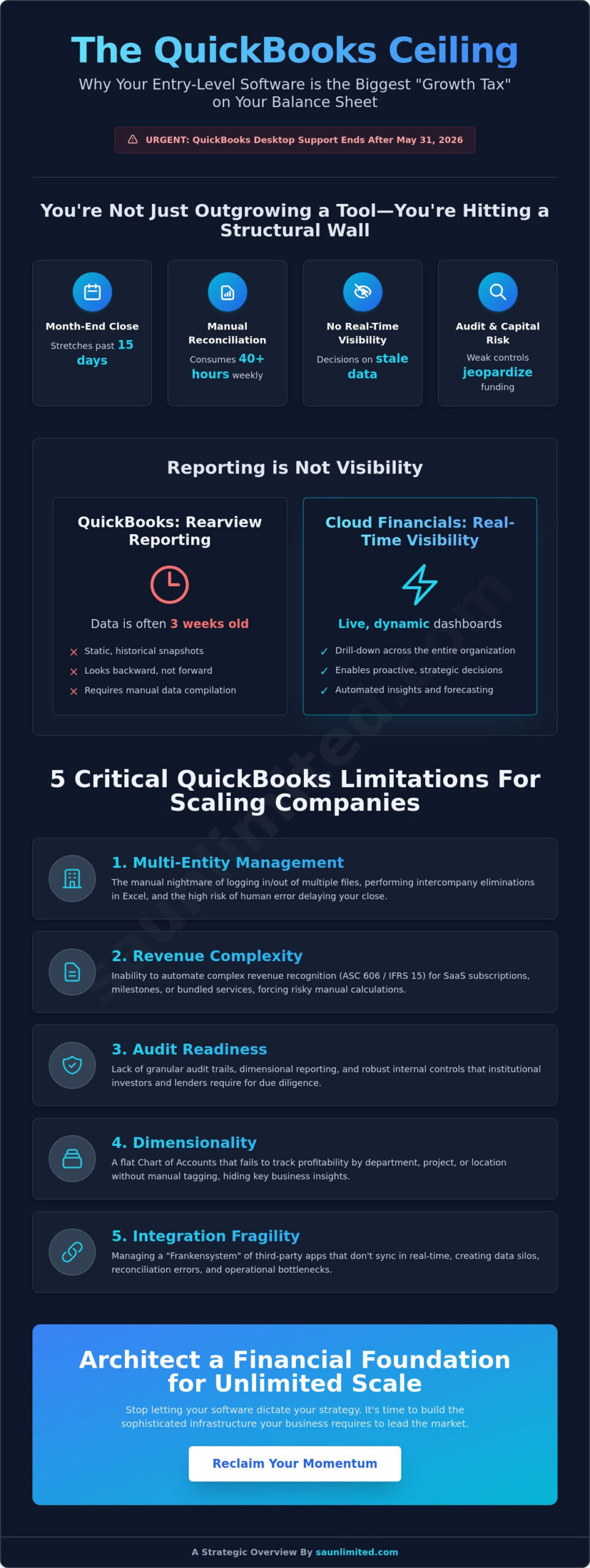
What if your accounting software is actually the biggest “growth tax” on your balance sheet? For many leaders, the realization hits when a month-end close stretches past fifteen days or when manual spreadsheet reconciliation starts consuming forty hours of your controller’s week. You aren’t just outgrowing a tool; you’re hitting a structural wall that prevents real-time visibility and creates a dangerous lack of internal controls. It’s a common stage in the journey of a high-growth company, but staying here puts your next capital raise or audit at significant risk.
We understand the pressure of managing complex revenue recognition while your current system feels like it’s held together by duct tape. You deserve a financial engine that drives expansion rather than slowing it down. In this guide, you’ll discover why your entry-level setup is stalling your momentum and how to architect a foundation for unlimited scale. We will dive into the five critical limitations of quickbooks for scaling in 2026, especially as support for QuickBooks Desktop officially ends after May 31, 2026. From automated multi-entity consolidation to strategic data transparency, it’s time to build the sophisticated infrastructure your business requires to lead the market.
Key Takeaways
- Identify the specific revenue milestones where entry-level software transitions from a helpful tool into a strategic bottleneck.
- Uncover how the limitations of quickbooks for scaling force your team into manual workarounds for multi-entity consolidation and advanced revenue recognition.
- Reclaim your executive impact by shifting your financial team’s focus from tedious data integrity checks to high-level strategic forecasting.
- Evaluate your current operations against a four-point checklist to determine if your month-end close and internal controls are ready for expansion.
- Learn why pairing advanced cloud financials like Sage Intacct with expert advisory is the winning formula for mid-cap market leadership.
The QuickBooks Ceiling: Why ‘Good Enough’ Is Stalling Your Scale
Most founders view their accounting system as a utility; it’s a tool that simply needs to function. For the first few years, QuickBooks accounting software is an exceptional partner. It handles basic ledger entries and simple invoicing with ease, supporting businesses as they climb toward the $5 million revenue mark. But as you scale, a subtle shift occurs. The software that once empowered you begins to dictate your business strategy. This is the QuickBooks Ceiling. Understanding the limitations of quickbooks for scaling is the first step toward building a resilient, high-value enterprise.
Scaling in 2026 requires more than just digital bookkeeping. It demands a sophisticated financial architecture that handles high transaction volumes and complex departmental structures. When you force a small business tool to perform mid-market tasks, you accumulate ‘Financial Technical Debt.’ This debt consists of the manual workarounds, offline spreadsheets, and fragmented processes your team creates to bridge the gap between software capability and business reality. It’s a temporary fix that eventually becomes a permanent barrier to efficiency and expansion.
The ‘Growth Tax’ of Manual Workarounds
Every spreadsheet ‘bridge’ your controller builds adds a hidden layer of risk to your financials. These manual processes act as a ‘growth tax’ that siphons away your most valuable asset: time. When your accounting team spends forty hours a month on data re-entry, they aren’t analyzing your margins or optimizing cash flow. The limitations of quickbooks for scaling become painfully visible during due diligence. Investors and lenders look for robust, automated systems. Fixing a messy, manual ledger during a capital raise often costs five times more than building a proper foundation from the start.
Visibility vs. Reporting: A Critical Distinction
There is a massive distinction between reporting and visibility. Reporting is looking in the rearview mirror; it’s a static snapshot of what happened last month. Visibility is the ability to look forward in real-time across your entire organization. QuickBooks reports are often three weeks old by the time they’re finalized. Making $10 million decisions based on stale data is a recipe for disaster. Real-time visibility allows you to pivot quickly, seize market opportunities, and manage departmental spend before it impacts your bottom line. To lead your industry, you need a system designed for dynamic growth, not just basic compliance.
5 Critical Limitations of QuickBooks for Scaling Mid-Cap Companies
As your organization expands, the cracks in a foundational system become chasms. You aren’t just dealing with more data; you’re dealing with more complexity. The operational bottlenecks of QuickBooks often surface when you move from a single entity to a multi-entity structure. The primary limitations of quickbooks for scaling center on its architectural inability to handle sophisticated financial workflows that mid-market leaders demand.
Beyond the basic ledger, five specific areas create friction for scaling companies:
- Multi-entity management: The operational drain of logging in and out of ten different files to see a single version of the truth.
- Revenue complexity: The inability to automate ASC 606 or IFRS 15 compliance for SaaS subscriptions or bundled service contracts.
- Audit readiness: A lack of granular audit trails and internal controls that institutional investors and lenders require.
- Dimensionality: Relying on a flat Chart of Accounts that fails to track profitability by department, project, or location without manual tagging.
- Integration fragility: Managing a “Frankensystem” of third-party apps that don’t sync in real-time, leading to data silos.
The Multi-Entity Consolidation Wall
Managing multiple legal entities in entry-level software is a manual nightmare. You’re forced to perform intercompany eliminations in Excel, which increases the risk of human error and delays your close. This lack of centralized control often leads to “rogue” accounting practices across subsidiaries. If your team spends three days just preparing a consolidated board deck, you’ve hit the wall. You need a unified ledger that provides instant, global visibility.
Revenue Recognition and Compliance Risks
As contracts grow more complex, GAAP compliance becomes a moving target. Tracking deferred revenue on a spreadsheet is a recipe for revenue leakage and potential audit failure. In 2026, automated revenue recognition has become a non-negotiable requirement for companies seeking high-multiple valuations. Without it, you’re guessing at your growth rather than proving it. Strategic leaders know that manual workarounds are the enemy of a clean audit.
Relying on “zaps” to move data between disconnected systems isn’t a long-term strategy for a high-growth company. True scale requires a financial engine where your data is integrated, not just connected. If you’re feeling the strain of these technical gaps, it may be time to consider solutions beyond QuickBooks that are built for the complexity of your next chapter.
The Strategic Friction Cost: How Entry-Level Software Dilutes Your CFO’s Impact
Your CFO is supposed to be the architect of your future, not the janitor of your past. In many scaling firms, the financial leader falls into the 80/20 trap: spending 80% of their energy on data integrity and only 20% on strategy. This imbalance isn’t a performance issue; it’s a software issue. The limitations of quickbooks for scaling force high-value talent to manually verify entries that should be automated. When your leadership team is stuck in the weeds of spreadsheet reconciliation, they can’t focus on the market-moving decisions that drive true expansion.
High-level fractional CFO services require high-level data to be effective. Without a unified ledger, a strategic advisor is essentially flying blind. They’re forced to wait for three-week-old reports rather than using real-time insights to steer the ship. This lack of sophisticated infrastructure also makes ‘What-If’ scenario modeling nearly impossible. If you can’t instantly model the impact of a new product launch or a shift in market conditions, your organization suffers from decision paralysis. You end up reacting to the market instead of leading it.
From Bookkeeper to Strategic Architect
A controller ensures the numbers are right; a strategic CFO ensures the business is headed in the right direction. When entry-level software fails to provide granular visibility, the line between these roles blurs. Your CFO’s expertise is wasted on verifying spreadsheet formulas and hunting for data discrepancies. This friction becomes a major liability during funding rounds. Investors expect a level of data sophistication that supports their due diligence. Clean, automated data is a prerequisite for successful capital raising support, as it proves your organization has the maturity to handle significant investment.
The Cost of ‘Garbage In, Garbage Out’
QuickBooks lacks the rigorous data validation found in enterprise-grade systems. This creates a “garbage in, garbage out” cycle that erodes executive confidence. If the board can’t trust the numbers, they can’t approve the aggressive expansion plans you’ve proposed. A cfo consulting partner can’t fix a broken system with advice alone. They need a single version of the truth to provide the strategic blueprint your company needs. The limitations of quickbooks for scaling eventually turn your financial department into a bottleneck rather than a catalyst for growth.
The Upgrade Checklist: 4 Signs Your Business Has Outgrown QuickBooks in 2026
Identifying the exact moment to graduate from entry-level software is a high-stakes leadership skill. Transition too early, and you over-invest in infrastructure you don’t yet need. Transition too late, and you create a structural bottleneck that can stall a $20 million expansion or sink a critical funding round. The limitations of quickbooks for scaling usually manifest as a slow, steady increase in manual effort that eventually reaches a breaking point. If your financial team is working harder just to keep the status quo, you’ve hit the ceiling.
Look for these four definitive signals that your current system has become a liability:
- Sign 1: Entity Explosion. You’ve surpassed three legal entities or have launched international subsidiaries. Managing separate logins and manual consolidations is no longer sustainable.
- Sign 2: The 10-Day Barrier. Your month-end close consistently takes longer than 10 business days. If you’re getting October’s data in the middle of November, you’re driving by looking in the rearview mirror.
- Sign 3: Institutional Scrutiny. You are actively preparing for a Series B round, an M&A event, or an IPO. Serious investors demand enterprise-grade controls.
- Sign 4: Shadow Accounting. Your team maintains “shadow” spreadsheets to track deferred revenue, intercompany eliminations, or project profitability because the General Ledger cannot handle the complexity.
The Multi-Entity and International Trigger
Foreign currency translation and global tax compliance are the specific points where entry-level tools fail. When you operate across borders, centralized financial control becomes a legal necessity rather than a luxury. An outsourced cfo will tell you that the risk of a tax Nexus error or a currency miscalculation can cost significantly more than a software upgrade. You need a system that automates these translations in real-time to maintain a clear picture of your global cash position.
The Audit-Ready Milestone
Institutional investors and lenders demand a “Single Source of Truth” that QuickBooks simply cannot provide at scale. They look for robust audit trails that show exactly who changed what and when. Disconnected files and Excel workbooks are major red flags during due diligence. By moving to a more sophisticated platform, you lower your cost of capital and prove your organization has the maturity to handle significant investment. Your financial system should be a competitive advantage that accelerates a deal, not a friction point that slows it down.
If your team is drowning in “shadow” spreadsheets just to keep the books straight, it’s time for a professional-grade solution. Discover how our fractional controllers can help you transition to a foundation built for unlimited scale.
Beyond QuickBooks: Architecting a Financial Foundation for Unlimited Scale
Recognizing the limitations of quickbooks for scaling is a vital leadership epiphany. It’s the moment you stop accepting manual workarounds as “part of the job” and start demanding a system that matches your ambition. Moving beyond an entry-level tool isn’t just a software swap; it’s a strategic upgrade to your company’s nervous system. By 2026, the transition to a sophisticated cloud financial platform has become the standard for companies moving from mid-cap status to market leadership.
The transition requires a shift in mindset. You’re no longer just recording transactions; you’re architecting data. This architecture must support high transaction volumes, complex revenue streams, and the rigorous demands of institutional investors. While the limitations of quickbooks for scaling can feel like a barrier, they actually serve as a signal that your business is ready for a more professional, automated, and transparent future.
Why Sage Intacct is the Scaling Standard
For businesses that have hit the ceiling, Sage Intacct (Sage Int) is the logical next step. It’s built specifically for the complexities of multi-entity management and global expansion. Unlike flat systems, it utilizes multi-dimensional reporting to give you instant visibility into profitability by project, location, or department. This automation is transformative. Industry benchmarks indicate that moving to sage int can reduce the month-end close cycle by up to 80%, giving your team back days of strategic time. Real-time dashboards replace static reports, empowering every department head with the data they need to hit their KPIs without waiting for finance to “run the numbers.”
Your Partner in Unlimited Growth
Success in the mid-market requires a proactive partner who understands the nuances of capital raising, cash forecasting, and tax planning. We serve as a strategic advisor to the CEO, ensuring your financial infrastructure is an asset during due diligence rather than a liability. Our approach focuses on a “Software + CFO Expertise” formula. A powerful engine is useless without a seasoned driver. We don’t just implement software; we architect the financial foundation that supports your specific growth trajectory.
Our team ensures that your transition happens without disrupting daily operations. We bridge the gap between “keeping the books” and “driving the business” by providing the strategic oversight that software alone cannot offer. Whether you need fractional controller services to clean up your data or Sage Intacct consulting to optimize your tech stack, we provide the high-quality talent your expansion demands. Don’t let your current system dictate your future. Schedule a strategic assessment of your financial infrastructure with SA Unlimited today and discover how we can help you break through the QuickBooks ceiling.
Secure Your Strategic Advantage for 2026 and Beyond
Scaling a business requires a radical shift from reactive bookkeeping to proactive financial leadership. You’ve identified the specific triggers that signal it’s time to move. Whether it’s the nightmare of multi-entity consolidation or the risk of manual revenue recognition, the limitations of quickbooks for scaling are actually proof of your company’s success. You’ve reached the point where your ambition requires an infrastructure built for complexity. It’s time to trade manual workarounds for automated precision.
We specialize in bridging this gap. As Sage Intacct Implementation Experts and Fractional CFOs for Mid-Cap Growth, we bring quantifiable success in scaling financial infrastructure to every partnership. Don’t let a legacy system be the bottleneck that stops your momentum. You deserve a financial engine that moves at the speed of your vision. Ready to break through the QuickBooks ceiling? Schedule your Strategic Financial Assessment with SA Unlimited today. Your next chapter of growth is waiting, and we’re here to help you architect it.
Frequently Asked Questions
Is there a specific revenue threshold where I should switch from QuickBooks?
Most businesses hit the QuickBooks ceiling when they reach between $5 million and $10 million in annual revenue. However, transaction volume and complexity are often better indicators than top-line revenue alone. If your team processes over 1,000 transactions monthly or manages more than three legal entities, the software’s structural gaps will likely begin to stall your growth. Proactive leaders transition before these bottlenecks become critical operational risks.
What is the difference between QuickBooks Enterprise and a true ERP like Sage Intacct?
QuickBooks Enterprise is essentially a more robust version of a flat-file system, whereas Sage Intacct is a multi-dimensional cloud ERP. While Enterprise offers more users and data capacity, it still lacks the automated multi-entity consolidation and advanced revenue recognition required for complex scaling. Sage Intacct allows you to tag transactions across multiple dimensions like department, location, or project, providing far deeper strategic insights than a traditional chart of accounts.
How long does it typically take to migrate from QuickBooks to a more robust system?
A professional migration usually spans 60 to 90 days. This timeline includes data cleansing, system configuration, and team training to ensure a seamless transition. Rushing the process often leads to data integrity issues, while a structured approach allows your business to maintain daily operations. Partnering with seasoned consultants ensures that your new financial foundation is correctly architected from day one to support unlimited future scale.
Can I still use QuickBooks for my small subsidiaries while using an ERP for the parent company?
While technically possible, maintaining a hybrid system creates significant data silos and manual work. Using different platforms forces your team to perform manual consolidations in spreadsheets, which reintroduces the very risks you are trying to eliminate. A unified ledger across all subsidiaries provides instant, global visibility and ensures that every entity follows the same internal controls. Centralizing your financials on one platform is the most efficient way to manage international growth.
Will upgrading my accounting software help me raise venture capital or private equity?
Yes, institutional investors prioritize companies with enterprise-grade financial systems and clean audit trails. Upgrading demonstrates that your organization has the maturity and internal controls necessary to handle significant capital. By addressing the limitations of quickbooks for scaling early, you provide investors with the high-level data transparency they need for due diligence. This professional infrastructure often leads to higher valuations and a faster closing process for your funding rounds.
What are the hidden costs of staying on QuickBooks for too long?
The primary hidden cost is the massive amount of manual labor required to bridge software gaps with spreadsheets. You’re essentially paying high-level talent to perform low-level data entry. Additionally, the risk of “shadow accounting” errors and the opportunity cost of making decisions based on three-week-old data can be devastating. These inefficiencies act as a “growth tax” that siphons away capital and executive focus from strategic expansion.
Do I need a full-time CFO to manage the transition away from QuickBooks?
You don’t need a full-time hire to successfully navigate this transition. Fractional CFO services provide the high-level expertise needed for system selection and implementation without the six-figure salary and benefits package of a permanent executive. This model allows scaling firms to access strategic financial leadership on an as-needed basis. It’s a cost-effective way to architect a sophisticated financial foundation while keeping your overhead lean during a critical growth phase.
How does Sage Intacct handle multi-currency and international tax compliance?
Sage Intacct automates the entire multi-currency process by providing real-time exchange rate updates and automated translations. It handles complex local tax requirements, such as VAT or GST, across different jurisdictions without manual intervention. This capability is one of the primary reasons companies move beyond the limitations of quickbooks for scaling when expanding globally. You gain a centralized view of your global cash position while ensuring full compliance with international accounting standards.