

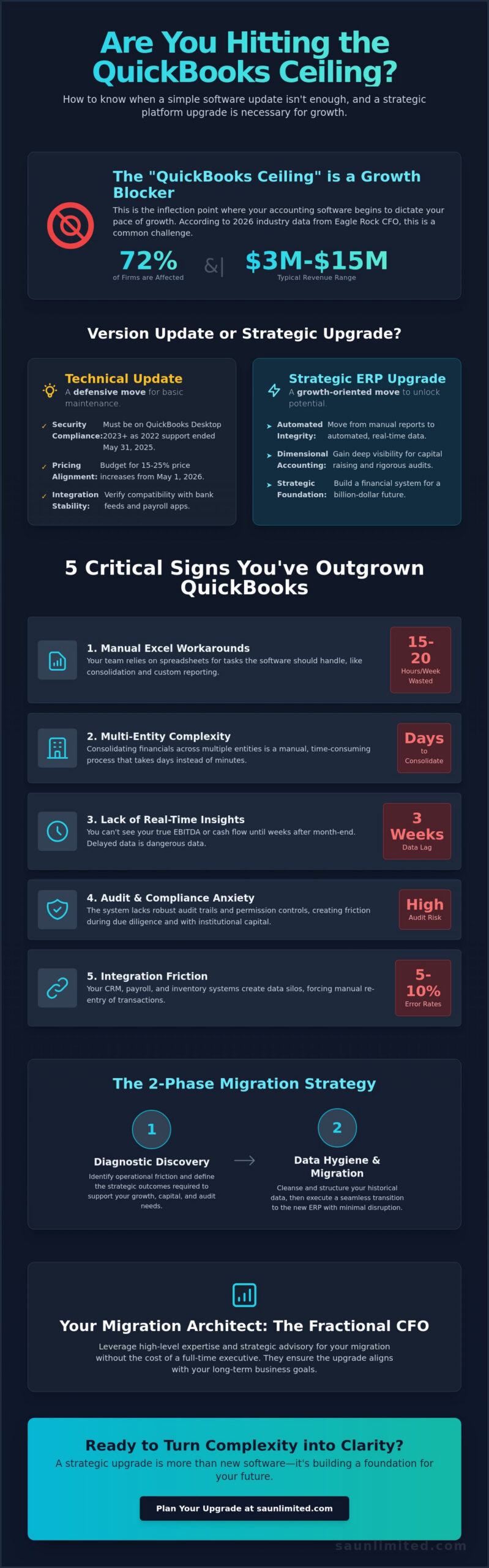
Upgrading your software version is merely a maintenance task, but upgrading your platform is a high-stakes strategic move. You likely chose QuickBooks for its simplicity, yet you now find yourself spending three days every month-end wrestling with Excel just to consolidate entities. It’s a common frustration for the 72% of firms with revenues between $3 million and $15 million that are currently hitting the “QuickBooks ceiling” according to 2026 industry data from Eagle Rock CFO. Knowing exactly when to upgrade from quickbooks is the difference between seamless scaling and a failed due diligence process.
At SA Unlimited, we solve for yes by turning financial complexity into strategic clarity. You deserve a system that supports bold moves and rapid capital raising, not one that leaves you fearing a rigorous audit or lacking real-time cash flow visibility. This guide helps you discover whether you need a technical version update to handle the May 1, 2026, price increases or a strategic shift to an ERP to unlock your business potential. We’ll explore the transition from manual reporting to automated data integrity, ensuring your financial foundation is built for a billion-dollar future.
Key Takeaways
- Differentiate between a routine version update and a strategic shift to an ERP like Sage Intacct to drive real growth.
- Recognize the specific operational friction, such as multi-entity complexity and Excel dependency, that dictates when to upgrade from quickbooks.
- Transition from a flat chart of accounts to dimensional accounting to gain the real-time visibility required for capital raising and rigorous audits.
- Implement a two-phase migration strategy focused on diagnostic discovery and data hygiene to ensure a seamless transition without the headache.
- Leverage a fractional CFO as your migration architect to provide high-level expertise and strategic advisory without the cost of a full-time executive.
QuickBooks Version Update vs. Strategic ERP Upgrade
Many business leaders mistake a software notification for a strategic milestone. In 2026, Intuit’s 15% to 25% price increases across QuickBooks Online plans are forcing a hard conversation in boardrooms. You aren’t just deciding on a new subscription tier. You’re deciding on the future velocity of your organization. Understanding when to upgrade from quickbooks requires distinguishing between routine maintenance and a fundamental shift in your financial architecture.
A technical version update is a defensive move. It ensures you have the latest security patches and UI tweaks. However, a strategic upgrade involves moving from entry-level accounting to a robust Enterprise Resource Planning (ERP) system like Sage Intacct. This transition is how you transform your world. It moves your finance team from the back office to the strategy table. At SA Unlimited, we solve for yes by focusing on the outcomes that drive value, not just the software that records it.
The 2026 Technical Update Checklist
If your business remains stable with low transaction volume, a version update might suffice. Ensure your system meets these 2026 requirements to maintain basic operations:
- Security Compliance: Support for QuickBooks Desktop 2022 ended on May 31, 2025. You must be on a 2023 or newer subscription to receive critical patches and connected services.
- Pricing Alignment: Budget for the May 1, 2026, increases. QuickBooks Online Plus is now $110 per month, while Desktop Premier Plus has risen to $1,609 per year for a single user.
- Integration Stability: Verify that your 2026 release maintains seamless compatibility with your bank feeds and third-party payroll applications to avoid manual data entry.
The Strategic Inflection Point
You hit the “QuickBooks Ceiling” when your accounting software begins to dictate your pace of growth. This usually occurs as firms reach the $3 million to $15 million revenue range. At this stage, “keeping the books” is no longer enough. You must start “driving the business.” Strategic financial advisory identifies these friction points before they become a crisis. When your team spends more time fixing data than analyzing it, you have reached the inflection point. Moving to an ERP allows you to unlock your business potential by providing the dimensional depth that basic software lacks. This isn’t just about new features. It’s about building a foundation that supports rapid scaling, capital raising, and institutional-grade due diligence.
5 Signs Your Business Has Outgrown QuickBooks
Growth is a double-edged sword. While revenue climbs, your back-office infrastructure might be quietly crumbling under the weight of new complexity. Identifying when to upgrade from quickbooks isn’t about looking for software bugs. It’s about recognizing when your financial system has become a bottleneck for your ambitions. If your accounting feels like it’s dragging behind your sales team, you’re likely facing one of these five critical indicators.
- Manual Excel Workarounds: Your team spends 15 to 20 hours a week in spreadsheets performing tasks the software should handle. When “Sheet1_Final_v4” becomes your primary reporting tool, your system is failing.
- Multi-Entity Complexity: Consolidating financials across three or more entities takes days instead of minutes. You need a system that handles intercompany eliminations automatically.
- Lack of Real-Time Insights: You can’t see your true EBITDA until three weeks after the month ends. In a fast-moving market, delayed data is dangerous data.
- Audit and Compliance Anxiety: Your current system lacks the robust audit trails and permission controls required for institutional capital. This creates friction during due diligence.
- Integration Friction: Your CRM, payroll, and inventory systems aren’t communicating with your ledger. This data silo forces your team to manually re-enter transactions, increasing the risk of 5% to 10% error rates.
The Hidden Cost of ‘Making it Work’
Sticking with a legacy system often costs more than the upgrade itself. When you factor in the labor hours wasted on manual reconciliation, the “cheap” solution becomes incredibly expensive. In 2026, the opportunity cost of stagnant data is higher than ever. If your controller is buried in data entry, they aren’t providing the strategic analysis you need to make bold moves. Human error in a manual forecast can lead to catastrophic cash flow miscalculations. You need a platform that empowers your team to work on the business, not just in it. Our fractional CFO services help you identify these leaks and plug them with better technology.
Preparing for Capital Raising
Institutional investors and lenders demand GAAP-compliant systems. They want to see that your numbers are backed by a rigorous, automated framework. Determining When to Upgrade Your Accounting System is a vital step in building the credibility required for a successful exit or a Series B round. Moving beyond basic bookkeeping to sophisticated financial modeling allows you to present your business with unwavering confidence. A dimensional ledger provides the granular detail that proves your profitability is sustainable, not just a lucky streak. We roll up our sleeves to ensure your data integrity is bulletproof before you ever step into a pitch meeting.
The ROI of Upgrading to Sage Intacct in 2026
The decision regarding when to upgrade from quickbooks shouldn’t be driven by a software renewal date. It should be driven by your return on investment. While QuickBooks Online Advanced costs $275 per month as of May 2026, mid-market companies often find that the “cheaper” option is actually costing them hundreds of thousands in lost efficiency and missed opportunities. Sage Intacct is the preferred ERP for growth-oriented firms because it replaces manual effort with strategic automation. It isn’t just an expense. It’s a foundational asset that allows you to unlock your business potential.
The most significant shift from QuickBooks to Sage Intacct is moving from a flat chart of accounts to dimensional accounting. In QuickBooks, every new department, location, or project requires a new sub-account, often leading to a bloated, unmanageable list of 1,000+ entries. Sage Intacct uses dimensions to tag transactions. This allows you to keep a clean, lean chart of accounts while gaining the ability to slice and dice data with surgical precision. Our Sage Intacct consulting team helps you design this architecture so your finance system mirrors your actual business operations.
Automation is where the ROI becomes undeniable. Sage Intacct handles complex processes like revenue recognition, intercompany transfers, and global consolidations in seconds. If your team is currently spending 40% of their time on manual data entry, this upgrade pays for itself through labor reallocation alone. We solve for yes by ensuring your system does the heavy lifting, allowing your team to focus on high-value analysis rather than clerical corrections.
Dimensional Reporting and Clarity
Knowing your numbers is impossible when they are buried in a spreadsheet. Dimensional reporting allows you to view profitability by project, customer, or even individual sales rep in real time. You can generate a P&L for a specific location without waiting for a manual roll-up at month-end. These real-time dashboards empower executive teams to act fast and make profitable decisions with unwavering confidence. You no longer have to guess which segments of your business are driving growth and which are draining resources.
Scalability and Future-Proofing
Sage Intacct is designed to be the last accounting system you’ll ever need to buy. It handles high transaction volumes without the system lag or data corruption issues that plague QuickBooks as it nears its limits. For firms looking toward international growth, Intacct supports multi-currency and global entity management with ease. It provides the institutional-grade infrastructure required to support billion-dollar success metrics. By investing in a scalable platform now, you create a clear pathway for rapid expansion and future capital raising.
How to Plan a Seamless Migration Without the Headache
Deciding when to upgrade from quickbooks is only the first step toward transforming your world. The real challenge lies in the execution. Many providers treat migration as a simple data export, but a “one-click” approach often leads to broken workflows and corrupted reporting. We believe a successful transition requires a meticulous, five-phase blueprint designed to protect your data integrity and support your billion-dollar success metrics.
- Phase 1: Diagnostic and Discovery. We map your current operational friction and future requirements. This ensures the new system solves for your specific bottlenecks.
- Phase 2: Data Hygiene. Do not move your mess. We clean up years of QuickBooks “clutter” to ensure your new ledger is a source of truth from day one.
- Phase 3: System Design. We build a dimensional architecture that supports your 3-year growth plan, moving beyond the limitations of a flat chart of accounts.
- Phase 4: Implementation and Training. We empower your team through hands-on education. A system is only as powerful as the people who operate it.
- Phase 5: Post-Launch Optimization. Our CFO consulting provides the ongoing strategic oversight needed to refine your processes as you scale.
Mapping Your Path to ‘Yes’
Success requires clarity on your “must-have” features for day one. We identify the critical automated reports and integrations that will provide immediate ROI. Our goal is zero downtime for your financial operations. You need a partner who understands that payroll and vendor payments cannot pause for a software rollout. We roll up our sleeves to handle the technical heavy lifting, allowing you to stay focused on making bold moves. Let’s connect to design your custom migration roadmap.
Overcoming the Fear of Change
The “we’ve always done it this way” mentality is the single greatest threat to your digital transformation. Executive buy-in is non-negotiable for a successful ERP rollout. We use a phased approach to reduce risk and spread out the investment. With typical implementation costs ranging from $25,000 to $37,500 for an average Sage Intacct installation, a structured plan ensures every dollar spent contributes to your scalability. By involving your team early, you turn potential resistance into proactive partnership, ensuring everyone is invested in the new pathway to profitability.
Why a Fractional CFO is Your Migration Architect
A software migration is a defining moment for your leadership. While a technical installer focuses on mapping fields and importing CSV files, a strategic partner focuses on your exit strategy and capital requirements. Determining when to upgrade from quickbooks is the first step, but choosing who leads that journey determines your eventual success. At SA Unlimited, we don’t just install software. We architect financial systems that empower you to make bold moves. We solve for yes by ensuring your new ERP isn’t just a ledger, but a strategic engine that drives profitability.
The fractional CFO market is projected to reach $6.4 billion by 2028, reflecting a massive shift in how mid-market firms access elite talent. This growth is driven by leaders realizing that fractional CFO services typically cost 40% to 60% less than the total compensation for a full-time executive. You get the institutional-grade expertise required for a billion-dollar success metric without the overhead of a permanent C-suite placement. This allows you to reallocate capital into growth initiatives while we handle the complexities of your financial transformation.
Strategic Oversight vs. Tactical Setup
Your accounting team focuses on the reality of today’s invoices, while your CEO vision focuses on tomorrow’s market share. A fractional CFO acts as the essential bridge between these two worlds. We ensure your system architecture supports sophisticated cash planning and forecasting from the moment you go live. When you’re preparing for due diligence or a new funding round, you don’t need a simple list of transactions. You need a narrative of profitability backed by bulletproof data. We integrate investor reporting into your ERP workflow, ensuring your data integrity is never questioned during a rigorous audit. Knowing when to upgrade from quickbooks is about recognizing that you need this level of sophistication to reach the next tier of success.
Unlocking Your Business Potential
Reactive accounting keeps you afloat, but proactive financial leadership transforms your world. Moving beyond QuickBooks is the catalyst for this evolution. SA Unlimited creates pathways for growth by combining top-notch talent with cutting-edge technology. We roll up our sleeves to ensure your system architecture supports your 2026 ambitions, not just your 2025 taxes. We don’t just point out obstacles; we create solutions that allow you to scale with unwavering confidence. It’s time to move from “making it work” to “making it grow.” Ready to move beyond QuickBooks and unlock your business potential? Let’s connect.
Transform Your Financial Foundation for Future Growth
Stop settling for “good enough” accounting. In 2026, the complexity of your business demands more than just a software version update. You’ve learned that the “QuickBooks Ceiling” is real, especially for the 72% of mid-market firms now seeking higher-level financial guidance. Knowing exactly when to upgrade from quickbooks is the first step in moving from reactive bookkeeping to proactive strategic leadership. This transition ensures your data integrity remains bulletproof during rigorous audits and capital raising rounds.
At SA Unlimited, we solve for yes. We’ve supported over $1B in successful client transactions by providing decades of high-level strategic expertise. As specialized Sage Intacct implementation partners, we roll up our sleeves to ensure your migration is a catalyst for scale, not a source of stress. You need a system that offers dimensional clarity and institutional-grade integrity to attract capital and sustain growth. It’s time to build a financial architecture that supports your boldest moves and empowers your team to act with unwavering confidence.
Unlock Your Business Potential with a Strategic Financial Assessment. Your pathway to a billion-dollar future starts with the right partner. Let’s build it together.
Frequently Asked Questions
Is QuickBooks Desktop being discontinued in 2026?
Intuit has not officially discontinued QuickBooks Desktop for existing subscribers in 2026, but they have ceased selling new subscriptions as of September 30, 2024. Existing users must navigate significant price hikes, such as the February 1, 2026, increase that brought Premier Plus to $1,609 per year. The platform is being phased out in favor of cloud-native solutions, making it a legacy system for most growing firms.
What is the difference between upgrading QuickBooks and migrating to an ERP?
Upgrading QuickBooks is a technical version update for security or minor UI changes, while migrating to an ERP is a strategic infrastructure shift. A version update maintains the status quo. An ERP migration provides dimensional accounting and automated consolidations that QuickBooks cannot support. Knowing when to upgrade from quickbooks to an ERP depends on your need for institutional-grade reporting and audit readiness.
How much does a Sage Intacct implementation typically cost for a mid-sized company?
A Sage Intacct implementation typically costs between $25,000 and $37,500 for a mid-market company. This one-time expense usually ranges from 1 to 1.5 times the annual subscription fee according to 2026 market data. These costs cover system configuration, data migration, and team training to ensure your new financial foundation supports long-term scalability and billion-dollar success metrics.
Can I migrate my QuickBooks data directly into Sage Intacct?
You cannot perform a one-click migration, as QuickBooks data requires significant hygiene and mapping before entering Sage Intacct. The transition involves moving from a flat chart of accounts to a dimensional structure. We roll up our sleeves to clean up years of data clutter, ensuring your historical records align with the sophisticated architecture of your new ERP to maintain bulletproof data integrity.
How long does it take to move from QuickBooks to a more robust system?
A successful migration from QuickBooks to a robust ERP like Sage Intacct generally takes between 3 and 6 months. This timeline accounts for discovery, system design, data cleaning, and user acceptance testing. A phased approach reduces operational risk and ensures your team is fully empowered to use the new system without experiencing downtime in critical financial functions like payroll or vendor payments.
Do I need a full-time CFO to manage an ERP upgrade?
You don’t need a full-time CFO to manage an ERP upgrade, as a fractional CFO provides the same strategic oversight at 40% to 60% less cost. Fractional experts act as migration architects, bridging the gap between your CEO’s vision and the technical implementation. This model allows growing firms to access elite strategic advisory and billion-dollar success metrics without the overhead of a permanent executive placement.
What are the security benefits of upgrading my QuickBooks version in 2026?
Upgrading your QuickBooks version in 2026 provides critical security patches and ensures compatibility with modern operating systems. Since support for QuickBooks Desktop 2022 ended on May 31, 2025, older versions are vulnerable to data breaches and lack connected services. Staying current protects your financial data integrity while you evaluate when to upgrade from quickbooks to a cloud-native ERP with superior permission controls.
Can a Fractional CFO help with QuickBooks troubleshooting while we plan an upgrade?
A fractional CFO can assist with high-level troubleshooting and financial modeling while you plan your strategic transition. We solve for yes by identifying current bottlenecks and creating pathways for future growth. While we don’t provide general bookkeeping, we ensure your current QuickBooks data is clean and actionable, providing the clarity needed to make bold moves before the migration begins.