

Imagine sitting across from a Tier 1 venture capital firm, only to have them uncover a 12% discrepancy in your historical EBITDA within the first ten minutes of due diligence. For many founders, preparing financials for investors feels like a high-stakes race against a clock that’s already run out, especially when manual reporting processes slow you down and GAAP compliance feels like a moving target. You’ve worked too hard to let a single red flag or a messy spreadsheet derail your growth. We know that feeling of uncertainty, and we’re here to help you solve for yes.
This guide will empower you to make bold moves by transforming your raw accounting data into a high-impact financial narrative that builds immediate investor trust. You’ll gain a clear 10-point checklist of required documents and a proven strategy to mitigate risks before your first meeting. We’ll show you how to move beyond the numbers to tell a story of profitable growth, ensuring you have the clarity and confidence needed to unlock your business potential and secure the capital your vision deserves.
Key Takeaways
- Shift your mindset from tax-minimization to growth-maximization to build a financial narrative that commands investor trust.
- Master the essential 2026 checklist for preparing financials for investors, ensuring your core statements and cap table provide absolute clarity.
- Move beyond “hockey stick” guesswork by grounding your 5-year forecast in the unit economics that drive real-world profitability.
- Identify and neutralize accounting red flags before due diligence begins to protect your credibility during the Quality of Earnings review.
- Learn how a strategic partner acts as the ultimate translator between your vision and the investor’s data room to secure the “Yes.”
What Does it Mean to Have ‘Investor-Ready’ Financials?
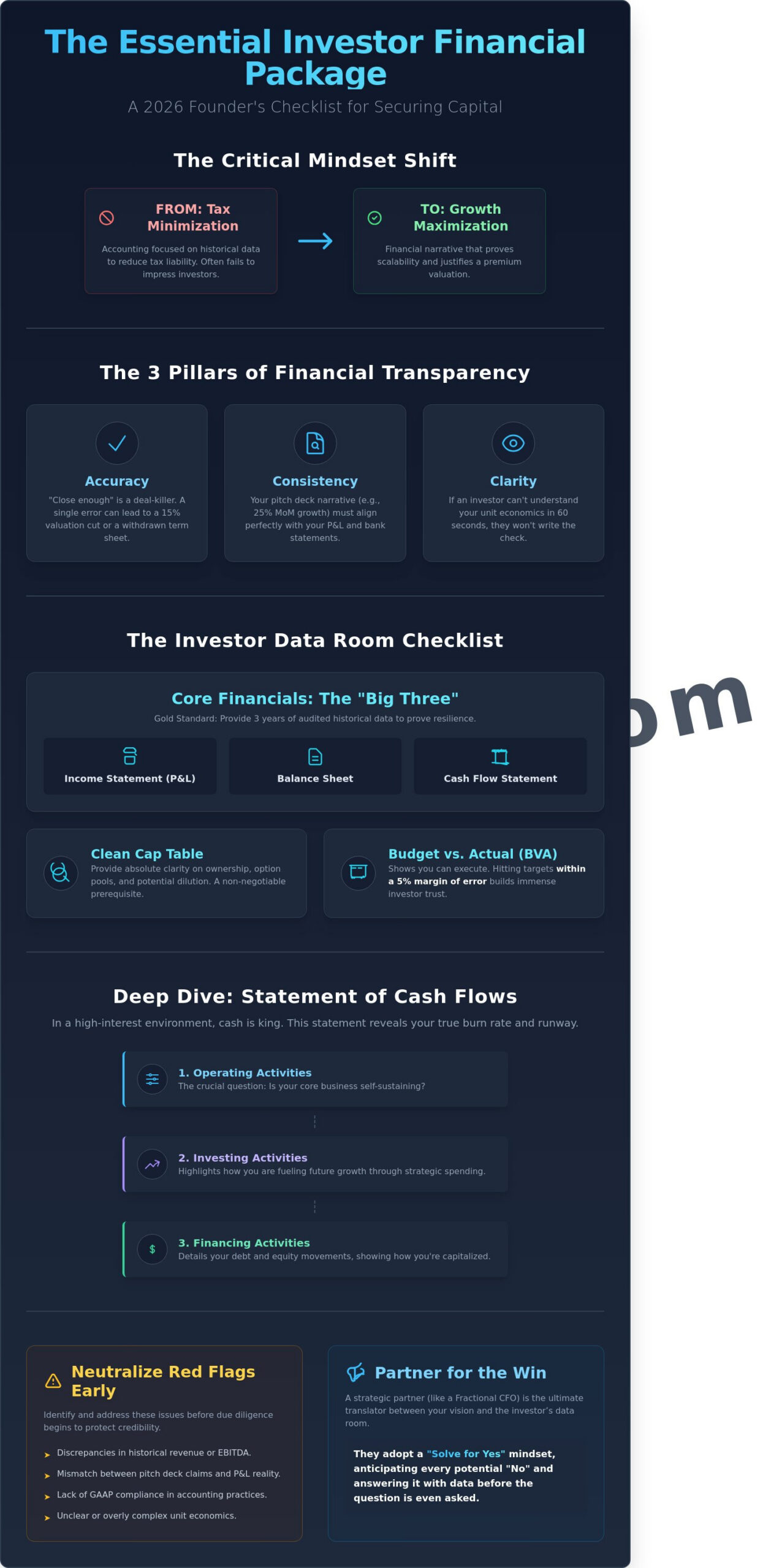
Investor-ready financials are more than just a set of clean books; they are a strategic asset that proves your business is a high-performance vehicle. When you begin preparing financials for investors, you’re moving beyond mere compliance. You’re building a narrative of growth. This requires a fundamental psychological shift. Most business owners spend years practicing tax-minimization accounting to reduce their liability. Investors, however, demand growth-maximization reporting. They want to see the profit you’ve generated and the scalability of your model, not how well you’ve hidden your gains from the IRS.
Investors look for “Management Credibility” inside your spreadsheets. If your numbers contain errors or inconsistencies, it signals that you lack a firm grip on your operations. A 3% discrepancy in reported revenue might seem small to a founder, but to an investor, it represents a systemic risk. At SA Unlimited, we adopt a “Solve for Yes” mindset. This means anticipating every “no” an investor might have and answering it with data before they even ask the question. You aren’t just presenting numbers; you’re presenting a roadmap that justifies a premium valuation.
The Three Pillars of Financial Transparency
Success in a capital raise rests on three non-negotiable pillars that turn raw data into a compelling investment case:
- Accuracy: In due diligence, “close enough” is a deal-killer. A single calculation error can lead to a 15% reduction in valuation or a total withdrawal of the term sheet.
- Consistency: Your pitch deck narrative must align perfectly with your P&L reality. If you claim 25% month-over-month growth, your bank statements must reflect that exact velocity without exception.
- Clarity: Complex revenue streams must be easy for outsiders to digest. If an investor can’t understand your unit economics in 60 seconds, they won’t write the check.
Why Your Current Bookkeeping Might Fail the Test
Standard bookkeeping is often “tax-ready,” focused on historical records to satisfy annual filing requirements. When preparing financials for investors, you need records that are forward-looking and GAAP-compliant. Institutional capital recognizes specific standards that standard small-business accounting often ignores. Bridging this gap is where a fractional CFO becomes essential. They transform your accounting from a back-office chore into a strategic growth engine. Ultimately, investor readiness is the intersection of historical proof and future potential.
The Essential Investor Financial Package: A 2026 Checklist
Investors in 2026 demand more than just a spreadsheet. They want a strategic roadmap that proves your business is a resilient, profit-generating machine. When preparing financials for investors, your package must demonstrate that you’re in total control of your fiscal destiny. Start with the “Big Three” core statements: your Income Statement, Balance Sheet, and Cash Flow Statement. These aren’t just documents; they’re the pulse of your operation. For mid-cap firms, providing 3 years of audited historical data is the gold standard. It proves you’ve weathered market shifts and maintained consistent margins.
A clean Cap Table is another non-negotiable prerequisite for preparing financials for investors who value transparency. You need to provide absolute clarity on ownership, option pools, and potential dilution. Pair this with a Budget vs. Actual (BVA) report. Investors use BVA to see if you can actually do what you say you’ll do. If you hit your targets within a 5% margin of error, you build the trust necessary to unlock your business potential during high-stakes negotiations.
Deep Dive: The Statement of Cash Flows
In a high-interest environment, paper profits don’t pay the bills. Investors prioritize the cash flow statement because it reveals your true burn rate and remaining runway. You must clearly differentiate between three areas. Operating activities show if your core business is self-sustaining. Investing activities highlight how you’re fueling future growth. Financing activities detail your debt and equity movements. If your operating cash flow is negative while your EBITDA is positive, you’ve got a story to tell; make sure it’s a good one.
Schedules and Supporting Documentation
Precision requires proof. Include Accounts Receivable aging reports to show that your revenue isn’t just a theoretical number; ideally, 85% of your receivables should sit in the under-30-day bucket. Surfacing debt schedules and lease obligations early prevents deal fatigue during late-stage due diligence. Finally, include at least two years of tax returns and audit reports. These are the ultimate verification tools for your internal books. They transform your financials from a simple pitch into a verified, strategic asset.
Financial Modeling: Projecting the Future with Confidence
Investors don’t buy into “hockey stick” graphs created in a vacuum. They look for models built on operational reality. When preparing financials for investors, your forecast must bridge the gap between where you are today and a $100M exit. A 3-to-5-year forecast shouldn’t be a collection of guesses; it needs to be a roadmap of your strategic decisions.
The Anatomy of a Defensible Forecast
Investors prioritize bottom-up modeling over top-down assumptions. A top-down approach claims you’ll capture 1% of a $50B market. A bottom-up approach proves you can scale based on your current sales rep capacity and lead conversion rates. If you double your sales spend from $15,000 to $30,000 next month, your model should precisely show the resulting impact on headcount and infrastructure. Ultimately, a model is a tool for strategy, not just a prediction of revenue.
- Sales Capacity: Base your revenue on the number of account executives you plan to hire.
- Conversion Ratios: Use your actual 2023 data to project 2024 lead-to-close rates.
- Ramp-Up Time: Account for the 4-month period it takes for new hires to become fully productive.
Unit Economics: The Deal-Breaker Metrics
Your unit economics reveal the core health of your business engine. Investors demand a Customer Acquisition Cost (CAC) that remains sustainable as you scale. A healthy Lifetime Value (LTV) to CAC ratio typically sits at 3:1 or higher. If your churn rate exceeds 7% annually, your growth is built on a leaky bucket. For growth-stage companies, the “Rule of 40” is the gold standard. This means your combined growth rate and profit margin should exceed 40%.
Professional CFO consulting helps refine these metrics to ensure they stand up to rigorous due diligence. We help you identify which levers to pull to improve margins by even 2% or 3%, which significantly impacts your terminal value.
Scenario Planning and Valuation
Don’t present a single path. Provide a base case, an upside case, and a downside case. This transparency proves you’ve prepared for market shifts or delayed product launches. Defensible EBITDA projections are the foundation of your valuation. If you project a 22% EBITDA margin by year three, you must back it up with specific cost-saving milestones and operational efficiencies. We solve for yes by turning abstract goals into a roadmap of hard numbers that empower you to make bold moves.
Cleaning Up the Books: Identifying Red Flags Before Due Diligence
Investors don’t just buy your profits. They buy your processes and your data integrity. When preparing financials for investors, realize that 85% of due diligence delays stem from messy books or commingled funds. If a founder’s personal travel is buried in the “Marketing” line item, an investor sees a lack of discipline, not just a small accounting error. This skepticism can lead to a “haircut” on your valuation or a complete withdrawal of the term sheet.
Smart leaders run a Quality of Earnings (QofE) report on themselves before opening the data room. This proactive move uncovers 95% of the red flags an investor’s auditor would otherwise find. It allows you to address discrepancies in your Chart of Accounts and present a professional-grade narrative. Moving beyond basic tools is essential; mid-cap companies often outgrow entry-level software by the time they hit $10 million in revenue. You need a system that reflects a sophisticated operation.
The Role of Sage Intacct in Investor Readiness
Investors demand a transparent audit trail. Sage Intacct provides this by tracking every transaction back to its origin, eliminating the “black box” of manual spreadsheets. By automating multi-entity consolidations, you remove the risk of human error that plagues 60% of manual financial reports. Real-time dashboards prove to your partners that you manage by the numbers. You aren’t guessing; you’re leading with precision.
Fixing Historical Inconsistencies
Revenue recognition is the most common deal-breaker. You must ensure your team follows ASC 606 standards to match revenue with the delivery of value, not just cash flow. Misclassifying expenses is another trap. Capitalizing costs that should be expensed can artificially inflate your EBITDA, which leads to painful price renegotiations later. Follow this 30-day cleanup plan to ensure you’re preparing financials for investors correctly:
- Days 1-10: Reconcile every bank and credit card account for the last 24 months.
- Days 11-20: Standardize your Chart of Accounts to match industry benchmarks.
- Days 21-30: Review all revenue contracts for ASC 606 compliance and verify EBITDA adjustments.
We solve for yes by ensuring your financial foundation is unbreakable. Don’t let a minor accounting oversight kill a major deal. Partner with SA Unlimited to audit-proof your books and unlock your business potential today.
Partnering for the Win: How a Fractional CFO Secures the ‘Yes’
Investors don’t just buy your product; they buy your future cash flows. A fractional CFO acts as the essential translator between a CEO’s ambitious vision and an investor’s rigid spreadsheets. While you focus on the “why,” we handle the “how.” When preparing financials for investors, speed is your greatest ally. A disorganized data room can stall a deal for 45 days or more, giving investors ample time to find reasons to walk away or renegotiate terms. SA Unlimited keeps the due diligence process moving at high speed, ensuring every document is ready before the first question is asked.
This clarity allows you to negotiate from a position of strength. When you own your numbers, you protect your equity. Without that precision, founders often see a 15% to 25% “risk discount” applied to their valuation during the final stages of a deal. We ensure your financial narrative is bulletproof, leaving no room for doubt or predatory terms. We don’t just report numbers; we unlock your business potential by creating pathways to sustainable growth.
For founders whose path to growth involves a strategic sale or merger, this financial clarity is equally critical. To see how a dedicated M&A advisory firm can help navigate that process, you can learn more about Bravo Kilo Advisors.
The Strategic Advantage of Fractional Expertise
You need billion dollar experience without the $400,000 annual salary. SA Unlimited brings a track record of over $1B in successful transactions to your corner. We roll up our sleeves to prepare you for the hot seat, stress testing your assumptions before you ever step into a pitch meeting. One client recently secured a $14M Series A round after we restructured their financial narrative. By shifting their focus from raw user growth to actual unit economics, we increased their pre-money valuation by 32% in just eight weeks. Our team identifies the hidden levers in your business that investors value most.
As founders successfully navigate these high-stakes negotiations and unlock significant personal wealth, the focus naturally shifts towards long-term preservation and growth. For those planning for the next chapter after a major funding round or exit, it’s wise to explore Investment Management to ensure that capital continues to work effectively for their family’s future.
Your Next Step Toward Capital
Waiting for a term sheet to start your cleanup is a recipe for failure. Statistics show that 60% of mid-market deals fall through during due diligence because of financial inconsistencies found at the eleventh hour. The value of an ‘Unlimited’ strategic partnership is that we stay in the trenches with you until the funds hit your bank account. Whether you need a targeted Review or a full-scale financial overhaul, we provide the roadmap to your capital. At SA Unlimited, “We Solve for Yes” is our core DNA. Let’s connect and solve for your ‘Yes’ today.
Secure Your Future with Strategic Clarity
Transforming your vision into a funded reality requires more than just a pitch deck. It demands a 2026-ready financial package and modeling that projects future growth with unwavering confidence. By identifying red flags early and cleaning your books, you eliminate the friction that often stalls due diligence. Successfully preparing financials for investors is a high-stakes endeavor where precision meets strategy. You don’t have to navigate this complex path alone.
At SA Unlimited, we roll up our sleeves to ensure you’re ready for the spotlight. Our team leverages decades of strategic financial expertise and our status as specialized Sage Intacct implementation partners to build your foundation. We’ve already powered $1B+ in successful client transactions; this proves we know what it takes to get to the finish line. We’re here to provide the clarity you need to make bold moves and unlock your business potential. Your next level of growth is waiting for you to take the lead.
Ready to secure your next round? Let’s Solve for Yes.
Frequently Asked Questions
How many years of financial statements do investors usually want to see?
Investors typically expect to see 3 years of historical financial statements alongside 3 to 5 years of detailed monthly or quarterly projections. If your company has been operating for less than 36 months, provide data from your inception date. This historical track record provides the clarity needed to validate your growth trajectory and proves your team can manage capital effectively. At SA Unlimited, we help you prepare these documents to ensure they tell a compelling, data-backed story.
What is the single biggest financial red flag for a private equity investor?
The single biggest financial red flag is a lack of data integrity or inconsistent reporting between the income statement and the balance sheet. Private equity firms often walk away from 25% of deals when they discover “adjusted EBITDA” figures that hide recurring operational expenses. If your numbers don’t tie out across every document, you lose the trust required to close. We roll up our sleeves to scrub your data and ensure 100% accuracy before the first meeting.
Do I need audited financials to raise a Series A round?
You don’t necessarily need fully audited financials to raise a Series A, but you should have CPA-reviewed statements at a minimum. Approximately 85% of venture capital firms will accept reviewed financials for early-stage rounds, provided the accounting follows GAAP standards. However, having an audit ready can accelerate the closing process by 3 weeks and demonstrates a level of maturity that builds investor confidence. It’s about removing friction from the deal.
What is a Quality of Earnings (QofE) report and why is it important?
A Quality of Earnings (QofE) report is an independent analysis that validates the sustainability and accuracy of a company’s historical earnings. Unlike a standard audit, which checks for compliance, a QofE report focuses on the core drivers of profitability and identifies one-time events that might skew your EBITDA. Investors use this to confirm that the $2 million in profit you reported isn’t propped up by temporary market spikes or accounting tricks.
How does a fractional CFO differ from a traditional accountant during fundraising?
A fractional CFO provides strategic, forward-looking guidance to unlock your business potential, while a traditional accountant focuses on historical compliance and tax filings. During fundraising, a CFO builds the 5-year financial model and leads the negotiation strategy. Accountants ensure your books are closed; however, they rarely have the experience to defend a $50 million valuation. When preparing financials for investors, having a CFO on your team ensures your narrative is as strong as your numbers.
Can I use QuickBooks for investor-level financial reporting?
You can absolutely use QuickBooks for investor-level reporting, provided you’ve migrated from cash to accrual-basis accounting. While QuickBooks serves over 80% of small to mid-sized businesses, the software is only as good as the data entry. For a successful raise, you must layer on advanced reporting tools or a customized chart of accounts that reflects your specific industry KPIs. We often see founders struggle because their QuickBooks setup lacks the sophistication investors demand.
What are the most important unit economics metrics for non-SaaS companies?
For non-SaaS companies, the most critical unit economics are Contribution Margin per Unit, Customer Acquisition Cost (CAC), and the Payback Period. If you’re in manufacturing, you must show a gross margin of at least 30% to 40% to attract institutional capital. Investors look for a LTV to CAC ratio of 3 to 1 or higher. These metrics prove your business model is scalable and that every dollar of invested capital generates a predictable return.
How long does the financial due diligence process typically take?
The financial due diligence process typically takes between 30 and 90 days to complete from the signing of the Letter of Intent. This timeline depends heavily on your preparedness; companies with a pre-organized data room can shave 15 days off the process. Preparing financials for investors ahead of time is the best way to avoid deal fatigue and close with confidence. We’ve seen deals collapse on day 60 because the founder couldn’t produce a clean capitalization table quickly enough.