

A growth story is not a creative writing exercise; it is the financial engineering of future certainty. You’ve likely felt the disconnect when a visionary roadmap fails to align with your financial data during a high-stakes pitch. It’s a valid fear. With the SEC proposing a shift to semiannual reporting as of May 5, 2026, the pressure of presenting a growth story to investors has never been higher. You must bridge the gap between ambitious goals and the hard numbers that survive rigorous due diligence in a market that now prioritizes quality over hype.
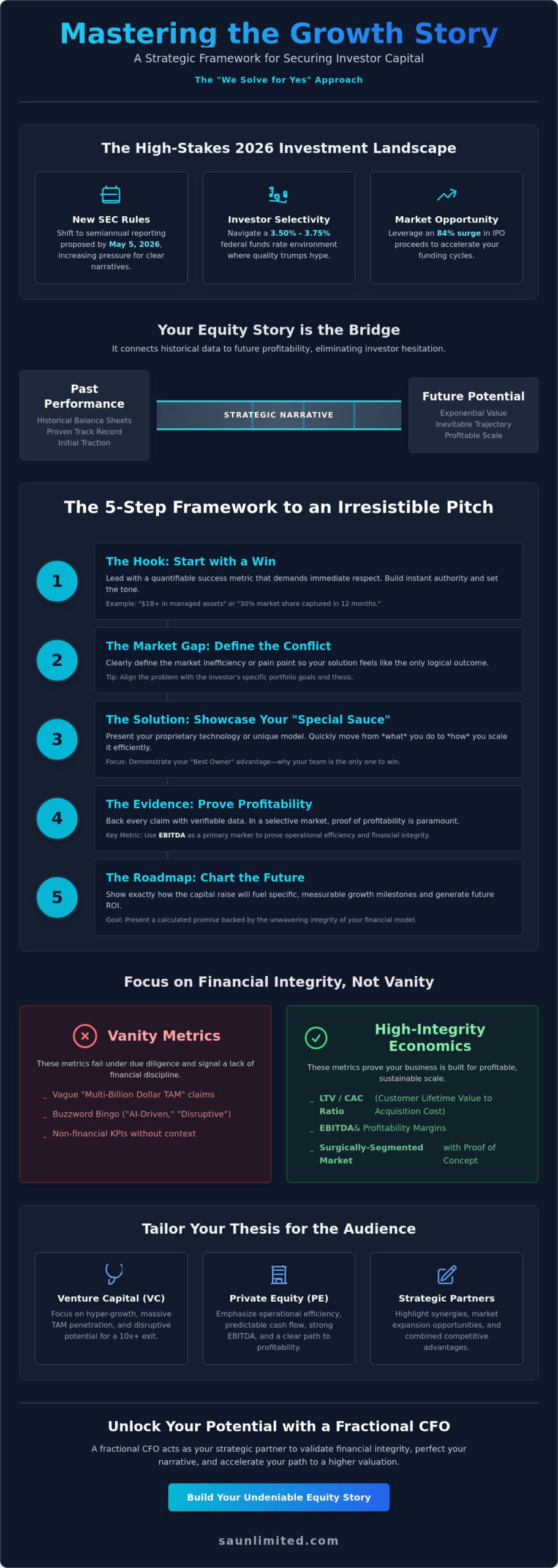
At SA Unlimited, we solve for yes by transforming your financial complexity into strategic clarity. You can master the art of the data-driven narrative to secure capital and align with high-impact investors who demand operational excellence. This guide explores how to navigate the current 3.50% to 3.75% federal funds rate environment and leverage the 84% surge in IPO proceeds to accelerate your funding cycles. We’ll show you how to build a clear equity story that unlocks your business potential and commands the valuation you’ve earned.
Key Takeaways
- Define your equity story as the essential bridge between past performance and future potential to eliminate investor hesitation.
- Master a five-step strategic framework for presenting a growth story to investors that leads with high-impact, quantifiable success metrics.
- Shift your focus from vanity metrics to high-integrity unit economics like LTV/CAC to prove your business is built for profitable scale.
- Learn to customize your investment thesis for VC, PE, or strategic partners to align your narrative with their specific exit expectations.
- Understand how a fractional CFO acts as a strategic partner to validate your financial integrity and accelerate your path to a higher valuation.
What is an Equity Story? Defining Your Narrative Foundation
An equity story is the definitive bridge between where your company has been and the exponential value it’s destined to create. It isn’t just a collection of slides; it’s the strategic architecture of trust. When you’re presenting a growth story to investors, you’re translating historical balance sheets into a roadmap for future profitability. This foundation ensures that every data point serves a single purpose: proving that your trajectory is both inevitable and scalable.
In the high-stakes world of investor relations, “maybe” is the most dangerous response you can give. Investors don’t allocate capital based on “perhaps” or “we’ll see.” They look for conviction. At SA Unlimited, we operate with a “We Solve for Yes” mindset. This means we roll up our sleeves to anticipate every objection before it’s even voiced. By the time you sit across from a partner at a private equity firm, your financial narrative should already have answered the “how” and “why” of your expansion. Your core thesis must be undeniable: there is one clear reason why an investor should choose you today over 100 other opportunities.
The Difference Between a Pitch and a Plan
Think of your business plan as the screenplay and your pitch as the performance. The plan contains the technical logic and the granular detail required for execution. The pitch is where you bring that data to life. Many leaders fall into the trap of “buzzword bingo,” using terms like “AI-driven” or “market disruption” without the numbers to back them up. Real authority comes from clarity. You must establish the “Best Owner” advantage, proving that your specific team, equipped with your specific technology, is the only group capable of capturing this specific value. It’s about demonstrating that you know your numbers better than anyone else in the room.
Setting the Stage: Market Opportunity and Proof of Concept
Vague claims about a multi-billion dollar Total Addressable Market (TAM) no longer suffice in the selective 2026 investment environment. You must segment your market with surgical precision. Show exactly which $500 million slice you are targeting first and why your early traction is a definitive proof of concept for the next $5 billion. Investors are looking for patterns of success that can be replicated. Your growth story is a calculated promise of future ROI backed by the unwavering integrity of your current financial performance.
How to Present a Growth Story: A 5-Step Strategic Framework
Presenting a growth story to investors is a high-stakes performance where every slide must earn its keep. You aren’t just showing charts; you’re building a fortress of credibility. To do this, you need a framework that transitions seamlessly from a compelling vision to undeniable financial integrity. This isn’t about being flashy. It’s about being right. When you know your numbers, you command the room. At SA Unlimited, we solve for yes by ensuring your narrative is backed by the kind of technical precision that survives the most grueling due diligence.
Step 1 & 2: The Hook and the Market Gap
Start with a number that silences the room. Step 1 is The Hook. Lead with a quantifiable success metric that demands immediate respect. Whether it’s $1B+ in managed assets or a specific percentage of market share captured in record time, start with a win. This builds instant authority and sets the tone for the rest of the meeting. Step 2 is The Conflict. You must define the market gap or inefficiency so clearly that your solution feels like the only logical outcome. When elevating your investor relations program, ensure this conflict aligns perfectly with the investor’s specific portfolio goals and investment thesis. They need to see that you aren’t just solving a problem; you’re solving their kind of problem.
Step 3, 4, & 5: Solution, Evidence, and Roadmap
Step 3 introduces The Solution. This is where you present your proprietary “special sauce” or cutting-edge technology. Move quickly from what you do to how you scale. Step 4 is The Evidence. In a 2026 market where the federal funds rate sits at 3.50% to 3.75%, investors are selective. They want proof of profitability. You must back every claim with verifiable data, using EBITDA as a primary marker to prove operational efficiency. Finally, Step 5 is The Roadmap. Show exactly how the capital raise fuels the next three milestones. With IPO proceeds growing by 84% over the last 12 months, your roadmap should reflect a clear path toward these expanding liquidity windows. If your current narrative feels disconnected from your data, our team can provide the capital raising support needed to bridge that gap and unlock your business potential.
By following this framework, you transform a simple pitch into a strategic asset. You aren’t just presenting a growth story to investors; you’re inviting them to participate in a calculated, data-driven journey toward a higher valuation. This structured approach ensures that you stay proactive, answering the tough questions before they are even asked.
Validating the Narrative: Moving from Fluff to Financial Integrity
While your deck might look professional, seasoned investors will tear through the design to find the financial engineering underneath. Presenting a growth story to investors requires more than vision; it demands a fortress of data. If your unit economics don’t hold up under stress testing, your valuation will crumble during due diligence. At SA Unlimited, we help you move beyond “fluff” by building models that prove your business is a profit engine, not just a cash consumer. We solve for yes by ensuring your numbers are as compelling as your narrative.
The Unit Economics Table: LTV, CAC, and Churn
Investors look for “sanity metrics” that indicate long-term viability rather than “vanity metrics” like total registered users or social media reach. A clear comparison shows the difference between a surface-level pitch and a narrative built on financial integrity. Use a simple table to demonstrate that you know your numbers with surgical precision.
- CAC: $500 (Good) vs. $485 with 12% MoM reduction (Investor-Ready)
- LTV: $2,000 (Good) vs. $2,150 based on 3-year cohort data (Investor-Ready)
- Payback Period: 12 months (Good) vs. 8.2 months (Investor-Ready)
The payback period is your most powerful measure of capital efficiency. In a market where the federal funds rate remains between 3.50% and 3.75% as of May 2026, investors prioritize companies that recycle capital quickly. If you’re showing a “J-Curve,” where initial losses precede exponential growth, you must justify that dip with precise data. This is where system integrity becomes non-negotiable. Using professional systems like Sage Intacct ensures that your historical data is beyond reproach and ready for the most intense scrutiny.
Forecasting with Confidence: The CFO’s Role
Clean data allows for “bottom-up” forecasting. This is where growth is driven by specific, repeatable actions rather than hopeful “top-down” percentages that lack a tactical basis. When you forecast from the bottom up, you show investors exactly how every dollar of their capital will be deployed to hit specific milestones. Historical accuracy is your best predictor of future performance. When you can show that you hit 95% of your targets over the last eight quarters, investors gain the confidence to bet on your next ten. Our CFO consulting services provide the strategic blueprint needed to align your operations with these high-integrity models. We don’t just report the numbers; we help you engineer them for a successful exit.
Tailoring the Story: VC vs. PE vs. Strategic Investors
One size does not fit all when you are presenting a growth story to investors. A narrative that captivates a venture capitalist might fall flat in a private equity boardroom. You must understand the specific “investment thesis” of your audience before you ever open your laptop. At SA Unlimited, we solve for yes by helping you pivot your financial narrative to align with the unique goals of your capital partners. Whether they seek a moonshot or a steady cash cow, your data must reflect their definition of success.
Venture Capital (VC) firms hunt for hyper-scale. With the number of global AI unicorns growing by 163 in the past year, these investors are looking for the next billion-dollar exit. They want to see a massive Total Addressable Market (TAM) and a roadmap for aggressive expansion. Conversely, Private Equity (PE) partners prioritize operational optimization. As PE firms in 2026 increasingly focus on operational improvements to drive value, your story should highlight EBITDA, consistent cash flow, and a lean cost structure. Strategic investors, however, look for synergy. They want to know how your technology or market share integrates with their existing ecosystem to create a 1+1=3 scenario.
Know Your Audience—Know Yourself
Attracting the right capital requires identifying what McKinsey calls the “Intrinsic Investor.” These are patient capital partners who align with your long-term value creation strategy rather than short-term market volatility. Your ask must shift based on where you sit in the capital stack. A debt lender prioritizes interest coverage and collateral, while an angel investor buys into your vision of a disruptive future. For a debt lender, you emphasize the stability of your cash planning; for an angel, you emphasize the speed of your market penetration.
Handling the Q&A with Authority
The Q&A session is where the real deal happens. Preparing a comprehensive “due diligence” data room in advance shows that you are ready for the scrutiny of a 2026 market. Use the “Bridge” technique to manage difficult questions. If an investor asks about a dip in quarterly revenue, acknowledge it briefly and bridge to your growth narrative by explaining the strategic shift that caused it. Never guess on a specific number. Saying “I don’t know, but our CFO will have that data by EOD” builds far more trust than providing an inaccurate estimate. It demonstrates that you value financial integrity above all else. If you need a partner to help you build this level of investor readiness, let’s connect for capital raising support to unlock your business potential.
Unlocking Your Potential: The Fractional CFO’s Role in Investor Readiness
Founders are the visionaries behind the brand, but presenting a growth story to investors requires a level of technical validation that goes beyond a passion pitch. Investors don’t just buy into your dream; they buy into the reliability of your data. Standing alone at the podium can be a strategic mistake. Having a seasoned partner by your side signals to the market that your company is built on a foundation of fiscal discipline. At SA Unlimited, we act as that strategic partner, ensuring your financial narrative is bulletproof before you ever step into the room.
For mid-cap companies, the gap between basic accounting and high-level strategy is often wide. You don’t need a full-time executive at a premium salary, yet your complexity has outgrown standard bookkeeping. This is where fractional CFO services provide the perfect bridge. We roll up our sleeves to audit your current narrative, ensuring it survives the rigorous due diligence processes that have become the norm in 2026. Our “Solve for Yes” approach means we identify potential deal-killers in your cap table or cash flow and fix them proactively.
From Startup to Global Enterprise: Scaling the Story
Your narrative must evolve as your business grows. A Seed round story is about the “what,” but a Series B story is about the “how.” Investors in the current 3.50% to 3.75% interest rate environment want to see the machinery of profit. An outsourced CFO acts as the architect for this transition. They ensure your financial systems scale as fast as your ambitions. With IPO proceeds growing by 84% over the last 12 months, the window for liquidity is opening for those who can prove their operational efficiency. We validate your “Ask” by linking every dollar of capital to a specific, measurable growth lever.
Conclusion: Your Story is Your Valuation
The clarity of your equity story directly impacts the cost of your capital. A muddy narrative creates perceived risk, which leads to lower valuations and slower funding cycles. Conversely, a data-driven story built on financial integrity creates a pathway to higher valuations and faster closes. It’s about transforming your financial complexity into a strategic asset that commands respect. Don’t leave your next round to chance. Empower your team to make bold moves by securing the high-level expertise needed to win. Let’s connect to build your investor-ready growth story.
Master Your Narrative and Secure Your Future
Your company’s value is defined by the clarity of your vision and the unwavering integrity of your data. We’ve explored how a strategic equity story serves as a bridge to future capital; and why tailoring that narrative to specific investor profiles is essential for accelerating your funding cycles. In a market where IPO proceeds grew by 84% in the last 12 months, the window for high-valuation exits is wide open for leaders who are prepared to meet the moment.
Success in presenting a growth story to investors is the final step in unlocking your business potential. At SA Unlimited, we bring decades of experience in mid-cap scaling and over $1B in successful financial management to your corner. Our “We Solve for Yes” methodology ensures that your financial architecture is proactive rather than reactive. We roll up our sleeves to transform your complexity into a strategic advantage that commands capital and builds lasting trust.
Unlock Your Business Potential: Partner with a Strategic CFO Today
Your trajectory becomes inevitable when your numbers finally match your ambition. It’s time to lead with clarity, eliminate the friction in your funding cycles, and make your next bold move with absolute confidence.
Frequently Asked Questions
What is the most important part of a growth story for investors?
The most important part is demonstrating a repeatable and scalable path to profitability through robust unit economics. Investors look for a LTV to CAC ratio above 3.0 to ensure your expansion isn’t just buying revenue at a loss. While vision matters, the technical logic behind your scale proves that your success is a calculated outcome rather than a lucky break.
How long should an investor presentation be?
An effective presentation should consist of 10 to 12 slides and take no longer than 20 minutes to deliver. This structure allows for a 40 minute Q&A session in a standard one hour meeting. Keeping your deck lean forces you to prioritize high impact data points and prevents your core message from being buried in unnecessary technical details.
Should I include my exit strategy in the growth story?
Yes, including a clear exit strategy is vital because it aligns your timeline with the investor’s need for liquidity. Whether you target an IPO or a strategic acquisition, showing a list of 5 to 7 potential acquirers demonstrates that you understand the competitive landscape. It proves you aren’t just building a business; you’re building a valuable and liquid asset.
How do I handle a lack of historical revenue when presenting a growth story?
You handle a lack of historical revenue by presenting a growth story to investors that focuses on leading indicators and market validation. Highlight data from pilot programs, signed letters of intent, or a 25% month over month growth in your user waitlist. These metrics serve as a proxy for demand and prove that your product has achieved market fit despite a short balance sheet.
What are vanity metrics and why do investors hate them?
Vanity metrics are surface level data points like social media followers or total app downloads that don’t directly correlate to revenue or retention. Investors hate them because they mask the actual health of the business. Instead, you should focus on sanity metrics like net churn or contribution margin, which provide an honest look at your operational efficiency.
How can a Fractional CFO help with my investor pitch?
A Fractional CFO helps by stress testing your financial models and providing the technical validation needed to survive due diligence. They act as a strategic partner who can answer complex questions about your capital stack or tax planning with authority. This presence reduces perceived risk and signals that your company has the institutional grade oversight required for a successful raise.
What is the difference between a growth story and an equity story?
The difference is that a growth story focuses on the mechanics of expansion, while an equity story focuses on the investment’s value proposition and eventual ROI. While growth explains how you will capture market share, the equity story explains why your company is a superior asset compared to other opportunities. Both are essential when presenting a growth story to investors to secure a premium valuation.