

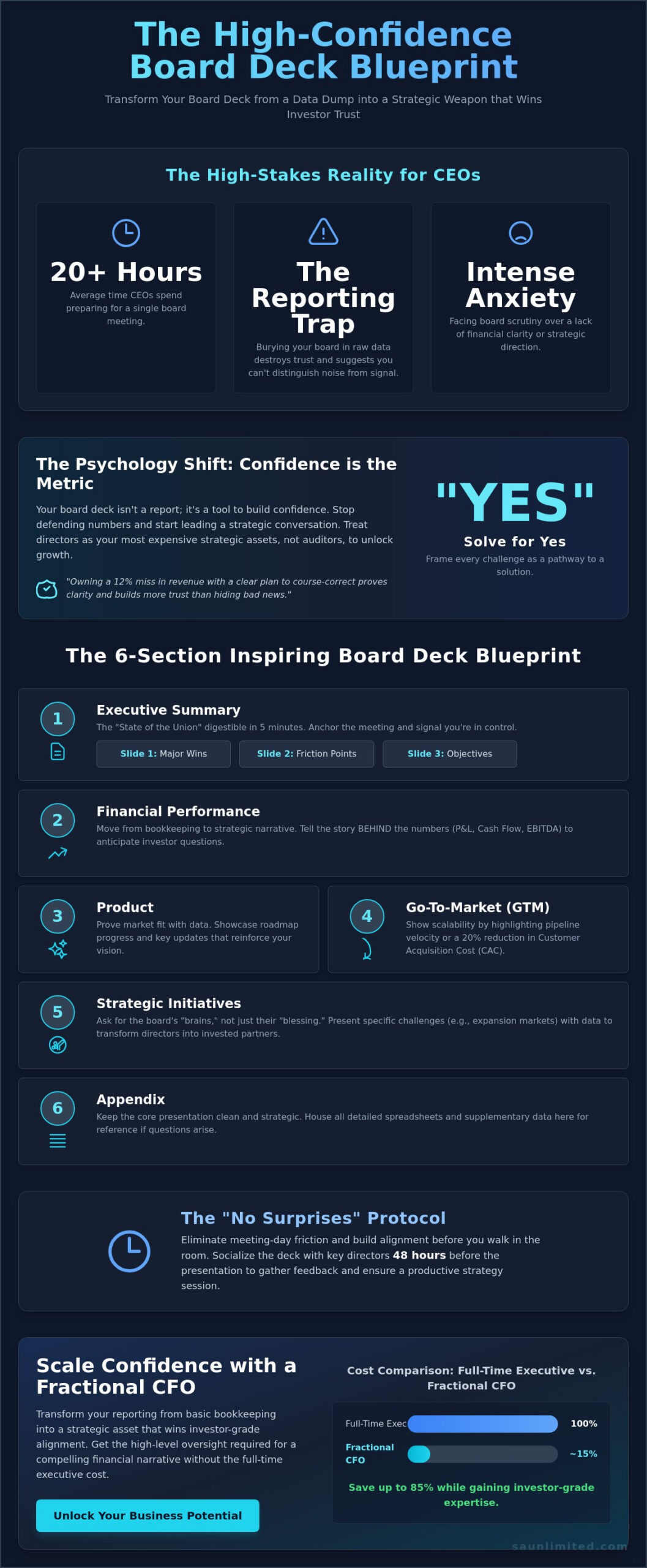
Your board deck shouldn’t be a data dump; it’s a strategic weapon designed to solve for “yes” before the first slide even hits the screen. Most CEOs spend over 20 hours preparing for these high-stakes meetings, yet many still face intense anxiety over board scrutiny or a lack of financial clarity when presenting to investors. The secret to building a board deck that inspires confidence isn’t adding more slides. It’s about providing a strategic narrative that proactively addresses the “why” behind your numbers so you can lead the room with authority.
You’ve likely felt the frustration of wasting days on spreadsheets that fail to drive a single decision. We believe your time is better spent scaling your vision toward that $50M revenue milestone. This playbook will show you how to master the art of high-stakes communication by transforming raw data into a narrative that wins board trust. We’ll preview how to streamline your reporting process to achieve unwavering board confidence and faster strategic alignment, helping you unlock your business potential while saving up to 85% compared to the cost of a full-time executive.
Key Takeaways
- Stop the data dump and learn why confidence is the only metric that matters when leading a high-stakes board meeting.
- Master the 6-section blueprint for building a board deck that inspires confidence, starting with an executive summary that highlights both wins and friction.
- Move beyond spreadsheets by translating your P&L, Cash Flow, and EBITDA into a strategic narrative that anticipates investor questions.
- Eliminate meeting-day friction by adopting a “no surprises” protocol, including socializing the deck with key directors 48 hours before the presentation.
- Discover how a fractional CFO transforms your reporting from basic bookkeeping into a strategic asset that wins investor-grade alignment.
The Psychology of a High-Confidence Board Deck
Confidence is the primary currency of the boardroom. While metrics like burn rate or customer acquisition cost are vital, they serve a higher purpose: validating that you’re the right leader for the job. Building a board deck that inspires confidence requires a fundamental shift in how you view your directors. They aren’t auditors; they’re your most expensive strategic assets. When you treat the meeting as a defensive interrogation, you invite scrutiny. When you treat it as a strategic partnership, you invite growth.
Many CEOs fall into the “Reporting Trap,” believing that a 60-slide deck proves they’ve worked hard. It doesn’t. In fact, burying your board in raw data actually destroys trust. It suggests you can’t distinguish between noise and signal. High-performing boards want insights, not spreadsheets. By filtering the data into a strategic narrative, you demonstrate that you’re in control of the ship. This proactive approach transforms the meeting from a look-back exercise into a forward-looking strategy session.
Transparency is your greatest tool for building trust. Hiding bad news is a confidence-killer because it suggests you’re either unaware of the problem or afraid to face it. Bring the friction to the front. Owning a 12% miss in revenue with a clear plan to course-correct proves you have the clarity needed to unlock your business potential. It shows the board that you know your numbers and aren’t afraid of the truth.
Understanding the Board Member’s Mindset
Directors balance fiduciary duty with a desire to be strategic advisors. A deep understanding of the board’s role is crucial here. Most are time-poor, managing multiple ventures or corporate responsibilities. They need to digest your deck in under 10 minutes to feel prepared for a high-level discussion. Board Confidence is the alignment of expectations and execution. If you consistently hit the targets you set, or explain why you missed them with a clear plan to pivot, you win.
Setting the Tone: We Solve for Yes
At SA Unlimited, we believe every challenge is a pathway to a solution. This “We Solve for Yes” mindset should permeate your slides. Don’t just report a dip in margins. Frame it as a strategic pivot to higher-quality revenue. Use authoritative language to anchor the meeting’s energy. Instead of saying, “We hope to see improvement,” say, “We’ve identified the friction and are executing these specific steps to reclaim margin.” This shifts the board from questioning your competence to supporting your execution.
The 6-Section Blueprint for an Inspiring Board Deck
Building a board deck that inspires confidence requires architectural precision. You aren’t just reporting history; you’re framing the future. A successful presentation isn’t a random collection of slides. It’s a structured journey designed to move directors from observation to alignment. This blueprint ensures every slide serves a strategic purpose, allowing you to lead with authority and clarity.
The first section is your Executive Summary. Limit this to exactly three slides. The first slide highlights major wins. The second slide addresses friction points directly. The third slide defines your meeting’s stated objectives. This “State of the Union” should be digestible in five minutes. It anchors the energy of the room and signals that you’re in total control. Following strategic board deck preparation best practices means focusing on milestones that matter to investors, such as reaching a specific ARR target or closing a key partnership, rather than just internal operational updates.
Next, move to Financial Performance. Don’t just paste a spreadsheet. Tell the story behind the numbers. If your burn rate increased by 15% last month, explain the specific investment in talent that will drive Q4 growth. This is where you move from bookkeeping to strategic advisory. If you need help refining this narrative, our fractional CFO services can provide the high-level oversight required for investor-grade reporting.
The middle sections cover Product and Go-To-Market (GTM) updates. Prove market fit with data. Show scalability by highlighting pipeline velocity or a 20% reduction in customer acquisition costs (CAC). This builds the case that your business is a growth engine, not just a series of experiments. Finally, dedicate space to Strategic Initiatives. This is where you ask for the board’s “brains,” not just their “blessing.” Present a specific challenge, such as choosing between two international expansion markets. Provide the data for both. Ask for their expertise. This transforms directors from passive observers into invested partners.
Crafting the State of the Union
The first five minutes of your meeting dictate the next two hours. By establishing stated objectives early, you prevent the conversation from drifting into tactical weeds. Highlight milestones that prove you’re executing against the long-term vision. If you promised a 10% increase in lead conversion and delivered 12%, lead with that win to anchor the board’s confidence in your execution.
Operational and Functional Deep-Dives
While the CEO leads the narrative, functional deep-dives spotlight your team’s execution. Focus on non-financial numbers that predict future success. Track churn rates, CAC, and pipeline health. If your sales cycle dropped from 90 days to 72 days, that’s a massive win for scalability. Link these functional results back to the primary service goals of the company to ensure every department is aligned with the overarching vision.
Financial Storytelling: Moving from Data to Insight
Data is a liability if you can’t translate it into insight. Building a board deck that inspires confidence requires you to move beyond the role of a reporter and adopt the mindset of a strategic narrator. Your board doesn’t want to see every transaction from the last 90 days. They want to see how those transactions validate your growth thesis. When you present numbers without a narrative, you invite directors to hunt for their own conclusions, which often leads to distracting tactical questions that derail your agenda.
The foundation of your financial narrative rests on the “Three Pillars”: the P&L, Cash Flow, and Balance Sheet. While the P&L shows performance, the Balance Sheet tracks health, and the Cash Flow Statement ensures survival. Investors prioritize profitability and operational efficiency above all else. This is why EBITDA explained is the most scrutinized slide in your deck. It serves as a proxy for your company’s ability to generate cash and scale profitably. If your EBITDA margins improved by 5% this quarter, don’t just state the number. Explain the specific operational lever, such as a 12% reduction in vendor costs, that drove the result.
Transparency is your greatest asset when visualizing variance. When comparing “Actual vs. Budget,” don’t bury the red. If you had a 10% variance in marketing spend, explain the strategic choice behind it. Perhaps you accelerated spend to capture a 15% increase in pipeline velocity. This frames a “miss” as a proactive decision rather than an oversight. To maintain this level of precision, we ensure our reporting tools provide real-time data. This commitment to data integrity is crucial for board-level trust, ensuring your numbers are bulletproof before you ever step into the room.
The Lifeblood Slide: Cash Flow and Runway
Cash is the ultimate truth. Presenting the cash flow statement with clarity and confidence is non-negotiable for emerging companies. Your board needs to see exactly how much runway remains and what milestones you’ll hit before the next capital raise. If you have 18 months of runway, show them the specific growth targets you’ll achieve in the next 6 months. This forward-looking model proves you aren’t just managing cash; you’re investing it to unlock your business potential.
Simplifying Complexity for Non-Financial Directors
Not every board member is a CPA. Follow the “One Chart, One Message” rule to keep the room focused. If a slide shows CAC trends, don’t clutter it with unrelated payroll data. Consistency is key. Define terms like Gross Margin, Burn, and LTV early and use them identically across every deck. This clarity prevents confusion and keeps the discussion centered on high-level strategy rather than terminology debates.
The Pre-Board Protocol: Eliminating Surprises
The board meeting shouldn’t be the first time your directors see your strategic pivots or financial hurdles. Successful CEOs know that building a board deck that inspires confidence is only half the battle; the other half is the “socialization” of that deck. You must establish a “No Surprises” rule. If you’re reporting a 10% miss in quarterly targets or a major shift in the product roadmap, that conversation happens via a phone call at least 48 hours before the meeting. Delivering the final deck at least 72 hours in advance shows respect for their time and ensures they arrive ready for a high-level discussion rather than a page-turning exercise.
Socializing the deck allows you to identify potential friction points in a low-stakes environment. When you call a key director two days early, you give them space to ask the “tough” questions privately. This prevents the meeting from being derailed by a single skeptical voice. It also allows you to refine your narrative based on their feedback, ensuring that when the full board convenes, you’ve already solved for “no” and are ready to lead the room toward “yes.”
Managing the Q&A requires more than just knowing your numbers; it requires an “Appendix of Truth.” This is a curated collection of deep-dive slides that address the granular details too technical for the main narrative. If a director wants to drill into the 15% increase in R&D spend, you don’t fumble through spreadsheets. You flip to the specific slide in the appendix that breaks down the investment. This level of preparation proves that you aren’t just skimming the surface. You’re in total command of the operation.
Aligning with the Board Chair
Your board chair is your most critical ally. A pre-meeting check-in ensures your agenda matches their current priorities. Use this time to walk through the “State of the Union” slides and gauge their reaction to major initiatives. Adopting a cfo consulting mindset allows you to anticipate objections before they reach the full board, turning potential roadblocks into pathways for alignment.
The Appendix Strategy
The main deck is for strategy; the appendix is for proof. Keep your core presentation lean, focusing on the “Why” and the “What.” Move detailed P&L breakdowns, cohort analyses, and technical roadmaps to the back. Preparing your fractional cfo services partner to speak to these technical nuances during the Q&A adds an extra layer of authority to your presentation. If you’re ready to transform your board meetings from a source of anxiety into a strategic engine, let’s connect and build your next deck together.
Scaling Confidence with a Fractional CFO
Building a board deck that inspires confidence requires a level of financial sophistication that most internal teams simply don’t possess. A fractional cfo acts as your secret weapon, bridging the gap between raw data and investor-grade strategy. While a bookkeeper tracks where your money went, a strategic partner shows you where it’s going. This shift from historical reporting to strategic advisory is what separates a standard update from a high-stakes power move.
At SA Unlimited, we don’t just provide reports. We provide clarity. Our approach is designed to unlock your business potential by grounding every strategic move in bulletproof financial modeling. We roll up our sleeves to ensure your P&L, Cash Flow, and Balance Sheet tell a unified story of growth. By integrating cutting-edge technology like Sage Intacct, we provide the data integrity required to “Solve for Yes” in every board meeting. You’ll walk into the room knowing your numbers are unassailable, allowing you to focus on leading the conversation rather than defending your math.
The SA Unlimited Difference
Success leaves clues. Our team brings a $1B+ success record in building confidence for CEOs across diverse industries. We provide the top-notch talent needed to transform your financial world without the $400,000 annual price tag of a full-time executive. Engaging our outsourced cfo services can result in 70-85% cost savings while delivering the same high-level expertise. We are the new standard for mid-cap companies generating between $2M and $50M in revenue who need a seasoned partner to navigate complex capital raises or strategic pivots.
Next Steps: Prepare for Your Best Board Meeting Ever
Winning the boardroom is a process of meticulous preparation and relentless follow-up. Use this final checklist to ensure your next presentation hits the mark:
- 72-Hour Rule: Deliver the final deck to all directors at least three days before the meeting.
- The Socialization Call: Connect with key directors 48 hours early to address friction points.
- The Appendix of Truth: Ensure your technical deep-dives are ready to shut down tactical rabbit holes.
- Post-Meeting Momentum: Distribute meeting minutes and action items within 24 hours to reinforce alignment.
Confidence isn’t a feeling; it’s a result of execution. Let’s connect to build your next board deck with unwavering confidence and transform your strategic vision into a profitable reality.
Lead the Room with Unwavering Authority
Mastering the art of building a board deck that inspires confidence transforms your meetings from high-stress hurdles into strategic growth engines. By shifting your focus from raw data to a proactive narrative, you demonstrate the clarity needed to scale toward that $50M revenue milestone. You now have the blueprint to eliminate surprises through socialization and the insight to turn complex financials into a compelling story. These aren’t just slides; they’re the strategic pathways to unlocking your business potential.
SA Unlimited brings a $1B+ success record in capital raising support and Red Dot-level financial design to your team. Our seasoned strategic partners roll up our sleeves to ensure your reporting is bulletproof and your vision is undeniable. We don’t just identify obstacles; we solve for “yes” to empower your boldest moves. Your next board meeting is an opportunity to anchor your leadership and accelerate your growth. Build an investor-grade board deck with SA Unlimited and lead your team with the authoritative expertise you deserve. Success is within your reach.
Frequently Asked Questions
How many slides should a standard board deck have?
Aim for a lean deck of 15 to 25 slides. High-performing boards focus on the 30,000-foot strategic view rather than granular operational details. If your deck exceeds 30 slides, you’re likely providing a data dump rather than a narrative. Use an appendix for the technical specifics to keep the main presentation focused on high-level decision-making and strategic alignment.
When should I send the board deck to the directors?
You must deliver the final board deck at least 72 hours before the meeting starts. Providing this lead time demonstrates respect for your directors’ schedules and allows them to arrive with informed questions. A 2024 survey of corporate directors indicated that 85% feel more confident in management when they have at least three business days to review materials before the session.
How do I present bad financial news to my board without losing trust?
Present bad news immediately and accompany it with a proactive recovery plan. Transparency is the foundation of building a board deck that inspires confidence. If you missed a revenue target by 12%, explain the friction point and the specific steps you’re taking to course-correct. Socializing this news via a phone call 48 hours before the meeting prevents defensive reactions in the boardroom.
What are the most important financial metrics for a board deck?
Focus on the “Big Four” metrics: Cash Runway, EBITDA, Burn Rate, and Customer Acquisition Cost (CAC). These indicators provide a comprehensive view of your company’s health and scalability. For mid-cap companies in the $2M to $50M range, tracking these metrics with 100% accuracy via tools like Sage Intacct ensures your strategic narrative is grounded in reality and data integrity.
Should I use a professional template for my board deck?
A professional template is essential for clarity, but the strategic narrative is what wins the room. Your design should be clean and authoritative, ensuring that charts are readable in under 10 seconds. Consistency in fonts and colors reinforces your brand’s premium positioning, but don’t let aesthetics overshadow the “why” behind your financial performance and strategic pivots.
How can a Fractional CFO help with my board presentation?
A Fractional CFO transforms your reporting from basic bookkeeping into a strategic advisory asset. They provide the high-level oversight needed to validate your data integrity and can speak to technical nuances during the Q&A. This partnership allows you to focus on leadership while they handle the complex financial modeling that underpins your growth strategy and investor reporting.
What is the biggest mistake CEOs make in board decks?
The biggest mistake is the “Data Dump,” where CEOs provide too much raw information without providing any insight. This forces board members to hunt for their own conclusions, which often leads to distracting questions. Building a board deck that inspires confidence requires filtering data into a clear story that highlights both wins and friction points while addressing the board’s primary concerns.
How do I handle a board member who constantly goes into the weeds?
Redirect “in the weeds” questions to your pre-prepared Appendix of Truth. If a director drills into a specific line item on the P&L, acknowledge the question and offer to walk through the detailed breakdown in the appendix at the end of the section. This keeps the main session focused on 30,000-foot strategy while proving you have the granular control required to manage the operation.