

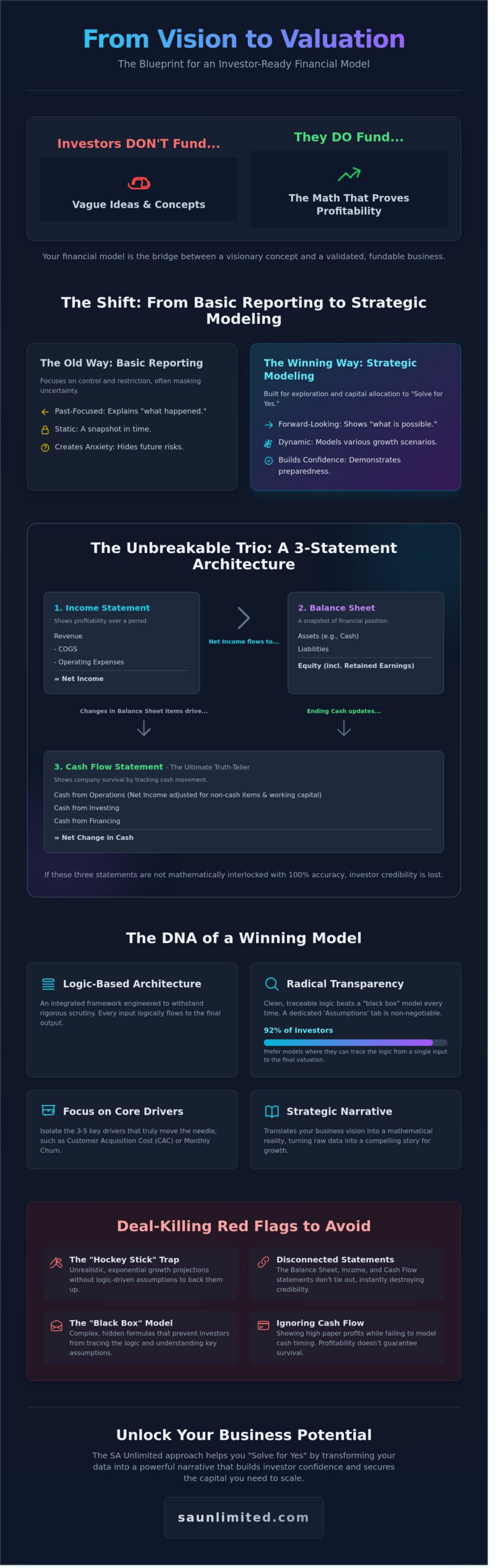
Investors don’t fund ideas; they fund the math that proves your vision is profitable. If your spreadsheets can’t survive 48 hours of rigorous due diligence, you aren’t just losing a check. You’re losing your credibility. At SA Unlimited, where we’ve guided partners toward $1B+ in successful outcomes, we know that investor-ready financial modeling is the bridge between a visionary concept and a $100 million valuation. It’s the difference between a “maybe” and a “yes.” We believe your financial data should be your most powerful storytelling tool, not a source of anxiety during a high-stakes capital raise.
You’ve likely felt the pressure of not knowing which growth levers to highlight or fearing your burn rate might surprise you at the wrong time. We understand that your time is best spent leading, not wrestling with complex integrated statements. This guide will show you how to transform your raw data into a high-impact strategic narrative that builds immediate investor confidence. We’ll walk through the process of creating a robust, three-statement model that highlights your key growth levers and drives your valuation higher. It’s time to stop fearing the spreadsheet and start using it to unlock your business potential and secure the capital you need to scale.
Key Takeaways
- Shift your focus from basic reporting to a strategic, logic-based architecture that withstands professional scrutiny and builds immediate trust.
- Ensure your financial trio-Income Statement, Balance Sheet, and Cash Flow-is mathematically interlocked to signal high-level financial sophistication.
- Master investor-ready financial modeling by anchoring your growth story in historical benchmarks and logic-driven assumptions that survive any stress test.
- Identify and eliminate “red flag” errors, like the hockey-stick trap, that kill deals and undermine your credibility with capital partners.
- Learn how a proactive Fractional CFO approach helps you “Solve for Yes” by transforming your data into a powerful narrative that unlocks your business potential.
The DNA of an Investor-Ready Financial Model
An investor-ready financial model is far more than a collection of static spreadsheets. It is an integrated, logic-based framework engineered to withstand the rigorous scrutiny of professional analysts. While basic accounting focuses on the past, investor-ready financial modeling acts as a forward-looking strategic architecture. It translates your business vision into a mathematical reality that venture capital and private equity firms can validate. Transparency serves as your greatest asset during this process. When you build a model that reveals its logic rather than hiding it, you establish the trust necessary to secure seven-figure and eight-figure capital injections. An investor-ready model is a dynamic tool that links operational drivers to financial outcomes.
The shift from historic reporting to strategic forecasting is where many founders struggle. Investors aren’t just buying your past performance; they’re purchasing a stake in your future potential. By using Financial modeling to map out various growth scenarios, you demonstrate a level of preparedness that sets you apart from the competition. This approach ensures that every dollar of requested capital has a specific, ROI-driven purpose. It moves the conversation from “what happened” to “what is possible” when your team has the right resources.
Strategic Clarity over Spreadsheet Complexity
Complexity often serves as a mask for uncertainty. At SA Unlimited, we know that a clean, transparent model beats a “black box” every single time. 92% of investors prefer models where they can trace the logic from a single input to the final valuation. You must focus on the 3 to 5 core drivers that actually move the needle, such as your Customer Acquisition Cost (CAC) or your monthly churn rate. We always establish a dedicated “Assumptions” tab. This single source of truth prevents confusion during high-stakes presentations and ensures your 36-month roadmap remains grounded in reality.
The Difference Between Budgeting and Strategic Modeling
Budgets are designed for control, but strategic models are built for exploration and capital allocation. A budget tells you where you are restricted; a model shows you where to double down. We use strategic modeling to “Solve for Yes” by identifying the exact pathways to profitability. This is how a startup transforms a $1 million seed round into a $10 million Series A valuation. If your business is scaling rapidly, our fractional cfo services provide the high-level expertise needed to navigate these complex financial waters. We help you unlock your business potential by turning raw data into a compelling narrative for growth.
Building the Three-Statement Architecture
An investor-ready financial model is a living, breathing map of your company’s future. It isn’t a collection of separate tabs. It’s a unified system. To earn the trust of institutional investors, you must build upon the non-negotiable trio: the Income Statement, Balance Sheet, and Cash Flow Statement. If these three don’t interlock mathematically, your credibility disappears. Every dollar of net income must flow into retained earnings, and every change in working capital must reflect in your cash position with 100% accuracy.
The Cash Flow Statement acts as the ultimate truth-teller for startups and mid-cap firms alike. While the Income Statement shows performance, the Cash Flow Statement shows survival. Many businesses with $5 million in paper profit have collapsed because they ignored the timing of their cash cycles. Your model must also ensure that ebitda calculations align with standard industry definitions. This allows analysts to compare your margins against peers without performing manual adjustments. We solve for yes by providing this level of clarity from the start.
Integrated Financial Logic
Institutional investors look for the key components of a financial model to see how operations impact the balance sheet. A standalone Profit & Loss statement is never enough. It hides the weight of accounts receivable and inventory cycles. If your Days Sales Outstanding (DSO) increases from 30 to 45 days, your model must automatically trigger a cash shortfall. Professional logic ensures that net income feeds retained earnings and cash balances reconcile to the penny. This integration proves you understand the mechanics of your business, not just the sales targets.
Why Bottom-Up Forecasting Wins Every Time
Top-down modeling is a red flag for seasoned VCs. Claiming you’ll capture 1% of a $10 billion market suggests a lack of tactical awareness. Real growth is built from the ground up. Start with your marketing leads. Apply a 4% conversion rate. Multiply that by a $12,000 Average Contract Value (ACV). This granular approach connects your headcount directly to growth milestones. If you plan to scale revenue by 50% in 2025, your model should show the exact hiring dates for the account executives needed to carry that quota. This level of detail allows you to unlock your business potential through data-driven decisions rather than guesswork.
By connecting every operational expense to a specific growth driver, you demonstrate a seasoned, strategic mindset. Investors don’t just buy into your vision; they buy into your ability to execute. A bottom-up model proves you’ve done the work to understand your unit economics. It turns a pitch into a partnership based on verifiable logic.
Assumptions: Where Your Growth Story Meets Reality
Investors don’t just buy into your results; they buy into your logic. Assumptions are the bridge between your vision and the investor’s checkbook. To secure a term sheet, you must document every underlying driver so an analyst can stress test your model without your intervention. This transparency builds immediate credibility and shows you have nothing to hide. It’s about proving that your numbers aren’t pulled from thin air but are rooted in operational reality.
Historical benchmarking is your primary tool for reality-checking. If your company maintained a 15% net margin over the last 24 months, projecting a 50% margin next year requires extraordinary evidence. We look for Critical Success Factors that justify your valuation. These are the specific levers, such as a 20% reduction in churn or a new high-margin distribution channel, that move the needle. When you align future projections with past performance, you transform a spreadsheet into a credible roadmap that unlocks your business potential.
Identifying Key Revenue and Cost Drivers
Scalability lives in the gap between fixed and variable costs. You need to demonstrate that your business model is built for leverage. For instance, if your variable costs represent only 18% of total spend, your path to profitability accelerates as you scale. Use investor-ready financial modeling to prioritize two core metrics: Customer Acquisition Cost (CAC) and Lifetime Value (LTV). We often see founders model growth as a straight diagonal line. This is a mistake. Real-world growth follows an S-curve. It begins with a slow build, hits a rapid acceleration phase, and eventually matures. Modeling this trajectory shows you understand market saturation and operational friction.
Scenario Planning and Sensitivity Analysis
At SA Unlimited, we solve for yes by preparing for every possible no. We build Base, Best, and Downside cases to show you’re ready for any market condition. A robust downside case isn’t a sign of weakness; it’s proof of management preparedness. Use sensitivity tables to visualize how small changes impact your 18-month runway. For example, a 10% decrease in subscription pricing might shorten your runway by six months. Knowing these numbers allows you to adjust your strategy before a crisis hits. This level of detail in your investor-ready financial modeling empowers you to make bold moves with confidence. It turns uncertainty into a calculated risk that you’re fully equipped to manage.
- Fixed vs. Variable: Show how your margins expand as revenue grows.
- Sensitivity Tables: Map how a 10% pricing shift changes your cash position.
- Historical Context: Use your 2023 data to anchor your 2025 goals.
Avoiding the Red Flags: Pitfalls That Kill Deals
Investors don’t just buy into your vision. They hunt for reasons to say no. A model that projects a 500% revenue jump without a 40% increase in operating expenses is a glaring red flag. This “Hockey Stick” trap signals a lack of operational reality and financial sophistication. Sophisticated investors expect the same rigor found in high-level cfo consulting during the due diligence phase. If your bank balance doesn’t account for 45-day payment terms or 12% seasonal dips, the deal will likely stall before it reaches the term sheet.
Unrealistic Growth and the “Burn Rate” Blind Spot
Investors obsess over your Net Burn and Runway because these metrics dictate your survival window. Many founders underestimate the 120-day period required to hire, onboard, and ramp up new sales talent to full productivity. Your investor-ready financial modeling must explicitly account for the “Cash Gap” in your business cycle. Since 82% of failed startups cite cash flow issues as a primary cause, your model must prove you have a firm grip on the timing of every dollar. Key metrics to track include:
- Gross Burn: Total monthly operating expenses.
- Net Burn: The actual cash lost each month after revenue.
- Runway: The number of months until your bank balance hits zero.
- Hiring Lag: The 3 to 6 month gap between a new hire and their first closed deal.
Overlooking Working Capital Dynamics
Rapid growth can break a business faster than a slow decline. If you scale 3x but ignore the 20% increase in required working capital, you’ll face a liquidity crisis despite high sales. Your model must include capital expenditures (CapEx) and clear debt service obligations to provide a full picture of your financial health. You need audit-ready data to pass the rigorous scrutiny of a Series A or B round. Setting up your systems correctly from the start, as outlined in our Sage Intacct guide, ensures your investor-ready financial modeling is backed by a single source of truth. We solve for yes by ensuring your balance sheet is as strong as your pitch deck.
Let’s connect and unlock your business potential.
The SA Unlimited Approach: Modeling to Solve for Yes
At SA Unlimited, “We Solve for Yes” isn’t just a motto; it’s a mindset. We transform financial modeling from a tedious chore into a powerful strategic advantage. Our team brings an unwavering commitment to your growth, ensuring your investor-ready financial modeling stands up to the most rigorous due diligence. We roll up our sleeves to build your future, providing top-notch talent that understands the pressure of the boardroom. We move beyond simple bookkeeping to provide solutions that offer real-time clarity and confidence.
Leveraging Fractional CFO Expertise for Capital Raising
A CEO’s vision requires a precise financial architect. We act as your strategic advisor to ensure the narrative you share with investors matches your numbers perfectly. SA Unlimited brings a “Billion-Dollar Perspective” to emerging and mid-cap companies, drawing on our history of managing over $1.5 billion in financial transactions. You don’t need a $300,000 full-time hire to secure world-class results. Our three-tiered pricing structure ensures you get elite strategic guidance without the burden of a full-time executive salary. We stand beside you during investor Q&A, defending every assumption and turning skeptical questions into clear pathways for funding.
Integrating Systems for Real-Time Model Accuracy
Static models become obsolete the moment you close your books for the month. We move your business beyond the limitations of entry-level software to provide “Solutions beyond” traditional accounting. By integrating Sage Intacct, we feed actual financial data into your model automatically. This integration allows for sophisticated, custom reporting and monthly Actuals vs. Forecast (AvF) analysis. Knowing your numbers every single day empowers you to make bold moves. When you understand your revenue drivers with 100% confidence, you unlock your business potential.
- Automated data flows: We eliminate 95% of manual entry errors by connecting your ERP directly to your financial model.
- Custom dashboards: Our team builds reporting that provides daily visibility into your most critical KPIs and unit economics.
- AvF Analysis: We conduct monthly deep dives to compare actual performance against your forecast, allowing for rapid pivots.
- Real-time cash flow: Integrated systems ensure you have an accurate view of your runway at all times.
We don’t just hand over a static file and walk away. We partner with you to ensure your investor-ready financial modeling is a living asset that drives your success. By combining high-level strategy with cutting-edge technology, we provide the clarity you need to lead with authority and the data you need to win over the most demanding investors.
Turn Your Vision into a Funded Reality
Capital raising is a high-stakes environment where your numbers speak louder than your pitch deck. Success hinges on a robust three-statement architecture and growth assumptions that stand up to rigorous due diligence. By avoiding common red flags like inconsistent data or opaque logic, you demonstrate the strategic clarity investors demand. High-quality investor-ready financial modeling isn’t just a requirement for your next round; it’s the foundation of your company’s future scalability.
At SA Unlimited, we don’t just build spreadsheets. We create pathways to growth. Our team brings a proven track record of driving $1B+ in successful financial outcomes for our partners. We combine deep expertise in Sage Intacct implementation and optimization with a proactive “Solve for Yes” mindset to ensure your financial infrastructure is as ambitious as your goals. Whether you’re a scaling startup or a global enterprise, we roll up our sleeves to ensure your data tells a winning story.
Unlock Your Business Potential: Connect with SA Unlimited for Investor-Ready Modeling
Your next big move starts with numbers you can trust. Let’s build something extraordinary together.
Frequently Asked Questions
What is the most important part of an investor-ready financial model?
The assumptions tab is the most critical component of an investor-ready financial model. Investors don’t just look at the bottom line; they scrutinize the logic behind your revenue drivers and customer acquisition costs. At SA Unlimited, we’ve seen that 90% of due diligence failures stem from unrealistic conversion rates or churn expectations. Your assumptions must be rooted in 12 months of historical data or proven industry benchmarks to build immediate credibility.
How far into the future should a financial model forecast?
You should forecast your financials for three to five years. Most venture capital firms require a 36 month monthly projection to understand your burn rate and runway. For Series A rounds, a 5 year annual summary helps demonstrate your long term exit potential. We focus on the first 18 months with high precision because that’s where your immediate execution happens.
Should I build my financial model in Excel or specialized software?
Excel remains the industry standard because it offers the flexibility and transparency that 85% of institutional investors demand. While specialized software can track real time metrics, it often lacks the custom logic needed for unique business models. We build robust, formula driven models in Excel that allow investors to stress test your variables instantly. For those looking to master these skills, the Financial Modelling University offers focused training that builds the confidence needed to close your round.
How do I determine the right growth rate for my financial model?
Determine your growth rate by blending your historical performance with bottom up capacity constraints. For early stage SaaS, a 15% to 20% month over month growth rate is often the benchmark for high growth scaling. Don’t pull numbers from thin air. We help you calculate growth based on your actual sales headcount and marketing spend to ensure your investor-ready financial modeling stands up to intense scrutiny.
What is the difference between a top-down and a bottom-up financial model?
A bottom up model starts with individual units of production, like a single salesperson’s quota, while top down models start with a total addressable market percentage. Investors view top down models as “hoping for the best” and bottom up models as “planning for success.” Every model we’ve used to secure $1B+ in funding relies on bottom up logic because it proves you understand your operational levers.
How often should I update my financial model once it is built?
You must update your financial model every 30 days. Comparing your actual results against your projections monthly allows you to identify a 5% variance before it becomes a 50% shortfall. This discipline shows your board that you’re a proactive leader who manages by the numbers. We help teams implement these monthly review cycles to maintain a constant state of investment readiness and unlock your business potential.
Can a fractional CFO help me prepare for a Series A or B round?
A fractional CFO is a strategic partner who prepares you for the rigorous due diligence of a Series A or B round. We bring 20+ years of expertise to your team, handling everything from cap table management to complex revenue recognition. By partnering with us, you gain the authoritative voice of a seasoned executive who has successfully navigated $500M in transactions. We solve for yes by bridging the gap between your vision and investor expectations.