

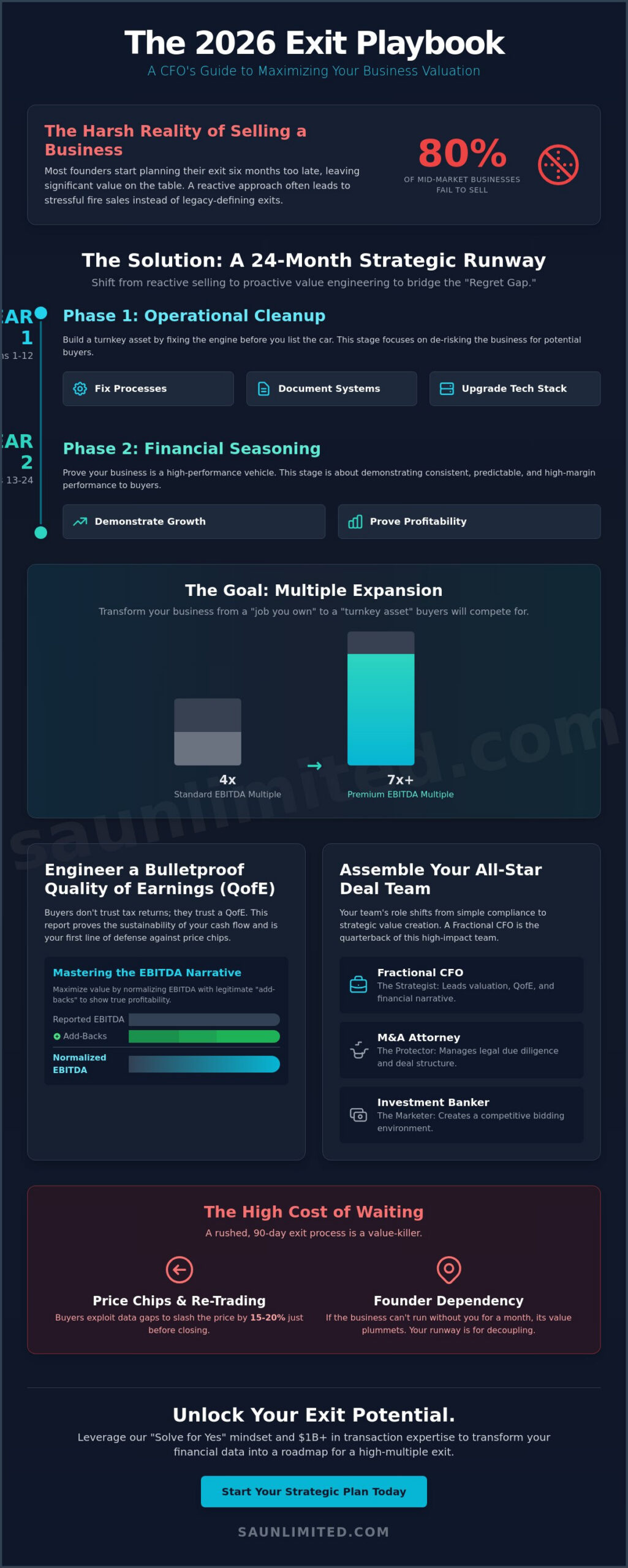
Most founders start thinking about their exit exactly six months too late. According to data from the Exit Planning Institute, 80% of mid-market businesses fail to sell, often because the leadership neglected the process of getting your business ready to sell until the last minute. You’ve spent years pouring your soul into your company. It’s natural to feel a sense of dread that a single “Quality of Earnings” report might expose messy financials and scare off Tier-1 buyers. You want a legacy-defining exit, not a stressful fire sale that leaves money on the table.
At SA Unlimited, we solve for yes by turning your financials into a strategic asset. You can unlock your business potential and secure a high-multiple offer by optimizing your systems at least 24 months before the first broker call. This article provides a comprehensive CFO playbook to help you maximize your valuation for a 2026 exit. We’ll walk you through the three-stage process of cleaning your data, building a scalable infrastructure, and creating the competitive bidding environment your hard work deserves.
Key Takeaways
- Establish a 24-month strategic runway to bridge the “regret gap” and shift from reactive selling to proactive value engineering.
- Engineer a bulletproof Quality of Earnings by normalizing EBITDA and removing owner perks, a critical step in getting your business ready to sell.
- Eliminate integration risk by scaling your systems beyond basic accounting software to meet the sophisticated tech requirements of Tier-1 buyers.
- Assemble a high-impact deal team that prioritizes transaction strategy over simple tax compliance to unlock your full exit potential.
- Leverage the “Solve for Yes” mindset and $1B+ in transaction expertise to transform your financial data into a powerful roadmap for a high-multiple exit.
The Strategic Runway: Why Getting Your Business Ready to Sell Starts 24 Months Early
We solve for yes by engineering value long before the sale. Getting your business ready to sell isn’t a reactive transaction. It’s a proactive phase of value-engineering designed to maximize your life’s work. Most owners treat an exit like a fire drill. They wait for a knock on the door or a sudden health scare to start the process. This reactive approach creates what BNY Mellon data identifies as the “regret gap.” 40% of business owners wish they had started their planning at least two years earlier.
A successful Mergers and acquisitions (M&A) outcome requires a 24-month strategic runway. Year one focuses on operational cleanup. You’re fixing broken processes, documenting systems, and upgrading tech stacks. Year two focuses on financial seasoning. This is where you demonstrate consistent, high-margin performance to potential buyers. Proper preparation drives “Multiple Expansion.” This shift moves your valuation from a standard 4x EBITDA to a premium 7x multiple by proving your business is a turnkey asset rather than a job you own.
The Cost of Waiting: Why Late Prep Destroys Value
Rushed due diligence is a value killer. When you scramble to get your business ready to sell in 90 days, you leave the door open for price chips and re-trading. Buyers find holes in your data and use them to slash the price by 15% or 20% just before closing. Founder dependency is often the biggest culprit. If the business stops breathing when you take a vacation, its value plummets. Your Exit Runway is the period required to decouple the owner from daily operations.
Setting the North Star: Your Personal and Financial Goals
Don’t confuse sale price with net proceeds. Your “number” must account for capital gains taxes, investment banking fees, and escrow holdbacks. This is where CFO consulting becomes your strategic blueprint. You need to know if you’re targeting strategic buyers who pay for synergy or financial buyers like Private Equity firms who pay for cash flow stability. We solve for yes by defining these targets before the first Letter of Intent arrives.
- Strategic Buyers: Often competitors or vendors who pay a premium for your market share or technology.
- Financial Buyers: PE firms looking for stable EBITDA and a strong management team to drive future growth.
- Net Proceeds: The actual cash you keep after the government and advisors take their share.
Clarity equals confidence. When you know your numbers and your “why,” you enter negotiations from a position of power. You aren’t just selling a company. You’re transferring a high-performance vehicle that’s ready for the next 100 miles.
Financial Hygiene: Engineering a Bulletproof Quality of Earnings (QofE)
Buyers don’t trust your tax returns. They trust a Quality of Earnings (QofE) review. While tax returns aim to minimize taxable income, a QofE report aims to maximize value by proving the sustainability of your cash flow. If you’re getting your business ready to sell, your financial statements must survive the scrutiny of sophisticated private equity or strategic buyers. These parties hunt for any reason to lower their offer, and a bulletproof QofE serves as your first line of defense.
Mastering the EBITDA Narrative
EBITDA is the universal language of business valuation. It’s the baseline that tells a buyer how much cash your operations actually generate. You must normalize this figure by identifying add-backs. These are expenses that won’t continue after the sale, such as owner perks like personal vehicles, one-time legal fees, or non-market salaries. Referencing this EBITDA guide for CEOs helps clarify which adjustments are defensible. In mid-cap firms, “Phantom Expenses” like excess inventory write-offs or discretionary bonuses often hide true profitability. We help you isolate these items to ensure your valuation reflects your real performance.
Predictability as a Premium: The Power of Forecasting
A buyer pays for the future, not the past. Historical data is just a proof of concept. To command a premium, you need a 3-year rolling forecast that aligns perfectly with your historical margins. Revenue quality plays a massive role here. Buyers prioritize recurring revenue models over transactional ones because they offer stability. They also check for customer concentration; having a single client represent more than 15% of your total revenue is a significant risk factor that often leads to price chips. Forecast accuracy is a primary trust-builder during due diligence. If your monthly performance deviates by more than 5% from your projections, buyers will question your internal controls.
Clean, GAAP-compliant financial statements for at least three years are the bare minimum for a successful exit. This ensures that revenue recognition and expense matching are consistent across all periods. When getting your business ready to sell, you must also prove the “stickiness” of your customer base. High churn rates or erratic purchasing patterns suggest a lack of market fit. Our team helps you build the financial infrastructure required to defend your price and close the deal on your terms.
Beyond QuickBooks: Scaling Systems for Post-Sale Integration
Founders often tell us their books are fine because they use QuickBooks. While that software works for a $2M lifestyle business, Tier-1 buyers looking at 2026 exits demand more. They evaluate your “Integration Risk.” This is the friction a buyer feels when they realize your data won’t easily slide into their enterprise tech stack. If a private equity firm has to spend six months migrating your records into their systems, they’ll simply lower their offer to cover the headache.
True data integrity means your CRM, sales pipeline, and general ledger all speak the same language. When these systems are siloed, it creates doubt. Buyers pay a premium for clarity. They want to see that your financial story is consistent across every department without manual entry errors or “spreadsheet magic” to make the numbers work. This level of preparation is vital when getting your business ready to sell at a top-tier multiple. We solve for yes by ensuring your tech stack is an asset, not a liability.
The ERP Advantage: Why Sage Intacct Increases Valuation
Moving to a robust ERP like Sage Intacct is a power move for any mid-market leader. It provides real-time visibility that entry-level software cannot touch. Automated reporting reduces the buyer’s perceived risk because the data is verifiable and instant. For companies with multiple locations or subsidiaries, this Sage Intacct guide highlights how multi-entity visibility streamlines consolidation. This transparency proves you have nothing to hide. It shows that your business is built for professional oversight and rapid post-sale integration.
Operational Scalability: Proving the Engine Works Without You
Buyers don’t just buy your past profits; they buy your future stability. If the business relies on your personal expertise to function, you have “Key Man Risk.” This is a valuation killer. You must transform your operations into a financial asset by documenting Standard Operating Procedures (SOPs) for every critical function. A Fractional CFO builds these systems to ensure growth continues post-exit. By institutionalizing knowledge, you prove the engine runs smoothly regardless of who is in the driver’s seat. This is a non-negotiable step in getting your business ready to sell to a strategic partner who wants a turnkey operation.
- Documented SOPs reduce transition time for the buyer.
- Automated workflows eliminate human error in reporting.
- Centralized data ensures one source of truth across the organization.
Assembling Your All-Star Deal Team: The Strategic Role of the Fractional CFO
You cannot win a championship with a roster of one. When getting your business ready to sell, the quality of your advisory team often determines whether you exit with a premium or leave millions on the table. A standard deal team includes an M&A attorney to protect your legal interests, an investment banker to market the company, and a CPA to handle the tax filings. However, the most critical player in 2026 is the Strategic CFO. While your CPA focuses on historical compliance and tax minimization, a Transaction CFO focuses on future value and deal execution.
At SA Unlimited, our mindset is simple: We Solve for Yes. This means we don’t just identify obstacles; we build the bridges to cross them. During the high-pressure window of due diligence, the CFO acts as the central project manager. They ensure the data room is populated, the financial narratives are consistent, and every buyer inquiry is met with a verified answer. Without this level of coordination, deals often lose momentum, and in M&A, time is the enemy of value.
The Fractional CFO: Your Secret Weapon in Negotiations
Negotiations aren’t just about the final number; they’re about defending that number against “Price Chipping.” This is where a buyer attempts to lower the valuation by finding inconsistencies in your data. A strategic CFO shuts this down by providing bulletproof financial clarity. By leveraging outsourced CFO services, mid-market companies can access Tier-1 expertise that has managed $1B+ in transactions without the overhead of a full-time executive salary.
High velocity is the lifeblood of a successful exit. A Fractional CFO manages the “Data Room” with surgical precision, keeping the process moving so the buyer stays engaged. When you’re getting your business ready to sell, you need a partner who rolls up their sleeves to ensure the financial story matches the operational reality.
Vetting Your Advisors: What to Look For
Not all advisors are created equal. Your family attorney might be excellent for personal estate planning, but they shouldn’t lead a $50M business sale. You need specialists who have a proven track record of successful exits in your specific industry. When vetting your team, look for these non-negotiables:
- Experience: Ask for a list of closed deals from the last 24 months.
- Success Fees: Ensure your investment banker’s incentives align with your target valuation.
- Strategic Alignment: Your advisors must prioritize your long-term goals over a quick commission.
Investment bankers typically charge a retainer plus a success fee (often 1% to 5% of the deal value), while strategic consultants and CFOs usually work on a fixed-fee or monthly basis. This structure ensures you have a dedicated partner focused on the preparation and “heavy lifting” required before the banker even takes the deal to market.
Ready to build a team that solves for yes? Let’s connect and unlock your business potential.
Unlocking Your Exit Potential: How SA Unlimited Solves for ‘Yes’
At SA Unlimited, we believe that getting your business ready to sell is a journey that requires more than just clean books. It demands a strategic vision. We don’t just report numbers. We create pathways to ‘Yes’. Our team has navigated the complexities of over $1B in successful transactions, giving us the perspective needed to anticipate buyer demands long before they reach the negotiating table. We’ve seen every hurdle a buyer can throw at a founder, and we know how to clear them.
Many business owners believe they need a full-time, top-tier CFO to reach this level of preparation. However, a high-level CFO often commands a salary exceeding $300,000, which is a heavy burden for companies focused on maximizing EBITDA. Our ‘Unlimited’ model provides a high-level strategic partnership at a fraction of that cost. This allows you to reinvest those savings back into your growth while still benefiting from elite financial leadership. We start every partnership with a comprehensive Readiness Assessment. This deep dive identifies value leaks that could cost you millions at the closing table, ensuring you don’t leave money behind.
The SA Unlimited Readiness Framework
Our framework begins with a rigorous audit of your financials, strategy, and systems. We focus heavily on modernizing your tech stack, often leveraging Sage Intacct to ensure your data is real-time and reliable. When we find gaps, we don’t just point them out. We roll up our sleeves to fix them. This proactive approach eliminates the surprises that often kill deals during due diligence. We’ve found that 60 percent of deal delays stem from inconsistent financial reporting. We solve that problem before it starts.
The ultimate benefit of our framework is confidence. You’ll enter every meeting knowing your numbers are bulletproof. When a potential acquirer asks for a granular breakdown of your customer acquisition costs or your five-year margin trends, the answer is already documented and verified. This level of preparation signals to buyers that your business is a professional, low-risk investment, which often leads to higher multiples and better terms.
Ready to Transform Your World? Let’s Connect.
Your legacy is too important to leave to chance. If you’re serious about getting your business ready to sell in 2026, it’s time to move beyond standard accounting and embrace strategic finance. We’re here to help you preserve your wealth and ensure your years of hard work translate into a life-changing exit. Schedule a strategic consultation with our team today to start your journey. Let’s work together to unlock your business potential and secure the future you’ve earned.
Engineer Your High-Value Exit Today
The path to a premium valuation isn’t built in the final months of a deal. It’s forged during a 24-month strategic runway where financial hygiene and scalable systems become your greatest assets. By prioritizing a bulletproof Quality of Earnings and implementing robust platforms like Sage Intacct, you transform your company from a risky bet into a turnkey acquisition. Getting your business ready to sell requires more than clean books; it demands a proactive mindset that anticipates buyer scrutiny before the first due diligence request arrives.
At SA Unlimited, we’ve guided clients through $1B+ in successful transactions using our proprietary ‘We Solve for Yes’ framework. As expert Sage Intacct implementation partners, we don’t just report numbers; we engineer the clarity and confidence required to unlock your business potential. You’ve spent years building your legacy. Now, it’s time to ensure that legacy is reflected in your final check. Let’s roll up our sleeves and create the pathway to your most profitable chapter yet.
Ready to engineer your high-multiple exit? Let’s connect.
Your boldest move is just one strategic partnership away.
Frequently Asked Questions
When is the best time to start getting my business ready to sell?
You should begin getting your business ready to sell at least 18 to 24 months before your target exit date. This timeframe allows us to roll up our sleeves and clean up balance sheets while maximizing your EBITDA. According to the Exit Planning Institute, 75 percent of owners regret selling their business within a year, often because they rushed the process. Starting early ensures you have the clarity to unlock your business potential and command a premium price.
What is a Quality of Earnings (QofE) report and why do I need one?
A Quality of Earnings (QofE) report is a rigorous financial analysis that validates the sustainability and accuracy of your historical earnings. It’s different from an audit because it focuses on future cash flow rather than just historical compliance. We use these reports to identify add-backs that can increase your valuation by 15 percent or more. This document builds immediate trust with buyers and prevents the deal from falling apart during the final stages of due diligence.
How does a Fractional CFO help with a business sale?
A Fractional CFO acts as a strategic partner who prepares your data room and optimizes your financial systems for a 2026 exit. We solve for yes by identifying growth pathways that increase your multiple before you hit the market. By providing top-notch talent on a part-time basis, we empower you to make bold moves while maintaining 100 percent financial transparency. This level of expertise is often the difference between a failed deal and a record-breaking sale.
Can I sell my business if I’m still using QuickBooks?
You can sell your business while using QuickBooks, but 80 percent of mid-market buyers require accrual-based financials rather than cash-basis records. If your books are disorganized, it creates a trust deficit that leads to price re-negotiations. We help you transition your existing data into a format that stands up to intense scrutiny while getting your business ready to sell. It’s not about the software; it’s about the integrity and clarity of the numbers you present to potential investors.
What are the most common mistakes owners make when selling a business?
The most common mistake is having owner-dependent operations where the business cannot function without your 60-hour work weeks. Another critical error is failing to disclose one-time expenses, which 40 percent of sellers forget to add back to their profit. These oversights lead to lower valuations and extended closing times. We eliminate these risks by professionalizing your management team and ensuring your financial reporting is bulletproof before the first buyer arrives.
How much does it cost to prepare a business for sale?
Preparation costs typically range from 1 percent to 4 percent of your target sale price, depending on the complexity of your financial records. This investment covers QofE reports, legal structuring, and strategic financial consulting. While these upfront costs exist, data from the 2023 M&A Source report shows that prepared businesses sell for 20 percent more than those that aren’t ready. We view these costs as a strategic investment to unlock your business potential and maximize your final payout.
What is the difference between a strategic buyer and a financial buyer?
A strategic buyer is usually a competitor or a company in a related industry looking for 1 plus 1 equals 3 synergies. They often pay higher multiples because your business adds immediate value to their existing operations. A financial buyer, such as a private equity firm, focuses on your standalone cash flow and potential for 3x to 5x growth over several years. Knowing which buyer to target allows us to tailor your financial story for maximum impact.
Will a buyer find out if my financials aren’t perfect?
Yes, a buyer’s due diligence team will find every financial inconsistency, and 50 percent of deals fail during this phase because of surprises. Incomplete records or hidden liabilities give buyers the leverage to re-trade and lower the purchase price by 10 percent or more. We solve for yes by conducting a sell-side audit before you go to market. This proactive approach ensures your financials are flawless, giving you the confidence to negotiate from a position of strength.