

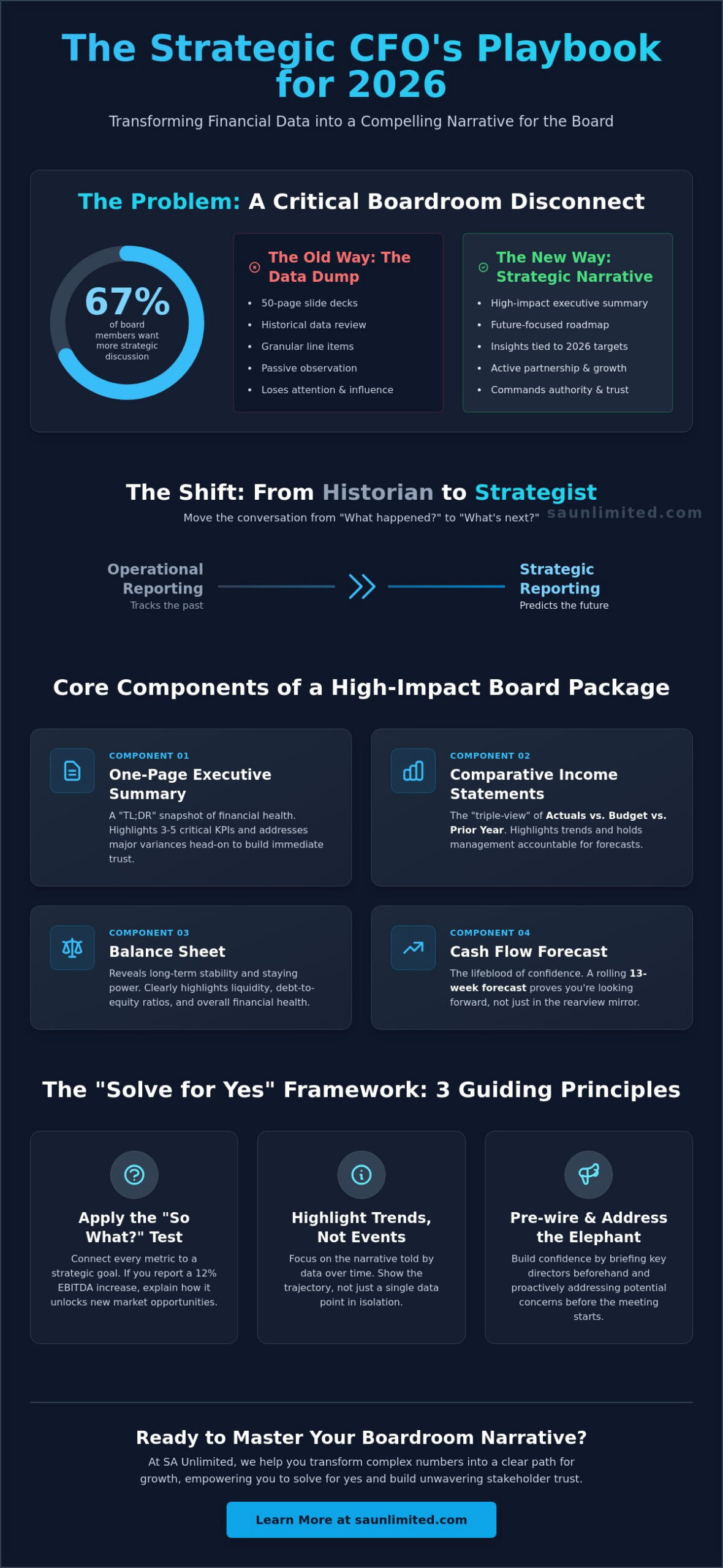
In a 2024 McKinsey survey, 67% of board members reported that they want management to spend significantly more time on strategic discussion and less on historical data review. If you’re still walking into meetings with 50-page slide decks, you’re not just losing their attention; you’re losing your influence. You know the feeling of a director getting stuck on a single line item in a spreadsheet while your most important strategic initiative sits on the sidelines. It’s time to stop reporting and start leading. At SA Unlimited, we solve for yes by helping you master how to present financials to the board through a lens of growth and clarity.
This strategic CFO playbook for 2026 will empower you to make bold moves by transforming complex numbers into a compelling narrative. We’ll show you how to connect every metric to the bottom line, ensuring you never get caught off-guard by questions about cash flow or EBITDA again. You’ll learn a streamlined, repeatable process to gain faster approvals and command the room with unwavering authority. We’ll explore the exact framework for narrative-driven reporting, the three questions every board member is secretly asking, and the visualization techniques that turn raw data into strategic decisions.
Key Takeaways
- Stop treating board meetings as data dumps and start delivering a strategic narrative that transforms raw numbers into a clear roadmap for growth.
- Master how to present financials to the board by utilizing a high-impact executive summary and comparative statements that highlight critical variances.
- Apply the “So What?” test to every metric to ensure your KPIs align with strategic goals and empower the board to make bold, informed moves.
- Build immediate boardroom confidence by pre-wiring your directors and proactively addressing the “elephant in the room” before the formal session begins.
- Discover how a seasoned financial partner brings a fresh perspective to your reporting, helping you solve for “yes” and build unwavering stakeholder trust.
The Strategic Shift: Why Board Financials Are Not a Data Dump
Board reporting is the process of distilling complex financial data into actionable insights for fiduciary oversight. It’s a high-stakes translation. You’re taking raw numbers and turning them into a roadmap for the future. Many CFOs fail because they treat the boardroom like a spreadsheet review. Knowing how to present financials to the board requires moving beyond operational accounting. You aren’t just a historian; you’re a strategist.
Operational reporting tracks the past. Strategic reporting predicts the future. At SA Unlimited, we know that the “We Solve for Yes” mindset begins with financial clarity. When you present a clear, bold narrative, you empower the board to approve ambitious moves. You shift the conversation from “What happened last month?” to “What does this mean for our 2026 targets?”. This shift is the difference between a static update and a catalyst for growth. It moves the needle from passive observation to active partnership.
Understanding the Board’s Fiduciary Perspective
Board members prioritize risk mitigation and long-term growth over granular line items. They don’t need to see every office supply expense. They need to see how your burn rate affects your three-year runway. The CFO serves as the Strategic Navigator for both the CEO and the Board. You must deliver transparency without drowning them in data. While a standard director’s report satisfies legal requirements, your presentation must drive executive engagement. Keep it tight. Keep it focused. Build trust by showing you’ve mastered the details but value their time.
Setting the Narrative for 2026
The 2026 market demands a dynamic approach. Volatility is the new baseline, and your reporting must reflect that reality. Use your financials to tell a story of unlimited potential. Don’t just report a 12% increase in EBITDA; explain how that capital unlocks new scaling opportunities in emerging markets. Align every report with the company’s long-term goals. If your 2028 objective is a $1B valuation, your 2026 board decks must prove you’re on that trajectory. This is how to present financials to the board with authority. You’re not just showing numbers; you’re demonstrating a clear path to victory.
- Focus on the “So What?” behind the numbers.
- Highlight trends rather than isolated events.
- Connect financial performance to strategic pillars.
The Core Components of a High-Impact Board Financial Package
A board package shouldn’t feel like a data dump. It’s a strategic narrative designed to drive decision-making. When you’re refining how to present financials to the board, your first slide must be a one-page Executive Summary. This “TL;DR” provides a snapshot of the company’s financial health, highlighting three to five Key Performance Indicators (KPIs) that matter most to your specific industry. If your burn rate increased by 15% this quarter, the summary is where you address it head-on before the directors start digging.
The meat of your package relies on Comparative Income Statements. Don’t just present static numbers. You need to show actuals versus the budget and the prior year. This triple-view highlights trends and holds the management team accountable for their previous forecasts. If there’s a 10% variance in operating expenses, your notes should explain the “why” with surgical precision. Transparency here builds the credibility you’ll need when proposing future investments.
Your Balance Sheet and Cash Flow Forecasts provide the necessary context for long-term stability. While the income statement shows performance, the balance sheet reveals your staying power. Highlight your liquidity, debt-to-equity ratios, and equity positions clearly. In 2026, cash flow remains the lifeblood of board-level confidence. A rolling 13-week cash flow forecast proves you’re looking through the windshield rather than just the rearview mirror. This forward-looking approach ensures the board feels secure in the company’s ability to meet its obligations and seize new opportunities.
Mastering the EBITDA Narrative
EBITDA remains the gold standard for board-level profitability analysis because it strips away non-operational noise. However, the real skill in how to present financials to the board lies in your command of “Adjusted EBITDA.” You must defend add-backs with 100% transparency. If you’re adding back $250,000 in one-time relocation costs or M&A legal fees, show the data behind the adjustment. Linking consistent EBITDA growth directly to valuation helps the board visualize the $50M or $100M exit potential you’re building together.
Leveraging Sage Intacct for Real-Time Accuracy
Manual spreadsheets are a liability in a high-stakes meeting. Using Sage Intacct eliminates the anxiety of a broken Excel formula ruining your presentation. With custom reporting dashboards, you can answer a director’s specific question about regional margins or customer acquisition costs in 15 seconds. This “one source of truth” creates a foundation of trust that spreadsheets simply can’t match. When your data is bulletproof, you spend less time defending the numbers and more time discussing strategy. If your current systems feel like a bottleneck, it’s time to partner with an expert team that can scale your financial infrastructure to match your ambitions.
Solving for Yes: Transforming Raw Metrics into Strategic Insight
Boards in 2026 don’t have time for a history lesson. They need a map. Every slide you show must pass the “So What?” test, meaning every data point must directly influence a future decision. When you master how to present financials to the board, you shift from being a reporter to a strategist. Focus on KPIs that actually move the needle. A 15% increase in customer lifetime value or a 22% improvement in net retention tells a story of sustainable health. Raw revenue numbers are just the start; the strategic insight lies in what those numbers mean for your next move.
Presenting bad news requires a specific, proactive framework. Don’t hide the numbers. Instead, wrap them in a solution. If a product line saw a 10% dip in margin, present the data alongside a three step plan to recover that margin by the next quarter. This approach builds unwavering trust. It shows the board you aren’t just watching the dashboard; you’re steering the ship. We solve for yes by turning obstacles into data-backed pathways for growth.
Variance Analysis with a Proactive Twist
Stop treating variance analysis as a post-mortem. It’s a forward-looking tool for strategic pivots. Variance is the gap between plan and reality that signals opportunity. If your department spent 8% less than budgeted, don’t just celebrate the savings. Explain how that capital will be redeployed to accelerate a high-performing project. Your goal is to explain how you’ll hit the next target, not just why you missed the last one. This mindset shifts the board’s focus from past errors to future wins.
Strategic Capital and Cash Planning
Mid-cap success depends on ruthless capital efficiency. Professional cfo services act as the engine for capital raising support, ensuring your balance sheet is ready for any market shift. When you discuss burn rates and runway, do it without triggering panic. Frame the conversation around “capital velocity.” If your current cash position provides 14 months of runway, show the board how a 4% optimization in your supply chain extends that runway to 18 months. You aren’t just managing cash; you’re creating a launchpad. This level of clarity helps you unlock your business potential and gives the board the confidence to approve bold moves.
- Focus on Capital Efficiency: Show the return on every dollar spent.
- Narrative Storytelling: Connect the numbers to the company’s 2026 vision.
- Actionable KPIs: Only present metrics that lead to a “yes” or “no” decision.
Preparation and Delivery: A 5-Step Framework for Boardroom Confidence
Preparation transforms a standard reporting session into a high-stakes strategic alignment. To master how to present financials to the board, you must move beyond the role of a data historian and step into the role of a strategic architect. This 5-step framework ensures you command the room with unwavering authority.
- Step 1: Pre-wire the board. Share your deck 48 to 72 hours in advance. This gives directors time to digest the data, which shifts the meeting focus from “what happened” to “what we should do.”
- Step 2: Identify the “Elephant in the Room.” If revenue dipped by 5% or a major project went over budget, address it in the first five minutes. Owning the narrative prevents a defensive atmosphere.
- Step 3: Prioritize trends over data points. A single month of performance is noise. Show the board the rolling twelve-month trend to provide context for long-term growth.
- Step 4: Execute the “Executive Summary First” method. Start with the three most critical takeaways. If the fire alarm rings ten minutes in, the board should already know the bottom line.
- Step 5: Build a “Deep Dive” appendix. Keep the main deck lean. Move technical reconciliations and granular departmental spends to the back to keep the conversation at a strategic level.
The Art of Visual Financial Storytelling
Clean, high-contrast charts are your best defense against “Death by PowerPoint.” Avoid dense tables that force directors to squint. Instead, use Waterfall charts to explain shifts in EBITDA or Cash Flow with precision. These visuals show exactly how you moved from Point A to Point B. Follow the rule of “one key takeaway per slide.” If a visual requires more than ten seconds to understand, it’s too complex. We solve for yes by providing clarity, not clutter. Your slides should empower the board to make bold moves based on unmistakable trends.
Handling Tough Questions with Authority
When a board member challenges your assumptions, stay calm and maintain eye contact. Credibility isn’t built by having every answer instantly; it’s built by the integrity of your process. If you don’t have a specific data point, use the “I will get back to you” rule. Provide a specific deadline for the follow-up, such as “I’ll have that breakdown to you by 9:00 AM tomorrow.” This approach maintains your professional standing. Use these moments to pivot the conversation back to strategy. Turning a technical query into a discussion about market positioning shows you are a partner in the business’s success.
Ready to lead your next meeting with total clarity? Unlock your business potential with our strategic CFO advisory services.
How a Fractional CFO Elevates Your Board Communication
Board members in 2026 demand more than just historical data; they require a narrative that connects today’s numbers to tomorrow’s growth. When you bring in a fresh set of eyes, you eliminate the internal biases that often clutter financial reporting. An outsourced CFO provides this objective clarity, transforming dense spreadsheets into a strategic roadmap that builds immediate trust with your directors.
For mid-cap companies, the challenge is often a talent gap. You need $1B+ level expertise to navigate complex market shifts, but the cost of a full-time executive at that caliber is frequently prohibitive. High-level fractional cfo services solve this by providing on-demand access to seasoned professionals who have mastered how to present financials to the board across diverse industries. You scale your financial leadership without the permanent overhead, ensuring your reporting matches the sophistication of global enterprises.
- Expert Authority: A seasoned CFO carries weight in the boardroom, diffusing tension and answering tough questions with data-backed confidence.
- Objectivity: Third-party experts identify risks that internal teams might overlook or minimize.
- Efficiency: Streamlined reporting processes reduce the time spent on deck preparation by up to 40 percent.
Strategic Partnership Beyond the Spreadsheets
At SA Unlimited, we don’t just deliver reports; we act as a strategic advisor to the CEO. We understand that your board isn’t looking for an accounting lesson. They want to know if the business is scalable and protected. Our team rolls up our sleeves to prepare your financials for rigorous due diligence, ensuring every metric stands up to investor scrutiny. We bridge the gap between accounting reality and investor expectations by translating “Quickbooks data” into actionable business intelligence.
Our approach ensures that when you discuss how to present financials to the board, the conversation shifts from “what happened” to “what is possible.” We focus on the KPIs that drive valuation, helping you maintain a proactive stance during quarterly reviews.
Ready to Unlock Your Business Potential?
The path from confusing data to board-level clarity requires a shift in mindset. It’s time to move away from basic “Quickbooks thinking” and embrace strategic maturity. We help you move past the noise to find the numbers that actually matter for your 2026 growth targets. Don’t let mediocre reporting stall your momentum or erode board confidence. Our team is ready to provide the high-level oversight your company deserves. Let’s connect and transform your board reporting today.
Command the Room with Strategic Financial Leadership
The era of the data dump is officially over. To lead effectively in 2026, you must master how to present financials to the board by shifting from historical reporting to forward-looking strategy. This means prioritizing the “why” behind the numbers and using a disciplined framework to ensure every metric drives a high-level decision. When you transform complex spreadsheets into clear insights, you don’t just report on the past; you actively shape your company’s future.
At SA Unlimited, we’ve spent decades refining this high-stakes communication. Our team has guided leaders through over $1B in successful transactions and serves as Sage Intacct implementation experts to ensure your data is always boardroom-ready. Our proprietary “We Solve for Yes” strategic framework is designed to turn obstacles into growth opportunities. We’ll roll up our sleeves to help you build a high-impact financial package that commands respect and builds unwavering trust with your directors.
Unlock Your Business Potential with SA Unlimited CFO Services
It’s time to stop reporting the numbers and start leading with them. Let’s build your pathway to success together.
Frequently Asked Questions
What are the most important financial metrics to show a board of directors?
Focus on high-level drivers that impact valuation and long-term sustainability. Your board cares about cash runway, burn rate, and LTV:CAC ratios. In 2026, 85 percent of high-growth boards prioritize EBITDA margins and Year-over-Year revenue growth over granular line items. We provide the clarity you need to lead these discussions with confidence and authority.
How far in advance should I send financial reports to the board?
Send your financial package at least 72 to 120 hours before the meeting. This 3 to 5 day window allows directors to digest the data and prepare strategic questions. Providing materials early demonstrates your unwavering commitment to transparency. It ensures the session focuses on growth and strategy rather than basic data clarification.
What is the best format for a board financial report?
Use a tiered structure that starts with a one-page executive summary followed by visual dashboards. Data from 2024 indicates that 70 percent of directors prefer charts over spreadsheets for identifying trends. When learning how to present financials to the board, remember to use a clean, professional slide deck that highlights 3 to 5 key takeaways per page.
How do I handle a board member who focuses too much on small details?
Pivot the conversation back to strategy by acknowledging the detail and offering to follow up offline. We Solve for Yes by including a comprehensive appendix that contains the granular data they crave. This keeps the main presentation focused on 2026 growth targets while satisfying the 1 or 2 members who want to see every transaction.
Should I include a full P&L in my board presentation?
Don’t clutter your main presentation with a 50-line P&L statement. Include a condensed version that highlights major categories like Revenue, COGS, and OpEx in the core deck. Place the full, detailed P&L in the appendix for reference. This approach maintains the strategic flow and helps you unlock your business potential without getting bogged down in the weeds.
How does a Fractional CFO help with board presentations?
A Fractional CFO brings seasoned expertise and $1B+ in transaction experience to your boardroom. They roll up their sleeves to build the models, refine the narrative, and coach you on the delivery. By partnering with an expert, you gain the top-notch talent needed to transform your financial reporting into a powerful tool for scaling your enterprise.
What is the difference between a board report and a management report?
Board reports focus on governance and long-term strategy, whereas management reports track daily operational performance. A board report might highlight a 15 percent shift in market share; a management report tracks the specific sales activities that caused it. Knowing your numbers means understanding which audience needs which level of detail to make bold moves and profitable decisions.
How can Sage Intacct improve my board reporting process?
Sage Intacct automates your reporting cycles, reducing manual data entry by up to 40 percent. It provides real-time visibility into multi-dimensional data, allowing you to slice financials by location, project, or department instantly. This cutting-edge technology ensures your board presentation is backed by accurate, up-to-the-minute insights that empower you to lead with unwavering confidence.