

CEO financial literacy isn’t about mastering the ledger; it’s about mastering the narrative of value creation. Many leaders feel a heavy dependency on their finance team for every interpretation, especially when bank lines of credit are hovering between 8% and 14% as of May 2026. This ceo guide to financial literacy is your roadmap to breaking that cycle. We’re moving beyond basic bookkeeping to help you master the high-level insights that drive valuation and capital efficiency.
You likely agree that leading a company without fluently speaking the language of investors is a recipe for missed opportunities. You shouldn’t have to be an accountant to understand how to drive your company forward. At SA Unlimited, we solve for yes by providing the tools you need to command the boardroom with confidence. We promise to equip you with the clarity needed to challenge assumptions and turn finance into a strategic engine. We’ll examine how to leverage the permanent 21% corporate tax rate and 100% bonus depreciation to increase EBITDA, unlock your business potential, and make bold, data-driven moves.
Key Takeaways
- Transform financial data into a strategic weapon by shifting from passive reporting to identifying the high-level levers that drive competitive advantage.
- Trace the “Golden Thread” through your core financial statements to understand how a single transaction impacts your overall valuation and cash position.
- Use this ceo guide to financial literacy to master EBITDA and the Cash Conversion Cycle, ensuring your capital is deployed with maximum efficiency.
- Identify the critical point where your business outgrows QuickBooks and requires the real-time visibility that only advanced ERP systems provide.
- Discover how a fractional CFO provides the strategic mentorship required to bridge the literacy gap and empower bold, data-driven decision-making.
Beyond the Balance Sheet: Why Financial Literacy is the CEO’s Strategic Weapon
True financial literacy is your most powerful strategic weapon. It isn’t about counting pennies or managing the ledger. It’s about having the confidence to look at a spreadsheet and see a roadmap for expansion. For many leaders, the finances feel like a black box that only the CFO can unlock. This ceo guide to financial literacy is designed to crack that box open. We don’t just want you to know your numbers. We want you to know your levers.
When you master Financial Intelligence for Leaders, you stop reacting to the past and start engineering the future. The cost of remaining in the dark is staggering. Beyond the $948 annual loss the average adult faces due to poor financial knowledge, a CEO’s illiteracy can lead to disastrous capital allocation. In May 2026, with SBA 7(a) variable rates reaching 13.25%, a single misstep in debt strategy can stifle a decade of growth. At SA Unlimited, we believe clarity is the precursor to confidence. We solve for yes by giving you the insights to make bold moves that others are too afraid to attempt.
The Difference Between Financial Management and Financial Leadership
Management is about accuracy, compliance, and looking in the rearview mirror. Leadership is about vision, velocity, and looking through the windshield. While your controller ensures the books are closed, a literate CEO uses those numbers to validate a pivot or accelerate a product launch. You’re shifting from historical reporting to proactive forecasting. It’s the difference between merely surviving an audit and unlocking your business potential through aggressive, data-backed scaling. For B2C founders, Founder Freedom provides the strategic coaching needed to master this transition and lead with confidence.
The Language of the Boardroom and Investors
Investors don’t just buy your product; they buy your ability to generate a return. If you can’t articulate the relationship between unit economics and margin expansion, you’ll lose the room. Credibility is built when you can explain the “why” behind the “what.” You need to show how you’ll navigate the 21% federal corporate tax rate to maximize reinvestment. CEO financial literacy is the bridge between operational vision and fiscal reality.
Mastering this language allows you to:
- Challenge financial assumptions with authority during board meetings.
- Explain how current market trends, like the 6.75% prime rate, impact your capital efficiency.
- Demonstrate a clear pathway to profitability that justifies a higher company valuation.
The CEO’s Financial Dashboard: Decoding the Three Essential Statements
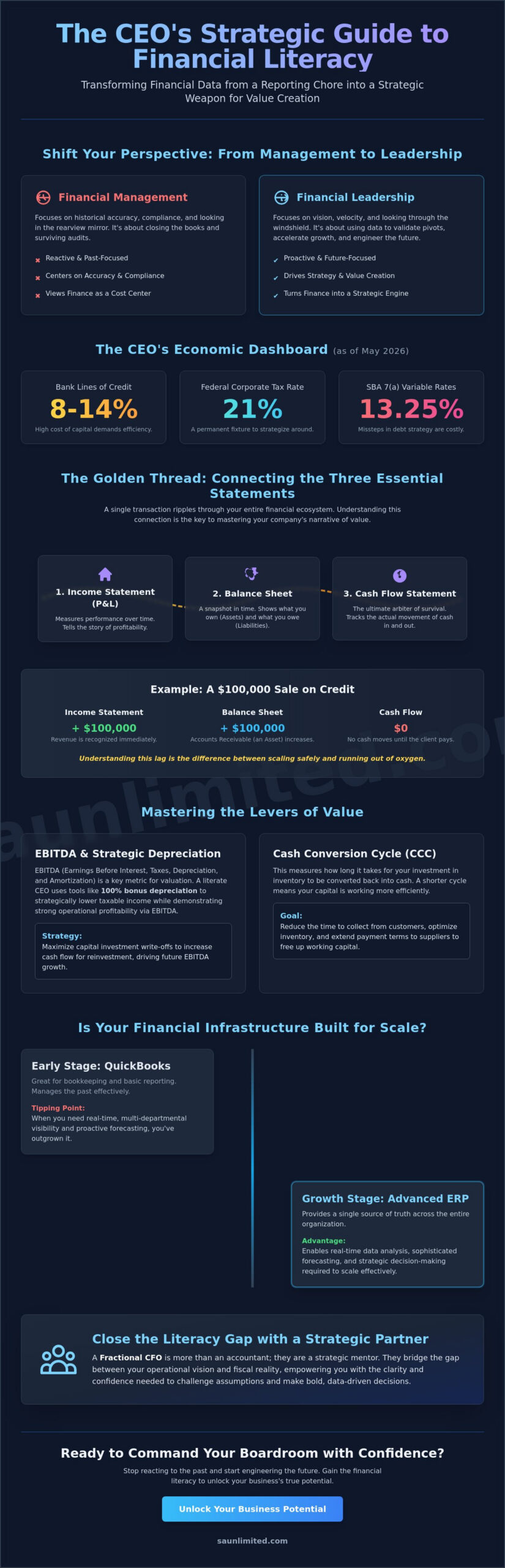
To lead with authority, you must understand the “Big Three” financial statements: the Income Statement, the Balance Sheet, and the Cash Flow Statement. Think of these not as separate reports, but as a single, interconnected ecosystem. This ceo guide to financial literacy focuses on the “Golden Thread,” the way a single transaction ripples through all three documents. For example, a $100,000 sale booked on credit shows up as revenue on your P&L and an asset on your Balance Sheet, but it won’t touch your cash flow until the client actually pays. Understanding this lag is the difference between scaling safely and running out of oxygen.
While the P&L often gets the most attention, the cash flow statement is the ultimate arbiter of survival. As of May 2026, businesses are navigating IFRS 18 changes that demand tighter presentation of financial statements. Aligning your internal reporting with the National Strategy for Financial Literacy ensures you aren’t just compliant, but strategically prepared for investor scrutiny. If you find your current reporting lacks this depth, our team can help you unlock your business potential with real-time data visibility.
The P&L: More Than Just Revenue and Expenses
Your Profit and Loss statement measures performance over time, but the real story is in the Gross Margin. This percentage is a direct proxy for your pricing power. If your margin is shrinking while revenue grows, you’re likely “buying” growth at the expense of sustainability. You must also distinguish between “Above the Line” costs (COGS) and “Below the Line” operating expenses. Many companies fall into the trap of being “profitable” on paper while facing a liquidity crisis because their cash is tied up in inventory or slow-paying accounts receivable.
The Balance Sheet: Assessing Your Business’s Health and Liquidity
The Balance Sheet is a snapshot of your company’s staying power at a specific moment. It reveals what you own versus what you owe. Literate CEOs track the Current Ratio to ensure they can cover short-term liabilities with current assets. With bank term loan rates reaching up to 17.25% in 2026, managing your Debt-to-Equity ratio is critical for maintaining investor trust. Use this statement to identify underutilized assets that could be liquidated or leveraged to fuel expansion without taking on high-interest debt.
The 30-Minute CEO Monthly Checklist:
- Verify the Cash Runway: Do we have enough liquidity to sustain operations for six months at current burn rates?
- Analyze Gross Margin Trends: Is our pricing keeping pace with the 6.75% prime rate and rising operational costs?
- Review Accounts Receivable: Are our collections slowing down, and how does that impact our cash conversion?
- Check Debt Covenants: Are we in danger of breaching any terms with our current bank lines of credit?
Mastering the Levers of Value: EBITDA, Cash Flow, and Capital Efficiency
Moving from the dashboard to the driver’s seat requires a shift in perspective. Most accounting tutorials focus on compliance, but this ceo guide to financial literacy focuses on the strategic levers that actually build enterprise value. You need to understand how to manipulate your capital structure to fuel growth without diluting your ownership. With bank term loans currently ranging from 8% to 17.25% as of May 2026, the cost of capital is too high for guesswork. You must know exactly how much gas is in the tank and how efficiently the engine is running before you press the accelerator.
The most vital metric for any growth-minded leader is EBITDA. While the 21% federal corporate tax rate is a fixed reality, your operational efficiency is not. By stripping away interest, taxes, and non-cash charges, you get a clear view of your company’s core profitability. This allows you to run “What If” scenarios through financial modeling. For instance, you can calculate the exact impact of a 5% price increase or a 10% reduction in customer acquisition costs on your bottom line. This level of clarity empowers you to make bold moves with surgical precision.
EBITDA and the Art of Valuation
EBITDA serves as the North Star for companies preparing for an exit or a major capital raise. It provides a standardized language for investors to compare your business against others in your industry. To maximize your valuation, you must master the art of “Add-backs.” These are one-time or non-recurring expenses, such as legal fees from a specific acquisition or excess owner compensation, that can be added back to show your true earning potential. EBITDA is a measure of operational efficiency, not just a line item. It proves to the market that your business model is scalable and profitable at its core.
Working Capital Management: The Secret to Stress-Free Scaling
Scaling often fails not because of a lack of sales, but because of a lack of liquidity. Your Cash Conversion Cycle (CCC) measures how fast a dollar spent on inventory or labor returns to your bank account as a dollar earned. If your accounts receivable are lagging while your accounts payable are due, you’ll hit a growth ceiling regardless of your P&L profit. We solve for yes by helping you optimize internal cash flow before you look toward expensive outside debt. Engaging in strategic cfo consulting can reveal hidden cash traps in your balance sheet, allowing you to unlock your business potential and fund your own expansion.
Building a High-Performance Financial Infrastructure
Infrastructure is the skeleton of your business strategy. You can’t scale a $20 million company on a $2 million tech stack without something eventually snapping. This ceo guide to financial literacy emphasizes that your tools must match your ambitions. If your team is still trapped in manual spreadsheets, you’re flying blind in a May 2026 market where bank lines of credit can reach 14%. You need an infrastructure that provides “one version of the truth” so you can stop arguing about the data and start acting on it.
For growing companies that have outgrown the limitations of QuickBooks, Sage Intacct has become the industry standard for cloud financials. It moves your finance team from simple data entry to high-level data analysis. Beyond the software, you must structure your team for the stage you’re entering. A bookkeeper records history. A controller manages the present. A CFO architects the future. To unlock your business potential, you need the right person in the right seat ensuring your financial engine doesn’t seize up as you accelerate.
The Power of Real-Time Data and Custom Reporting
Waiting 15 days for a monthly close is a strategic liability. By the time you see those reports, the market has moved and your 6.75% prime rate assumptions might already be outdated. Real-time visibility allows you to track KPIs that actually correlate with growth, such as departmental margin contribution or customer acquisition cost ratios. Our specialized Sage Intacct consulting transforms raw data into a strategic roadmap, giving you the clarity to pivot instantly rather than waiting for the next board meeting.
Implementing Financial Controls Without Killing Agility
Leadership is about setting the “Tone at the Top.” You must establish a culture of accountability where every department head understands their specific financial impact on the company’s 21% federal corporate tax liability and overall EBITDA. This isn’t about creating bureaucracy; it’s about building guardrails against fraud and waste. We help you implement automated workflows that reduce friction and prevent errors while maintaining our “Solve for Yes” mindset. When your systems are robust, you have the freedom to be bold.
If your current financial setup feels like a bottleneck rather than a bridge to your next milestone, it’s time to upgrade your engine. Connect with our strategic advisors to build an infrastructure that supports your next decade of growth.
Closing the Literacy Gap: How Fractional CFOs Empower Bold Decision-Making
You shouldn’t have to be a CPA to lead a profitable company. This ceo guide to financial literacy has covered the dashboard, the levers, and the infrastructure, but the final piece of the puzzle is mentorship. Many CEOs feel isolated, trapped between high-level vision and granular data they don’t fully trust. Statistics show that 72% of companies with revenues between $3 million and $15 million are already using or considering fractional CFO services to solve this exact problem. It’s a strategic mentorship model that allows you to “Know Your Numbers” without getting bogged down in the minutiae.
By engaging an outsourced CFO, you gain the expertise of a veteran who has navigated billion-dollar success metrics. You get this high-level guidance at 40% to 60% less than the cost of a full-time executive. In May 2026, as the fractional CFO market grows at a 12.4% compound annual rate, the competitive advantage isn’t just about saving money. It’s about having a strategic partner who identifies the hidden pathways to growth that your competitors are missing. At SA Unlimited, we don’t just provide reports; we provide the clarity that empowers you to make bold moves and unlock your business potential.
The CFO as the CEO’s Financial Translator
Think of your CFO as a translator who bridges the gap between the vision in your head and the cold reality of the balance sheet. When you prepare for board meetings or investor pitches, you need more than just spreadsheets. You need unwavering confidence. A fractional CFO helps you articulate the “why” behind your margins and the “how” behind your capital efficiency. Our “Solve for Yes” mindset means we don’t just point out obstacles; we find the financial pathways to overcome them. We help you transform finance from a cost center into a strategic engine that fuels your operational vision.
Your Pathway to Financial Mastery
Mastery is a continuous process, not a one-time event. Your next step is to assess your current literacy and the robustness of your financial infrastructure. Are you still making decisions based on 15-day-old data, or do you have the real-time visibility needed to navigate a 6.75% prime rate environment? A third-party financial review can identify the blind spots that are currently capping your growth. It’s time to stop feeling dependent on others for interpretation and start leading with fiscal authority. Ready to transform your financial leadership? Let’s connect and Solve for Yes.
Command Your Financial Future
Financial mastery isn’t a destination; it’s the engine that powers your next major milestone. You’ve learned how to decode the “Big Three” statements and identify the “Golden Thread” that links your daily operations to your company’s ultimate valuation. By shifting your focus to strategic levers like EBITDA and the cash conversion cycle, you’re no longer just managing numbers. You’re engineering outcomes. This ceo guide to financial literacy is your foundation for total fiscal authority.
At SA Unlimited, we bring decades of experience and a track record of $1B+ in success metrics to your table. We are specialists in Sage Intacct implementation, helping you move beyond the limitations of entry-level software to achieve real-time clarity. Our “We Solve for Yes” mindset ensures we don’t just identify risks; we create pathways to your most ambitious goals. It’s time to stop interpreting the past and start architecting the future.
Unlock Your Business Potential with Strategic Fractional CFO Services
You have the vision to lead. Now you have the financial insights to win. Let’s build something extraordinary together.
Frequently Asked Questions
What are the most important financial ratios for a CEO to monitor?
You should prioritize the Current Ratio, Debt-to-Equity, and Gross Margin. With SBA 7(a) variable rates reaching 13.25% in May 2026, your Debt-to-Equity ratio is a vital indicator of your company’s risk profile. The Current Ratio ensures you have the liquidity to cover short-term liabilities. Monitoring these metrics allows you to maintain investor trust and ensure your capital structure supports aggressive growth without compromising your staying power.
How much time should a CEO spend on financial reports each month?
A CEO should dedicate 30 to 60 minutes to a deep monthly financial review, supplemented by weekly 15-minute KPI check-ins. You don’t need to get lost in the ledger; instead, focus on significant variances and trends. Using a high-performance dashboard allows you to identify red flags quickly. This disciplined approach ensures you stay focused on high-level strategy while maintaining a firm grasp on your company’s fiscal health.
What is the difference between a Controller and a CFO in terms of CEO support?
A Controller focuses on historical accuracy and compliance, while a CFO acts as a strategic architect for future growth. Your Controller ensures that the books are closed and the 21% federal corporate tax is handled correctly. In contrast, a CFO uses that data to build forecasts and model “What If” scenarios. The CFO is your partner in making bold moves, providing the forward-looking insights necessary to scale effectively.
How can financial literacy help me in capital raising?
Financial literacy allows you to speak the language of investors and articulate the “why” behind your unit economics. This ceo guide to financial literacy emphasizes that credibility is built through clarity. When you can explain how the 6.75% prime rate affects your capital efficiency, you build immediate trust. Investors are more likely to back a leader who demonstrates total command over their company’s valuation levers and margin expansion potential.
When is the right time to move from QuickBooks to an ERP like Sage Intacct?
You should consider moving to Sage Intacct when your revenue hits $5 million or when you require multi-entity consolidation. QuickBooks is a solid tool for startups, but it lacks the real-time visibility and automated workflows required for mid-cap growth. If you find your team spendings days on manual spreadsheets to close the month, your infrastructure is a bottleneck. Upgrading provides the “one version of the truth” needed for complex scaling.
Can a fractional CFO help me improve my own financial literacy?
Yes, a fractional CFO acts as a strategic mentor who helps you interpret data and make informed decisions. Unlike a full-time hire, this model provides billion-dollar expertise at 40% to 60% less cost. They bridge the gap between your operational vision and the numbers on the page. By working closely with an expert, you gain the confidence to challenge assumptions and turn your finance department into a proactive strategic engine.
What is the “Solve for Yes” philosophy in corporate finance?
The “Solve for Yes” philosophy is a proactive, solution-oriented mindset that focuses on finding pathways to growth rather than identifying obstacles. At SA Unlimited, we don’t just tell you why a move is risky; we find the financial structure that makes it possible. It is our core DNA. We roll up our sleeves to unlock your business potential by turning complex financial challenges into clear, actionable strategic opportunities.
How does EBITDA impact my company’s valuation during an exit?
EBITDA is the universal language of business valuation and serves as the primary multiplier for determining your sale price. It measures your core operational efficiency by stripping away non-operational costs. By identifying non-recurring add-backs, you can present a higher adjusted EBITDA to potential buyers. This significantly increases your company’s enterprise value, ensuring you receive maximum credit for the profitable engine you have built over the years.