

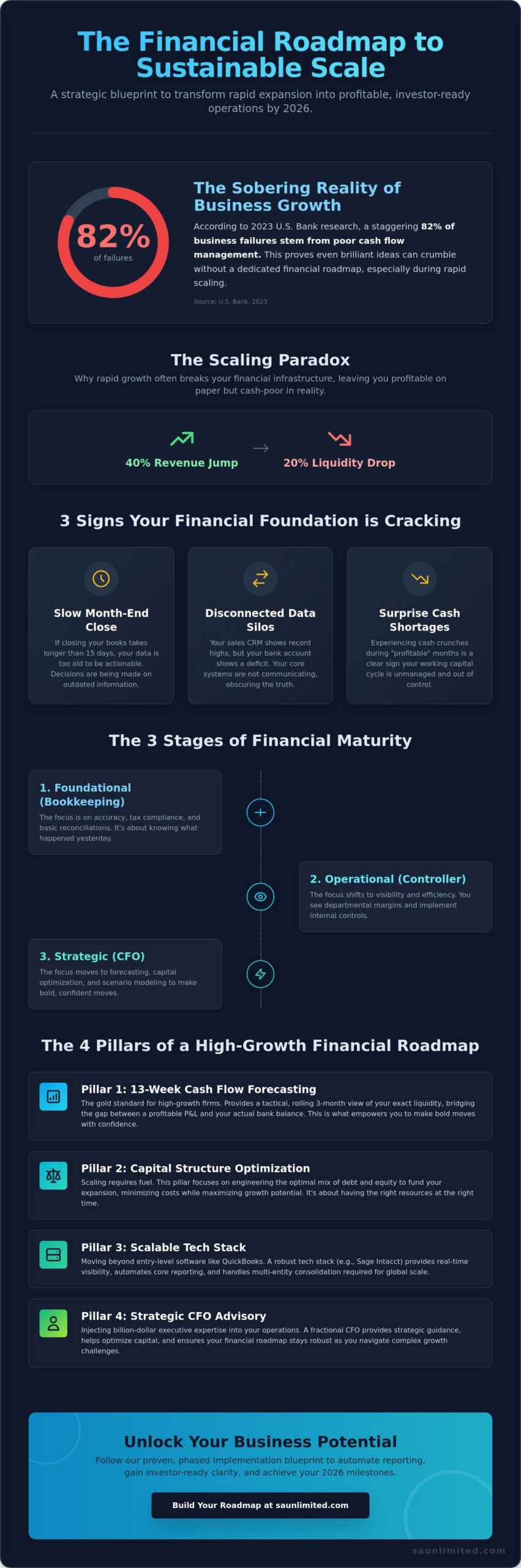
According to 2023 research from U.S. Bank, 82% of business failures are caused by poor cash flow management, proving that even the best ideas fail without a dedicated financial roadmap for scaling a business. You’ve likely felt that specific pressure. It’s the moment when your spreadsheets start to break, your basic accounting software feels like a toy, and you realize you can’t provide the 24 month forecasts your board expects. You’ve built something incredible, but the financial engine is struggling to keep up with the speed of your ambition.
At SA Unlimited, we solve for yes. We believe your financial department should be a growth catalyst rather than a bottleneck. This guide delivers a strategic blueprint designed to transform rapid expansion into sustainable, profitable scale. By following this phased plan, you’ll gain the clarity needed to make bold moves and the investor-ready reporting required to secure your next round of funding. We’re moving beyond basic bookkeeping to establish a sophisticated framework that unlocks your business potential. We’ll walk through the three essential stages of financial maturity you must master before the end of 2026.
Key Takeaways
- Identify the “Scaling Paradox” and learn why traditional entry-level software often obscures the financial truth during periods of rapid expansion.
- Master the four essential pillars needed to construct a professional financial roadmap for scaling a business that evolves alongside your growth.
- Discover how transitioning to a robust tech stack like Sage Intacct provides the real-time visibility and multi-entity consolidation required for global scale.
- Leverage strategic CFO consulting to gain billion-dollar executive expertise, empowering you to make bold moves with absolute confidence.
- Follow a proven, phased implementation blueprint to automate core reporting and unlock your business potential by the 2026 milestones.
The Scaling Paradox: Why Rapid Growth Often Breaks Financial Infrastructure
Growth is a double-edged sword. Most CEOs believe that more revenue cures every ailment, yet the Scaling Paradox proves otherwise. This phenomenon occurs when a 40% jump in top-line revenue leads to a 20% decrease in available liquidity. As you scale, your overhead often outpaces your collection cycles, leaving you “profitable” on paper but cash-poor in the bank. Without a dedicated financial roadmap for scaling a business, you’re essentially driving a high-performance vehicle with a broken fuel gauge.
Many firms hit the QuickBooks Ceiling once they surpass $5 million in annual revenue. Entry-level software is designed for recording history, not predicting the future. When your accounting system begins to obscure rather than reveal the truth, you’ve outgrown your tools. Effective growth planning requires more than just a standard business plan; it demands a real-time feedback loop between your sales pipeline and your balance sheet. You must shift from reactive accounting, where you look at last month’s data, to proactive financial architecture that anticipates next year’s capital needs.
Middle-market companies often find themselves in a talent gap. They’ve outgrown their bookkeeper but can’t yet justify the $300,000 salary of a full-time, high-level executive. A fractional cfo services model acts as the strategic bridge. This approach allows you to inject elite financial intelligence into your operations, ensuring your financial roadmap for scaling a business remains robust as you enter the 2026 fiscal year. We solve for yes by creating pathways to capital that traditional models often miss.
The Three Stages of Financial Maturity
- Foundational: This is the bookkeeping phase. The primary focus is accuracy, tax compliance, and basic bank reconciliations. It’s about knowing what happened yesterday.
- Operational: This is the controller phase. Here, the focus shifts to visibility and efficiency. You begin to see departmental margins and implement internal controls to prevent leakage.
- Strategic: This is the CFO phase. We move into forecasting, capital optimization, and scenario modeling. You gain the confidence to make bold moves because you know exactly how they affect your bottom line.
Signs Your Financial Foundation is Cracking
If your month-end close takes longer than 15 days, your infrastructure is failing. By the time you see the numbers, they’re already too old to act upon. Another red flag is a persistent disconnect between your sales CRM and your accounting software. If your sales team sees record numbers but your bank account shows a deficit, your data is siloed. Finally, surprise cash shortages during profitable months indicate that your working capital cycle is unmanaged. These aren’t just inconveniences; they’re existential threats to your expansion plans.
The 4 Pillars of a High-Growth Financial Roadmap
A strategic financial roadmap for scaling a business isn’t a static budget gathering dust in a digital folder. It’s a living, breathing document that evolves alongside your company. Static budgets fail because they assume a linear world; scaling is rarely linear. To manage the complexity of rapid expansion in 2026, you need a framework that prioritizes agility over rigid adherence to a twelve-month-old guess.
Pillar 1: Mastering 13-Week Cash Flow Forecasting
The 13-week cash flow model is the gold standard for businesses in a high-growth phase. It provides a tactical view of your liquidity, allowing you to see exactly where your cash position will be three months from today. This visibility is vital because growth often consumes cash faster than it generates it.
You must bridge the gap between your P&L and your bank balance. A profitable P&L doesn’t pay the bills; cash does. By integrating specific ebitda targets into your weekly cash monitoring, you ensure that operational efficiency translates directly into liquid capital. This level of clarity empowers you to make bold moves with confidence.
Pillar 2: Capital Structure Optimization
Scaling requires fuel, and that fuel comes from either debt or equity. Optimization means finding the right mix to minimize your weighted average cost of capital while maintaining control. We’ve seen companies dilute their ownership too early or take on high-interest debt that chokes their cash flow. Your financial roadmap for scaling a business should outline exactly when to pull each lever based on your current valuation and market conditions.
Pillar 3: Understanding Your Growth Equation
You need to calculate the “Cost of a Dollar.” This metric determines what it actually costs your organization to acquire $1 of new revenue. If your Customer Acquisition Cost (CAC) is $500 and the Lifetime Value (LTV) is $1,500, you have a 3:1 ratio that signals a green light for expansion. Unit economics are the DNA of a scalable business model.
Use these metrics to decide when to step on the gas or hit the brakes. If your payback period extends beyond 12 months during a capital crunch, it’s time to optimize before you expand. If you’re looking for a partner to help sharpen these metrics, let’s connect to discuss your specific growth trajectory.
Pillar 4: Risk Mitigation and Internal Controls
Rapid growth exposes cracks in your foundation. What worked for a team of 10 will fail for a team of 100. You must implement robust internal controls to prevent fraud and operational errors. This includes:
- Segregation of financial duties to ensure no single person controls the entire money cycle.
- Automated expense management to catch leakage before it impacts the bottom line.
- Regular “stress tests” of your financial model against potential market downturns.
These controls don’t slow you down; they provide the safety harness that allows you to climb higher and faster.
Building a Scalable Tech Stack: Transitioning to Sage Intacct
Scaling a business to eight or nine figures requires a digital foundation that maintains data integrity under intense pressure. Entry-level software like QuickBooks serves its purpose for startups, but mid-sized companies eventually hit a glass ceiling where manual workarounds lead to costly errors. Transitioning to sage int provides the structural integrity needed to support rapid growth. It automates multi-entity consolidation, turning weeks of manual closing into a real-time process. This shift allows your finance team to stop acting as historians and start acting as strategic architects.
The ROI of this automation is immediate and impactful. By reducing manual data entry by as much as 40 percent, your team shifts their focus to high-level analysis that drives profitability. This transition is a non-negotiable step in your financial roadmap for scaling a business, ensuring your tech stack evolves as fast as your ambitions. We solve for yes by providing the tools that turn complex data into actionable intelligence.
When to Make the Switch to Enterprise ERP
The complexity trigger occurs when you manage multiple legal entities, handle international currencies, or process thousands of monthly transactions. If your month-end close takes longer than 10 days, your current system is failing you. Sage Intacct implementation consultants streamline this transition to avoid downtime and protect your data flow. Waiting until you are bigger is the most expensive mistake a CEO can make. It results in fragmented data, missed market opportunities, and expensive forensic accounting projects down the road.
Unlocking Clarity with Custom Dashboards
It is time to move beyond static spreadsheets that are obsolete the moment they are saved. Custom dashboards provide the clarity needed to make bold moves with confidence. You can visualize EBITDA, burn rate, and departmental performance at a single glance. Our approach ensures your tech stack provides the data needed for fast, aggressive decisions. Consider these benefits of real-time visualization:
- Immediate Burn Rate Tracking: Monitor cash flow daily rather than monthly.
- Departmental Accountability: Hold leaders responsible with transparent, live performance metrics.
- Strategic Agility: Pivot your strategy based on facts, not gut feelings.
A robust financial roadmap for scaling a business depends on your ability to see through the noise. When you know your numbers, you unlock your business potential. Don’t let an outdated tech stack be the anchor that holds back your global enterprise.
The Fractional CFO Advantage: Strategic Advisory for Bold Moves
Scaling a business requires more than a bookkeeper. Traditional accounting looks at the rearview mirror; cfo consulting focuses on the windshield. You need a partner who can anticipate roadblocks before you hit them. A fractional CFO brings the weight of $1B+ in transaction experience to your table without the $300,000 annual salary burden. This is about leverage. You get high-level strategic advisory that turns a standard P&L into a weapon for growth.
At SA Unlimited, we operate with a “Solve for Yes” mindset. Most financial professionals tell you why an idea won’t work. We find the creative pathway to fund your boldest moves. Whether you’re eyeing a 40% market share expansion or a strategic acquisition, we build the financial framework to make it happen. Our team doesn’t just report numbers. We roll up our sleeves to ensure your cash flow supports your ambition.
The CFO as the Strategic Partner to the CEO
A CEO dreams in vision; a CFO executes in numbers. Your CFO translates that vision into a quantifiable financial roadmap for scaling a business. They act as the financial architect in the room, providing the data-backed confidence needed during high-stakes board meetings. The CEO and CFO relationship functions as the engine and the steering wheel of scaling. This partnership ensures that every hire, every product launch, and every expansion is backed by rigorous analysis.
Capital Raising and Fundraising Support
Investors don’t just buy your product; they buy your future cash flows. To secure a capital raise, you need a “due diligence ready” financial package. Navigating cfo services helps you decide between debt financing and venture capital. We use your financial roadmap for scaling a business to prove to investors that your model is repeatable. When your numbers are airtight, your valuation follows. We prepare you for the next level, whether that’s a Series B raise, a $50M acquisition, or an eventual exit.
Ready to unlock your business potential? Partner with SA Unlimited to build your strategic blueprint today.
Executing the Roadmap: 2026 Implementation Milestones
Execution separates the market leaders from the companies that stagnate. A strategic financial roadmap for scaling a business only provides value when it’s met with disciplined, phased implementation. We don’t believe in passive observation. We believe in building unbreakable financial architectures that empower you to make bold moves with clarity and speed.
Month 1-3: Knowing Your Numbers
The first 90 days focus on radical transparency and foundational integrity. You can’t scale what you can’t see. We prioritize establishing a hard close within 5 to 7 business days. This benchmark is critical; it ensures that by the second week of the month, you’re looking at reality, not history. We immediately implement a 13-week cash flow forecast to provide a granular view of your liquidity. According to industry data, roughly 82% of small to mid-cap businesses fail because of poor cash management. We solve this by identifying immediate “leaks” in your current financial model, such as uncollected receivables or underperforming service lines, ensuring every dollar is accounted for.
Month 4-12: Making Bold Moves
Once the foundation is secure, the focus shifts to high-impact optimization. During months 4 through 6, we refine your tech stack to automate core reporting. This transition often saves finance teams 30 to 50 hours of manual data entry every month. With these efficiencies, you can leverage outsourced cfo expertise to negotiate better terms with vendors and lenders. We’ve seen strategic negotiations reduce operational costs by 10% to 15% without sacrificing quality.
The final stage of your financial roadmap for scaling a business involves executing the capital plan. Whether your goal is a capital raise, debt restructuring, or aggressive reinvestment of profits, you’ll move forward with unwavering commitment. You’ll scale with the confidence that your systems can handle a 2x or 5x increase in volume. This isn’t just about growth; it’s about profitable, sustainable expansion.
Unlocking your business potential requires more than a standard accounting firm. It demands a partner who lives by the motto, “We Solve for Yes.” An “Unlimited” strategic partnership gives you access to top-notch talent and billion-dollar success metrics. We roll up our sleeves to create pathways where others see obstacles. Let’s connect and transform your world in 2026.
Master Your Growth Trajectory for 2026
Scaling isn’t just about bigger numbers; it’s about building a resilient foundation that won’t buckle under pressure. You’ve seen how a sophisticated tech stack like Sage Intacct and the high-level guidance of a fractional CFO help you navigate the scaling paradox. By focusing on the four pillars of growth and hitting your 2026 implementation milestones, you turn market volatility into a distinct competitive advantage. Success requires moving beyond spreadsheets to a system that provides real-time clarity and confidence.
At SA Unlimited, we’ve spent decades mastering these transitions. Our team has guided over $1B in successful transactions, providing the authoritative expertise you need to make bold moves. As premier Sage Intacct implementation partners, we ensure your infrastructure stays ahead of your ambitions. We offer flexible, tiered pricing models, from hourly projects to unlimited strategic partnerships, so you get the exact level of support your company requires. Building a robust financial roadmap for scaling a business is the difference between a company that merely survives and one that dominates its industry.
Ready to unlock your business potential? Let’s connect and solve for yes.
Your next chapter of profitable growth starts today.
Frequently Asked Questions
What is the difference between a financial plan and a financial roadmap for scaling?
A financial plan focuses on historical data and static budgets, while a financial roadmap for scaling a business acts as a dynamic strategic path. Plans often look back at the last 12 months. Roadmaps look forward 36 months to align your capital with your vision. We solve for yes by turning your static spreadsheet into a proactive engine for growth.
When is the right time to hire a fractional CFO for my scaling business?
Hire a fractional CFO when your annual revenue reaches the $2 million mark or your growth rate exceeds 25% year over year. At this stage, simple bookkeeping can’t manage complex cash flow or strategic tax planning. You need top-notch talent to unlock your business potential and manage your $1M+ capital allocations with precision and confidence.
How much does it cost to implement Sage Intacct for a mid-sized company?
Implementation costs for Sage Intacct typically range from $15,000 to $35,000 for mid-sized firms according to 2024 industry benchmarks. This investment covers core modules and initial configuration. Annual licensing fees often start at $15,000. These figures vary based on your specific module requirements and the complexity of your multi-entity consolidation needs.
Can I scale my business using only QuickBooks and a part-time bookkeeper?
Scaling beyond $5 million in revenue with only a part-time bookkeeper and basic QuickBooks is a high-risk move. Research shows that 82% of small businesses fail due to cash flow mismanagement. You need robust systems and strategic oversight to handle the 40% increase in transaction volume that comes with rapid expansion. Don’t settle for basic; choose clarity instead.
How does a financial roadmap help with capital raising or bank loans?
A financial roadmap for scaling a business provides the 3 year projections and debt-to-equity ratios that banks demand for 7(a) loans. Lenders look for a 1.25x debt service coverage ratio. Having a documented roadmap demonstrates you have a seasoned partner guiding your strategy. It builds the immediate trust needed to secure $500,000 or more in growth capital.
What are the most common financial mistakes businesses make when scaling?
The most frequent mistake is ignoring a Burn Multiple that exceeds 2.0 during aggressive growth phases. Many leaders also fail to account for the 15% increase in overhead costs that occurs every time they double their headcount. We solve for yes by identifying these gaps before they drain your reserves. Focus on your gross margins to stay profitable.
How often should a financial roadmap be updated during rapid growth?
You should review your roadmap every 30 days and perform a deep-dive update every 90 days. Rapid growth can shift your unit economics by 10% in a single quarter. Keeping your roadmap current ensures your 2026 targets remain realistic. It allows your team to make bold moves based on real-time data rather than outdated assumptions.
What specific KPIs should be included in a scaling roadmap?
Your roadmap must track Net Revenue Retention (NRR) above 105% and a Customer Acquisition Cost (CAC) payback period under 12 months. Include your Operating Cash Flow and Gross Margin targets to ensure profitable scaling. These metrics provide the quantifiable success markers required to attract investors and maintain a billion-dollar mindset.