

Revenue is a vanity metric that can mask a looming crisis if your financial infrastructure isn’t built for velocity. Many leaders discover too late that high growth often consumes more cash than it generates, leaving them with impressive top-line numbers but dangerous cash flow gaps. Mastering financial planning for rapid growth is the only way to ensure your expansion doesn’t outpace your liquidity. If you’re still relying on basic accounting software that just retired its classic reporting features on May 22, 2026, you’re likely flying blind in a high-stakes environment where the prime rate sits at 6.75% and every capital decision carries significant weight.
You’ve worked too hard to let a lack of visibility stall your momentum. We’re here to help you move past the limitations of entry-level tools and adopt a proactive, solution-oriented stance. This article delivers the frameworks you need to turn volatility into a strategic asset. We will explore how to implement a dynamic financial model that predicts future outcomes, upgrade to a scalable accounting infrastructure, and produce the sophisticated reporting required to win at the highest levels of business.
Key Takeaways
- Avoid the “profitable bankruptcy” trap by shifting your focus from surface-level revenue to cash-centered strategic planning.
- Modernize your financial planning for rapid growth by replacing static annual budgets with dynamic rolling forecasts and scenario modeling.
- Identify the critical “QuickBooks Ceiling” where manual spreadsheets and basic software become a liability to your 2026 expansion goals.
- Leverage the strategic expertise of a Fractional CFO to gain executive-level financial transparency without the overhead of a full-time hire.
- Deploy a 13-week cash flow forecast as a primary steering tool to maintain liquidity and protect your competitive advantage.
The Growth Paradox: Why Rapid Expansion Requires a New Financial Framework
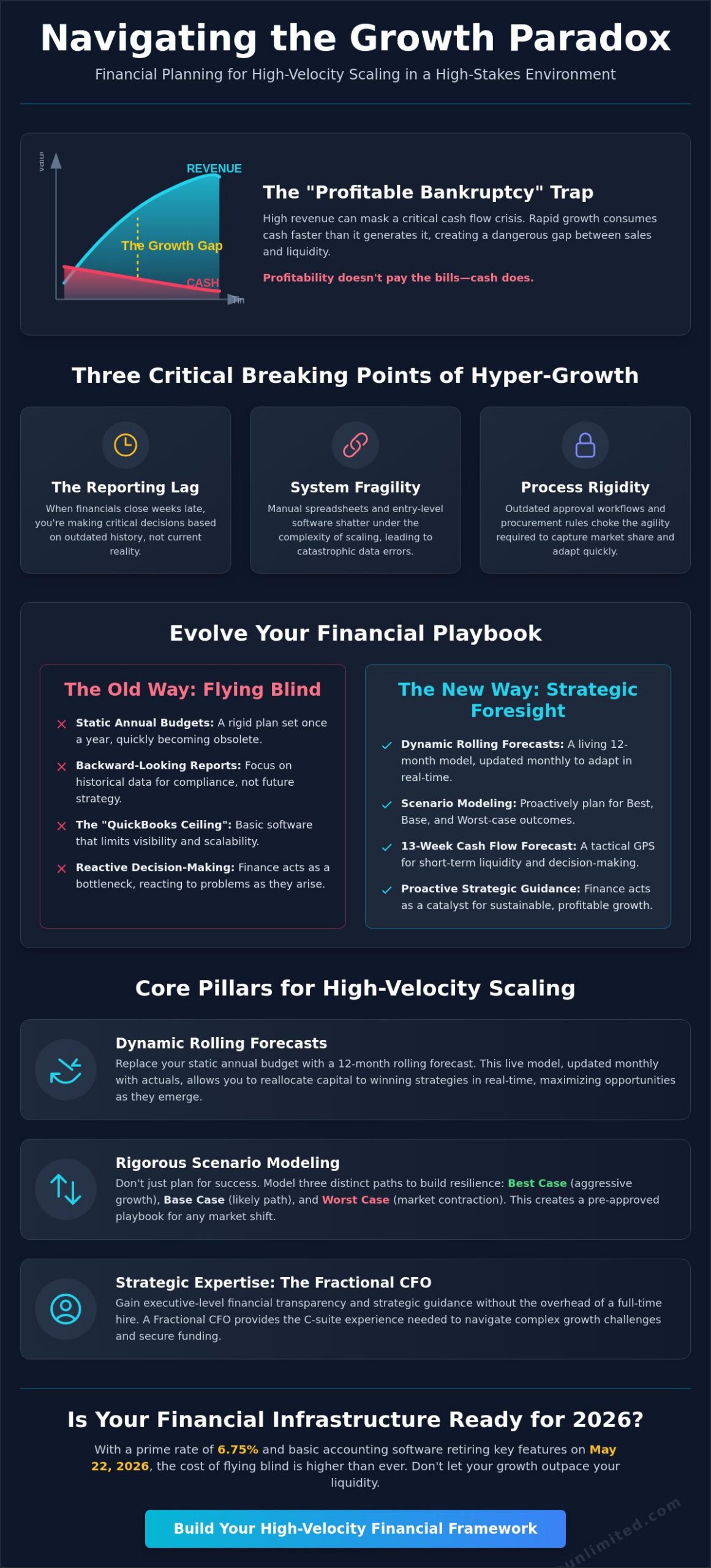
Expansion is often the very thing that kills a business. It sounds counterintuitive, but rapid scaling creates a massive appetite for capital that your current operations might not be able to feed. This is the growth paradox: the faster you run, the more likely you are to trip over your own success. To survive, you must move beyond basic bookkeeping and embrace sophisticated growth planning that prioritizes liquidity over vanity metrics. Effective financial planning for rapid growth isn’t just about tracking what happened; it’s about building an elastic architecture that stretches as your complexity increases.
During hyper-growth, standard financial processes typically hit three critical breaking points:
- The Reporting Lag: When your books close weeks after month-end, you’re driving by looking in the rearview mirror while the market moves at warp speed.
- System Fragility: Manual spreadsheets and entry-level software break when headcount or product lines double, leading to catastrophic data errors.
- Process Rigidity: Old approval workflows and procurement rules choke the agility required to capture market share in a competitive 2026 economy.
Revenue vs. Cash Flow: The Invisible Gap
Profitability doesn’t pay the bills; cash does. In a scaling environment, the Cash Conversion Cycle often lengthens as you prepay for inventory, talent, or software seats before the revenue actually hits your bank account. You can be technically profitable while your bank balance trends toward zero because your cash is tied up in accounts receivable or upfront investments. The Growth Gap is the delta between sales and realized cash. Without a framework to bridge this gap, you risk falling into “profitable bankruptcy,” where you have plenty of customers but no liquidity to fulfill their orders or meet payroll.
The Limits of Traditional Accounting
Standard accounting is designed for tax compliance, not executive decision-making. While a backward-looking P&L tells you what you spent, it doesn’t tell you what you should spend next. You need to shift from recording history to forecasting it. This requires moving toward a strategic advisory model that prioritizes unit economics and EBITDA as a lever for strategic growth. Modern financial planning for rapid growth demands real-time data that informs your next move, ensuring your finance function acts as a catalyst rather than a bottleneck.
Core Pillars of Financial Planning for High-Velocity Scaling
Static budgets are dead. In a 2026 economy defined by a 6.75% prime rate and rapid technological shifts, a financial plan set in January is often obsolete by March. To maintain momentum, you need a framework that acts as a GPS, not a paper map. Effective financial planning for rapid growth requires a transition from rigid annual targets to a modular, responsive architecture. This approach ensures your resource allocation reflects current market realities rather than outdated assumptions made six months ago.
Scenario modeling is your insurance policy against the unknown. You must rigorously test your financial model against three distinct paths: the Base case (the likely path), the Best case (aggressive expansion), and the Worst case (market contraction or funding delays). This isn’t just about risk mitigation. It’s about having a pre-approved playbook for every situation. High-level Financial Management Explained through this lens ensures that when the market shifts, you don’t panic; you execute.
Dynamic Rolling Forecasts vs. Static Budgets
The key to agile financial planning is the 12-month rolling forecast. Unlike a static budget, this model is updated every 30 days with actual performance data. This constant feedback loop reduces budget variance and allows you to reallocate capital to the highest-performing channels in real-time. If a specific product line is outperforming expectations, a rolling forecast identifies the trend early, allowing you to double down while your competitors are still waiting for the next quarterly review. For many CEOs, transitioning to strategic cash planning and forecasting is the single most important step in professionalizing their finance function.
Cash Runway and Burn Rate Management
Precision is the difference between a successful exit and a total collapse. You must calculate your “Zero Cash Date” with absolute certainty. This requires a granular understanding of your burn rate and your Burn Multiple, a metric that measures how much you’re spending to generate each dollar of new revenue. A high-growth firm needs a capital efficiency strategy that balances aggressive customer acquisition with sustainable unit economics. Focus on your Customer Acquisition Cost (CAC) and Lifetime Value (LTV) to ensure that every dollar you invest is creating long-term equity. If your unit economics don’t scale, your growth is simply a faster way to run out of money. Capital efficiency isn’t about spending less; it’s about spending with higher conviction.
Scaling Financial Infrastructure: Moving Beyond QuickBooks
QuickBooks is a reliable starting point, but it wasn’t built for the complexities of a multi-entity, high-velocity organization. Even with the May 2026 AI-powered updates to bank feeds, you’ll eventually hit a functional wall. Manual workarounds and “Excel glue” start to consume your team’s time. This is where financial planning for rapid growth shifts from a strategic exercise to a technical one. You need a foundation that supports international expansion and complex consolidation without breaking. Relying on entry-level tools during hyper-growth is like trying to win a Formula 1 race in a sedan. It simply won’t hold up under the pressure.
At the $10M revenue mark, manual spreadsheets become a dangerous liability. They’re prone to human error and lack the robust audit trails required for institutional capital. Investors in 2026 demand high levels of financial transparency. They want to see that your data comes from a single, immutable source of truth, not a collection of disconnected tabs. Moving to a cloud ERP isn’t just a software upgrade. It’s a signal to the market that your business is ready for the big leagues. It provides the infrastructure needed to manage increased headcount and operational complexity with confidence.
When to Migrate to Sage Intacct
If your accounting team spends more time reconciling data than analyzing it, you’ve reached the limit. Manual data entry is a growth killer. It introduces lag and prevents real-time visibility into your performance. Sage Intacct provides the dimensional reporting necessary to slice data by location, department, or project without creating a bloated chart of accounts. For a deeper dive into how this transforms operations, see our Strategic Leader’s Guide to Cloud Financials. This level of granularity is essential for identifying which segments of your business are actually driving value and which are draining your resources.
Automating the Quote-to-Cash Cycle
Friction in your billing process is a direct threat to your cash runway. If your sales team is closing deals in a CRM but your finance team is manually re-entering those details into an invoice, you’re losing days of cash flow. Integrating your CRM with your financial system creates a seamless flow of data. This automation accelerates cash inflows and ensures your “One Version of the Truth” remains accurate. It also allows you to scale revenue without a linear increase in finance headcount. You don’t need a massive back-office; you need a smarter one. Modern financial planning for rapid growth leverages these integrations to keep the organization lean and focused on execution.
The Strategic Architect: Why Fractional CFOs are the Secret to Sustainable Growth
Execution requires more than just a vision. It requires a financial engine capable of sustaining high-speed maneuvers. While your accounting team handles the ledger, a Fractional CFO acts as the strategic architect of your future. They transform raw data into actionable insights that drive the CEO’s agenda. This partnership ensures that your financial planning for rapid growth isn’t just a document in a drawer; it’s a living strategy that adapts to market shifts. By bridging the gap between back-office accounting and boardroom strategy, these experts turn financial transparency into a scalable competitive advantage.
In the capital-intensive environment of 2026, having a seasoned pro in your corner is non-negotiable. Whether you are navigating SBA 7(a) loans with variable rates reaching 13.25% or preparing for a Series B, a CFO manages the intricate dance of investor relations and capital structure. For a comprehensive look at how this role integrates into your team, explore our Fractional CFO Services: The Ultimate Guide to Scaling Your Business. They don’t just report numbers. They tell the story that wins over lenders and VCs alike.
Fractional CFO vs. Full-Time: A Strategic Comparison
The math favors the fractional model for companies in the scaling phase. You get the same caliber of executive leadership found in Fortune 500 firms but without the $300,000+ annual salary typically required for a full-time hire. This flexibility allows you to scale CFO hours up during a merger or capital raise and down during periods of steady execution. Beyond the internal benefits, you gain immediate access to a broader network of institutional lenders and industry experts. It’s about buying the results, not the overhead. This lean approach to executive leadership is a cornerstone of modern financial planning for rapid growth.
Driving Valuation and Exit Readiness
Maximizing your valuation starts years before a potential sale. A Fractional CFO rigorously cleans up your financials, ensuring your revenue recognition and EBITDA calculations are bulletproof. They prepare your organization for the intense scrutiny of due diligence before the growth round even begins. Exit readiness is a continuous state of operational excellence, not a one-time project. By maintaining this standard, you ensure your business is always investor-ready, allowing you to move with speed when a strategic opportunity arises. If you are ready to elevate your leadership team, explore our Fractional CFO services to build a foundation that lasts.
Executing Your 2026 Growth Plan: Immediate Next Steps
Strategy without execution is just a wish. To turn hyper-growth into a sustainable competitive advantage, you need immediate, decisive action. The transition from a reactive startup to a proactive enterprise requires a complete overhaul of how you view your numbers. Professional financial planning for rapid growth demands that you move past passive monitoring and embrace aggressive, data-driven management. Your first step is a comprehensive Financial Health Audit. This isn’t a basic review of your P&L; it’s a deep dive into the operational bottlenecks that are currently leaking cash and slowing your momentum.
Once you’ve identified the gaps, you must establish a 13-week cash flow forecast as your primary steering tool. In an environment where the prime rate sits at 6.75%, capital is too expensive to manage with guesswork. This forecast provides the visibility required to navigate payroll, vendor obligations, and aggressive growth investments without the constant threat of a liquidity crisis. Simultaneously, evaluate your current tech stack against your three-year growth projections. If your systems can’t handle multi-entity consolidation or the reporting requirements of sophisticated investors, you are building your future on a foundation of sand.
Building Your 90-Day Financial Roadmap
Execution happens in stages. Your roadmap should be broken down into three distinct phases of transformation:
- Month 1: Stabilizing Reporting. Focus on data integrity. Clean up your chart of accounts and ensure your month-end close is fast, accurate, and automated.
- Month 2: Advanced Forecasting. Implement rolling forecasts and begin tracking high-velocity KPIs like Burn Multiple and LTV/CAC ratios.
- Month 3: Strategic Optimization. Conduct a full review of your capital structure. Use your new financial transparency to negotiate better terms with lenders or prepare for your next funding round.
The SA Unlimited Approach to Rapid Growth
We don’t just identify obstacles; we clear the path for your expansion. Our “Unlimited” tier is engineered for ambitious companies that require a proactive, integrated partnership rather than a distant service provider. We provide the high-level expertise needed to navigate complex transitions, merging deep Sage Intacct consulting with elite CFO leadership. For a detailed look at how we professionalize your finance function, see our guide on CFO Consulting: The Strategic Blueprint for Scaling Your Business in 2026. We are invested in your success, providing the modern infrastructure and strategic advisory required to make your 2026 growth goals a reality. Don’t let outdated processes hold you back. It’s time to build a financial engine that matches your ambition.
Master the Velocity of Your Expansion
Success in 2026 isn’t about working harder; it’s about building a smarter financial engine. You’ve seen how the growth paradox can swallow cash and why static budgets fail in a volatile market. Mastering financial planning for rapid growth requires a shift from backward-looking accounting to proactive, strategic forecasting. By breaking through the QuickBooks ceiling and integrating executive-level leadership, you turn financial transparency into a scalable weapon for your organization.
We specialize in this transition. Our team brings deep expertise in Sage Intacct implementation and a proven track record with emerging and mid-cap firms. With tiered pricing designed for every growth stage, we provide the specific financial architecture you need to win. Scale with confidence; explore our Fractional CFO tiers today. Your vision deserves a financial framework that can keep up with your ambition. Let’s build it together.
Frequently Asked Questions
What is the difference between a controller and a fractional CFO for growth?
A controller manages historical accuracy and compliance while a fractional CFO drives future strategy and capital allocation. Controllers ensure your financial statements are correct. CFOs use those statements to build the roadmap for your next funding round or market expansion, bridging the gap between basic accounting and executive leadership.
How much revenue should a company have before hiring a fractional CFO?
Most companies find the most value in a fractional CFO when they reach between $2M and $10M in annual revenue. At this stage, the complexity of financial planning for rapid growth usually exceeds the capabilities of a standard bookkeeper or founder. It’s the point where strategic capital management becomes more important than simple expense tracking.
Can financial planning actually accelerate growth or does it just slow it down?
Strategic financial planning accelerates growth by removing the uncertainty that causes leaders to hesitate. It provides the data-driven confidence to invest in new hires or marketing channels because you know exactly how those moves affect your cash runway. Planning replaces guesswork with precision, allowing for faster, bolder decision-making.
What are the most important KPIs for a rapidly scaling SaaS or service business?
Focus on your Burn Multiple, LTV to CAC ratio, and Net Revenue Retention. These metrics reveal the true efficiency of your expansion. A healthy Burn Multiple ensures you aren’t overspending to buy revenue that isn’t sustainable. These indicators provide a clearer picture of value creation than a standard balance sheet alone.
How does Sage Intacct help with financial planning compared to QuickBooks?
Sage Intacct offers multi-entity consolidation and dimensional reporting that QuickBooks simply cannot match. It automates complex revenue recognition and provides the granular data needed for financial planning for rapid growth in a way that entry-level software can’t. This infrastructure allows you to slice data by location or project for deeper insights.
What happens if our financial planning doesn’t account for a market downturn?
Failure to model a downturn can lead to a liquidity crisis where you have high revenue but zero cash. Scenario modeling allows you to identify exactly which levers to pull if the market shifts, protecting your core operations from sudden shocks. It ensures you have a pre-approved playbook for survival and recovery.
How often should a rapid-growth financial plan be updated?
You should update your financial plan every 30 days using a rolling forecast model. In a high-velocity environment, an annual budget becomes obsolete within weeks. Monthly updates ensure your resource allocation stays aligned with actual performance and allows you to pivot quickly when new opportunities or risks emerge.
How do investors view companies with outsourced or fractional CFO services?
Investors see fractional CFOs as a sign of executive maturity and financial discipline. It gives them confidence that your reporting is reliable and that a seasoned professional is managing the capital they’ve invested. This level of professionalization often leads to smoother due diligence and higher valuation multiples during funding rounds.